9 Best Thermostats for Electric Heaters (November 2026)
The best thermostat for electric heater include the Amazon Basics Ceramic Space Heater for a compact desk or bedside heater, the DREO Space Heater for precise portable temperature control, and the Lasko Oscillating Digital Ceramic Tower Heater for wide room coverage with oscillation.
On this page (10 sections)
- Our top picks for the best thermostat for electric heater setups
- What is the best thermostat for electric heater use? Compare by heater type
- How we compared these thermostats for electric heaters
- How do I choose a thermostat for an electric heater?
- What voltage does an electric heater thermostat need?
- How many watts can my electric heater thermostat handle?
- Do I need a programmable or smart thermostat for electric heat?
- Which thermostat fits baseboards, radiant floors and heat mats?
- What safety limits should I check before I buy?
- The verdict on the best thermostat for electric heater use
The best thermostat for electric heater use depends on the heater type, because a portable heater has built-in controls while a baseboard heater needs a line voltage wall thermostat.
For a room heater you carry to a desk or bed, the DREO gives precise 41 to 95 F settings and quiet operation.
For hardwired baseboard heat, the Honeywell Home or Mysa matches the voltage and load.
That split matters more than brand.
A thermostat is only best when its voltage, load and sensor placement match the heater it controls.
A 24 volt thermostat will not control a 240 volt baseboard, and a wall thermostat will not help a portable heater that already cycles on and off.
Start by naming your heater.
If it plugs into an outlet and you move it from room to room, you are shopping for a heater with thermostat controls.
If it is fixed to the wall or baseboard and wired into the home, you are shopping for a line voltage wall thermostat.
Our best thermostat for electric baseboard heater guide covers the second group in more detail.
Our picks at a glance
-
1
 Best for a compact desk or bedside heater
Amazon Basics Ceramic Space Heater
9.7/10 our score
See it on Amazon -
2
-
3
 Best for wide room coverage with oscillation
Lasko Oscillating Digital Ceramic Tower Heater
9.6/10 our score
See it on Amazon
- 4
 Check it
Honeywell Home 5-2 Day Programmable Thermostat Electric
Best for programmable line voltage baseboard heat - 5
 Check it
Riseem NonProgrammable Thermostat for Home
Best for a simple low voltage furnace or boiler - 6
 Check it
Mysa Smart Thermostat LITE for Electric Baseboard
Best for smart control of electric baseboards - 7
 Check it
BN-LINK Reptile Thermostat Temperature Controller
Best for heat mats, seed starting and terrariums - 8
 Check it
Inkbird ITC-308 Digital Temperature Controller Thermostat
Best for dual heating and cooling control - 9
 Check it
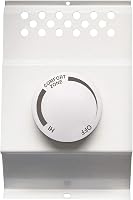
Cadet Single Pole Built-In Thermostat Kit
Best for a built-in control on a Cadet baseboard
Our top picks for the best thermostat for electric heater setups
The top picks cover the two main jobs.
The DREO and Amazon Basics suit portable room heat.
The Honeywell Home and Mysa suit fixed electric baseboard heat.
The probe controllers suit heat mats and equipment, not whole rooms.
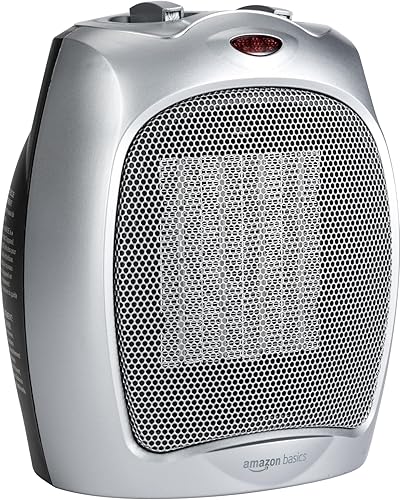
Amazon Basics Ceramic Space Heater: Best for a compact desk or bedside heater
- 1500W ceramic heat with 900W low setting
- Adjustable thermostat with fan only mode
- Overheat and tip-over protection
- 7.52 x 6.34 x 9.45 inches and 2.8 lb
A small portable heater with a built-in thermostat, three settings and safety shutoffs for a desk, office or bedside spot.
Pros
- Compact and light to move
- Fan only mode for air circulation
- Tip-over and overheat protection
Cons
- Non-oscillating, so heat stays in one direction
- Not for bathrooms or other humid rooms
This Amazon Basics heater suits a desk, office corner or bedside table where a small unit needs to move often.
At 7.52 by 6.34 by 9.45 inches and 2.8 lb, it is the most portable of the three room heaters here.
You can carry it with one hand and set it down where you sit.
Its built-in thermostat works with three settings.
High uses 1500W, low uses 900W, and fan only circulates air without heat.
That fan only mode helps in mild weather when you want air movement without adding warmth.
Safety features include tip-over protection, overheat protection and a power indicator light.
Amazon Basics says the ceramic heat is fast and noise stays near 43 dB.
Keep it out of bathrooms and laundry rooms, since the maker warns against humid environments.
The main trade-off is direction.
This model does not oscillate, so it heats the area in front of it.
Point it toward your chair or bed rather than the center of a large room.
For wider coverage, look at the Lasko tower below.
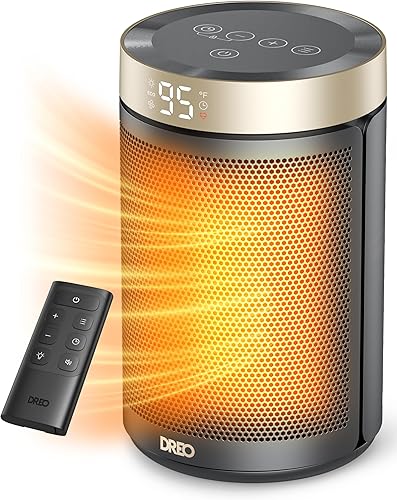
DREO Space Heater: Best for precise portable temperature control
- 1500W PTC ceramic heat
- 41 to 95 F settings in 1 F steps
- 34 dB quiet operation with remote
- 12-hour timer, ECO and fan only modes
A portable heater with fine temperature steps, remote control and a timer for a bedroom or office where you want closer control.
Pros
- 1 F temperature steps
- Remote control and 12-hour timer
- Low running noise for bedrooms
Cons
- Free-standing portable design, not a wall thermostat
- 200 sq ft coverage is a stated maximum, not a promise for every room
The DREO suits a bedroom, home office or reading corner where you want to set a temperature and leave it.
Its thermostat lets you choose from 41 to 95 F in 1 F steps.
That finer control is the main reason it shares the top spot here.
It uses a 1500W PTC ceramic system with a heat funnel design.
DREO says warm air reaches farther than traditional heaters and coverage goes up to 200 sq ft.
Treat that as a stated maximum.
A drafty room or high ceiling will need more time to feel warm.
Controls include a remote, a 12-hour timer, ECO mode, fan only mode, mute, child lock and a memory function.
DREO says running noise is 34 dB, which is lower than the Amazon Basics and Lasko.
Safety features include tilt detection, overheat protection, a safety plug and ETL certification.
The trade-off is size and style.
At 6.02 by 6.02 by 10 inches and 3 lb, it is still portable, but it is a free-standing tower rather than a wall thermostat.
It cannot control a fixed baseboard heater in another room.
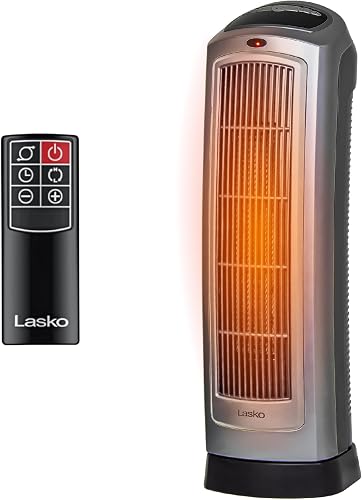
Lasko Oscillating Digital Ceramic Tower Heater: Best for wide room coverage with oscillation
- 1500W ceramic tower, 23 inches tall
- Adjustable thermostat with two heat settings
- Oscillation with remote and 1 to 8 hour timer
- Overheat protection and cool touch exterior
A tall tower heater that spreads warm air across a room with oscillation, a remote and an adjustable thermostat.
Pros
- Oscillation distributes heat more widely
- Remote storage on the back
- Fully assembled and ready to plug in
Cons
- Taller and heavier than the small portable picks
- 150 sq ft coverage is a stated maximum
The Lasko suits a living room, finished basement or home office where one heater needs to warm a wider area.
At 23 inches tall, it stands on the floor and pushes warm air across the room.
Oscillation is the key difference from the smaller picks.
Its adjustable thermostat holds a temperature you set, and two quiet heat settings give high and low heat.
You can turn oscillation on or off, set the thermostat and set the timer from the remote.
The timer runs from 1 to 8 hours in 1-hour steps.
Lasko says the exterior stays cool to the touch and overheat protection helps prevent overheating.
The heater is ETL listed and comes fully assembled.
A carry handle and 7.29 lb weight make it easier to move between rooms than a fixed heater.
The trade-off is footprint.
At 7.25 by 8.6 by 23 inches, it needs floor space that the small Amazon Basics does not.
It is also a portable heater, so it still plugs into an outlet and does not replace a wall thermostat for baseboard heat.
Honeywell Home 5-2 Day Programmable Thermostat Electric: Best for programmable line voltage baseboard heat
- 240V line volt for baseboards, convectors and fan-forced heaters
- 5-2 day programming with four periods per day
- Up to 3500W at 240V, 14.6 A resistive
- Silent TRIAC switching with backlit display
A wall thermostat for electric baseboards and convectors that follows weekday and weekend schedules without audible switching.
Pros
- Made for 240V electric baseboard heat
- Separate weekday and weekend programs
- 2-wire non-polarized connection
Cons
- Line volt only, so it will not fit a standard 24V furnace system
- Minimum load is 2 A resistive
The Honeywell Home suits fixed electric baseboard, convector or fan-forced heat on a 240 volt circuit.
This is a wall thermostat, not a portable heater.
It is the right type when your heat is wired into the wall and you want control from a wall location.
Its 5-2 day programming gives separate schedules for weekdays and weekends, with four periods per day for wake, leave, arrive and sleep.
You can set a lower temperature while you are out and let the room warm before you return.
A temporary bypass lets you change the temperature without rewriting the program.
Honeywell Home rates it for up to 3500W at 240V, or 14.6 A resistive, with a minimum load of 2 A.
TRIAC switching gives silent operation and tighter control, which helps reduce temperature swings.
The display is backlit for reading in a dim room.
The trade-off is limits.
It is line volt only and cannot be used with a central heating system, a contactor or relay system, or loads outside the stated range.
If your baseboards run at 120 volts, check the load and voltage rules before you buy.
Riseem NonProgrammable Thermostat for Home: Best for a simple low voltage furnace or boiler
- 1 heat / 1 cool single-stage control
- 44 to 90 F control range, plus or minus 1 F
- 24VAC or 2 AA battery power
- Backlight LCD with easy DIY install
A simple non-programmable wall thermostat for single-stage low voltage heating and cooling systems, not for line voltage baseboards.
Pros
- Simple controls with backlight display
- Battery power option when no C-wire is needed
- Large terminal blocks for wiring
Cons
- Not compatible with electric baseboard heat at 120 to 240 volts
- Not for heat pumps, multistage or mini split systems
The Riseem suits a single-stage gas, oil or electric furnace, a boiler, or a forced-air system on low voltage.
It is here as a warning and a contrast.
It looks like a home thermostat, but it is not made for electric baseboard heat.
Its 1 heat / 1 cool control covers conventional single-stage systems.
The control range is 44 to 90 F, with accuracy of plus or minus 1 F.
A backlight LCD display makes the set temperature easier to read.
Power comes from 24VAC or 2 AA batteries.
Riseem says no C-wire is required on most systems, with exceptions for heat only and cool only systems.
Large terminal blocks and a universal sub-base are aimed at DIY install.
The trade-off is compatibility.
Riseem lists electric baseboard heat at 120 to 240 volts as incompatible, along with heat pumps, multistage systems, mini splits and radiant ceiling heat.
If you have baseboards, choose a line voltage model instead.
If you have a standard furnace, this simple non-programmable design may be enough.
Mysa Smart Thermostat LITE for Electric Baseboard: Best for smart control of electric baseboards
- 120V or 240V line voltage for baseboard and convector heat
- Up to 1900W at 120V or 3800W at 240V
- Wi-Fi app, voice control and 7-day scheduling
- Geofencing, away and vacation modes
A smart line voltage thermostat for electric baseboards that schedules heat by room and lets you adjust it from an app.
Pros
- Works at 120V or 240V line voltage
- No subscription for scheduling and remote control
- HomeKit, Alexa and Google support
Cons
- Needs 4 wires including neutral or a second live wire
- Will not work on a two-wire switch loop or 24V systems
The Mysa suits electric baseboard, fan-forced, wall or convector heat where you want smart control by room.
It is a line voltage wall thermostat for 120V or 240V systems.
That makes it a direct choice for fixed electric heat, not for a portable heater.
Its 7-day scheduling lets you set different temperatures for each day.
Geofencing can ease the heat when you leave and bring it back as you head home.
Away and vacation modes help on longer trips.
You can control it from the app, on-device buttons, or with HomeKit, Alexa or Google.
Mysa rates it for up to 1900W at 120V or 3800W at 240V.
It joins 2.4 GHz Wi-Fi with no hub.
Scheduling, remote control, voice control and geofencing are included with no subscription, and a monthly runtime email shows which rooms ran longest.
The trade-off is wiring.
It needs 4 wires, including a neutral or a second live wire.
It will not work on a two-wire switch loop or on 24V furnaces and central heat pumps.
Turn power off at the breaker and check local code before you install it.
BN-LINK Reptile Thermostat Temperature Controller: Best for heat mats, seed starting and terrariums
- 40 to 108 F control range
- Up to 1000W, 8.3 A at 120VAC
- Sensor probe with LED display
- For heat mats, lamps and greenhouse heaters
A plug-in temperature controller for a heat mat or heat lamp where you place the sensor at the mat or tank.
Pros
- Simple three-button setup
- Bright display with heating indicator
- Sensor probe for close placement
Cons
- For heating devices only, not a room heater
- Heat mat is not included
The BN-LINK suits a heat mat, seed starting tray, greenhouse, incubator or reptile tank.
It is a temperature controller for a heating device, not a thermostat for heating a room.
The sensor probe goes near the mat or tank so the controller can react to that spot.
Its control range is 40 to 108 F.
You set a target with three buttons and switch between Fahrenheit and Celsius.
LED lights show power and heating status, and the display is bright enough to read in a dark room.
A hanging tab helps with placement.
The controller is rated for 120VAC, 8.3 A and 1000W maximum.
BN-LINK says it is ETL listed and comes with a 3.94 ft power cord and a 4.92 ft sensor probe.
It is for heating devices only, such as reptile heating pads, seedling heat mats and heat lamps.
The trade-off is scope.
The heat mat is not included, and the total power of the heating device must stay at or under 1000W.
It will not control a baseboard heater or a whole room the way a wall thermostat does.
Inkbird ITC-308 Digital Temperature Controller Thermostat: Best for dual heating and cooling control
- Heating and cooling dual relay output
- Up to 1100W at 110V
- Dual display for measured and set temperature
- High and low temperature alarms
A plug-in controller that can switch heating or cooling equipment on and off based on a sensor you place in the space.
Pros
- Can run heating or cooling equipment
- Shows measured and set temperature together
- Alarms for high or low temperature
Cons
- Designed for equipment control, not whole-room heating
- Temperature accuracy is plus or minus 2 F in the stated range
The Inkbird suits equipment that needs heating or cooling based on a sensor.
Think of a freezer, a heating wrap or an exhaust fan, rather than a living room.
It can power refrigeration or heating equipment as conditions change.
Its dual relay lets it handle heating or cooling loads.
The dual display shows measured temperature and set temperature at the same time.
That helps you see both the current reading and the target without switching screens.
Inkbird rates the maximum output load at 1100W at 110V.
You can set a compressor delay to protect refrigeration equipment.
High and low temperature alarms sound when the temperature goes too far or the sensor malfunctions.
The trade-off is purpose.
This is a plug-in equipment controller with a sensor probe, not a wall thermostat for a home heating system.
Temperature accuracy is plus or minus 2 F in the stated range, so it is best where close equipment control matters more than exact room comfort.
Cadet Single Pole Built-In Thermostat Kit: Best for a built-in control on a Cadet baseboard
- Single pole built-in kit for Cadet F series baseboards
- 45 to 80 F range with twist dial
- 22 amp, 240/208/120 volt
- Mounts to either end of the heater
A built-in dial thermostat that mounts directly on a Cadet F series baseboard heater to control that heater from the unit.
Pros
- No extra wall wiring needed for the kit
- Dial color matches the baseboard heater
- Compact single pole design
Cons
- Made only for Cadet F series electric baseboard heaters
- Manual dial, with no display or scheduling
The Cadet suits a Cadet F series electric baseboard heater where you want the control on the heater itself.
It is a single pole built-in kit, so it mounts to either end of the baseboard unit.
That removes the need for extra wall wiring for the thermostat.
Its twist dial covers 45 to 80 F.
You turn the dial to choose a setting, and the low position is when it is turned fully counterclockwise.
The white color is made to blend with the baseboard heater.
Cadet rates the kit at 22 amp for 240, 208 or 120 volt use.
It is made for Cadet F series electric baseboard heaters only.
The compact design keeps the control at the heater instead of on a wall.
The trade-off is limits.
It has no display, no scheduling and no remote control.
It also will not fit other baseboard brands or a portable heater.
If you want a wall location or a program, choose the Honeywell Home or Mysa instead.
What is the best thermostat for electric heater use? Compare by heater type
The best thermostat for electric heater use is the type matched to your heater, not the model with the most features.
Portable heaters, fixed baseboards and heat mats use different controls.
Compare voltage, load and sensor placement first.
| Product | Best for | Heat output | Size | Settings | Our score |
|---|---|---|---|---|---|
| Amazon Basics Ceramic Space Heater | a compact desk or bedside heater | 1500 watts | 7.52 x 6.34 x 9.45 in | High 1500W, Low 900W, Fan Only | 9.7 |
| DREO Space Heater | precise portable temperature control | 1500 watts | 6.02 x 6.02 x 10 in | 9.7 | |
| Lasko Oscillating Digital Ceramic Tower Heater | wide room coverage with oscillation | 1500 watts | 7.25 x 8.6 x 23 in | 9.6 | |
| Honeywell Home 5-2 Day Programmable Thermostat Electric | programmable line voltage baseboard heat | 1.31 x 4.75 x 4.88 in | 9.5 | ||
| Riseem NonProgrammable Thermostat for Home | a simple low voltage furnace or boiler | 9.5 | |||
| Mysa Smart Thermostat LITE for Electric Baseboard | smart control of electric baseboards | 2.48 x 4.65 x 6.02 in | 9.2 | ||
| BN-LINK Reptile Thermostat Temperature Controller | heat mats, seed starting and terrariums | 1.5 x 2.95 x 3.94 in | 9.2 | ||
| Inkbird ITC-308 Digital Temperature Controller Thermostat | dual heating and cooling control | 1.3 x 2.68 x 5.51 in | 9.0 | ||
| Cadet Single Pole Built-In Thermostat Kit | a built-in control on a Cadet baseboard | 1 x 7 x 7.6 in | 8.6 |
For portable heat, compare heat settings, noise and size.
The DREO gives 1 F steps and 34 dB operation.
The Amazon Basics is smaller and lighter.
The Lasko adds oscillation for wider coverage.
For fixed baseboard heat, compare voltage and watts.
The Honeywell Home is rated to 3500W at 240V.
The Mysa is rated to 3800W at 240V or 1900W at 120V.
The Cadet kit is a built-in dial for Cadet F series units only.
For heat mats and equipment, compare probe placement and load.
The BN-LINK tops out at 1000W.
The Inkbird tops out at 1100W at 110V and can run cooling equipment too.
How we compared these thermostats for electric heaters
We compared specs, features and buyer feedback against what you are shopping for.
Our score weighs specs, features and buyer feedback against what you're shopping for.
We checked voltage, load, temperature range, size and included controls for each pick.
We also checked what each product cannot do.
The Riseem is incompatible with electric baseboard heat.
The BN-LINK and Inkbird are equipment controllers.
The Cadet kit fits Cadet F series baseboards only.
We did not test these products.
Claims about noise, coverage and savings are labeled as maker claims.
Room coverage for portable heaters is a stated maximum that depends on insulation, ceiling height and outdoor temperature.
How do I choose a thermostat for an electric heater?
Match the thermostat to the heater first, then compare features.
A portable heater needs no separate wall thermostat.
A fixed baseboard heater needs a line voltage model rated for its volts and watts.
Will a portable heater thermostat work for my room?
Yes, if the heater is portable and plugs into an outlet.
The built-in thermostat cycles the heater to hold the temperature you set.
The DREO, Amazon Basics and Lasko all work this way.
Pick the DREO for 1 F steps and a remote.
Pick the Amazon Basics for the smallest size.
Pick the Lasko for oscillation in a larger room.
Will a wall thermostat work for baseboard heat?
Yes, if it is rated for line voltage and your heater load.
The Honeywell Home and Mysa are made for electric baseboards and convectors.
The Cadet kit is made to mount on a Cadet baseboard.
Check volts and watts before you buy.
A 240 volt baseboard circuit needs a model rated for that circuit.
Our best 240 volt baseboard heater thermostat guide helps narrow that group.
What voltage does an electric heater thermostat need?
An electric heater thermostat needs the same voltage as the heater circuit.
Portable heaters use their own built-in controls on household outlet power.
Fixed baseboards use line voltage, often 120 or 240 volts.
What is a line voltage thermostat?
A line voltage thermostat controls a heater wired directly to household power.
It handles higher volts and amps than a standard furnace thermostat.
The Honeywell Home and Mysa are line voltage models.
Can a 24 volt thermostat control baseboard heat?
No.
A 24 volt thermostat is made for low voltage furnace, boiler or air conditioner systems.
It is not rated for line voltage baseboard heat.
The Riseem is a low voltage model and lists electric baseboard heat as incompatible.
How many watts can my electric heater thermostat handle?
Your thermostat must handle at least the watts of the heater it controls.
Add up the heater load on the circuit and compare it with the thermostat rating.
Leave room for the stated maximum.
What load does the Honeywell Home handle?
The Honeywell Home handles up to 3500W at 240V, or 14.6 A resistive.
The minimum load is 2 A resistive.
It is for baseboards, convectors, radiant ceilings and fan-forced heaters on line volt.
What load does the Mysa handle?
The Mysa handles up to 1900W at 120V or 3800W at 240V.
It needs 4 wires, including a neutral or a second live wire.
Check the wires in your box before you order.
Do I need a programmable or smart thermostat for electric heat?
No, but scheduling can cut the time your heater runs at full comfort temperature.
A programmable model follows set times.
A smart model adds app control and geofencing.
When is a programmable thermostat enough?
A programmable thermostat is enough when your schedule is steady.
The Honeywell Home gives 5-2 day programs with four periods per day.
You can lower heat while you are out and warm the room before you return.
If you want a wider choice of programmable wall controls, see our best programmable baseboard heater thermostat picks.
When is a smart thermostat worth it?
A smart thermostat helps when your schedule changes or you want room-by-room control.
The Mysa supports app control, voice control and geofencing with no subscription for those features.
For more smart options for electric heat, see our best wifi electric heat thermostat guide.
Which thermostat fits baseboards, radiant floors and heat mats?
Baseboards, radiant floors and heat mats need different controls.
Baseboards use line voltage wall thermostats.
Radiant floors use floor sensors and floor-specific controls.
Heat mats use plug-in probe controllers.
Which thermostat fits electric baseboards?
A line voltage wall thermostat fits most electric baseboards.
The Honeywell Home and Mysa cover baseboards, convectors and fan-forced heaters.
The Cadet kit fits Cadet F series baseboards from the heater itself.
If you have a Honeywell system already, see our best honeywell thermostat for baseboard heater guide for brand-specific options.
Which thermostat fits radiant floor heat?
A floor heating thermostat fits radiant floor heat.
It often uses a floor sensor to protect the floor covering.
Our best floor heating thermostat guide covers that separate category.
For Wi-Fi floor control, see our best wifi radiant floor thermostat picks.
Which thermostat fits a heat mat or seed tray?
A plug-in probe controller fits a heat mat or seed tray.
The BN-LINK measures temperature at the mat and switches the heater on or off.
The Inkbird does the same and can also run cooling equipment.
What safety limits should I check before I buy?
Check voltage, load, wire count and placement before you buy.
A mismatch can leave a heater uncontrolled or overload a thermostat.
High voltage wiring should be done with power off at the breaker.
Portable heaters need tip-over and overheat protection.
The Amazon Basics, DREO and Lasko all list those safety features.
Keep portable heaters away from bedding, curtains and humid rooms.
Probe controllers need a load limit.
The BN-LINK is rated to 1000W.
The Inkbird is rated to 1100W at 110V.
Do not connect a heater that draws more than the controller allows.
If you are comparing simpler wall controls, our best digital thermostat for baseboard heater guide lists digital options.
Our best low voltage thermostat for baseboard heater guide also explains why low voltage models are usually the wrong fit for line voltage heat.
If you have a furnace or heat pump instead, our What Is a Heat Pump Thermostat? The Complete Guide and [What Is a Furnace Thermostat?
A Simple Guide](/what-is-a-furnace-thermostat/) explain those low voltage systems.
The verdict on the best thermostat for electric heater use
Pick the DREO if you want a portable heater with precise temperature steps and quiet running.
Pick the Amazon Basics if size and light weight matter most.
Pick the Lasko if oscillation and a remote help you warm a wider room.
Pick the Honeywell Home if you want a programmable line voltage wall thermostat for 240 volt baseboards.
Pick the Mysa if you want smart scheduling and app control for baseboards.
Pick the Cadet kit if you want a dial built into a Cadet F series baseboard.
Pick the BN-LINK or Inkbird only for heat mats, tanks or equipment with a sensor probe.
Pick the Riseem only for a low voltage single-stage furnace or boiler system.
The best thermostat for electric heater use is the one whose voltage, load and placement match your heater.
Our top 3 picks at a glance
-
1
Best for a compact desk or bedside heater
Amazon Basics Ceramic Space Heater
9.7/10 our score
See it on Amazon -
2
-
3
Best for wide room coverage with oscillation
Lasko Oscillating Digital Ceramic Tower Heater
9.6/10 our score
See it on Amazon
Frequently asked questions
What is the best thermostat for an electric heater?
The best thermostat for an electric heater is the one matched to the heater. A portable heater uses its built-in thermostat.
A hardwired baseboard heater needs a line voltage wall thermostat rated for its voltage and watts.
Can a regular furnace thermostat control electric baseboard heat?
No. A standard furnace thermostat is made for low voltage systems near 24 volts.
Electric baseboards run at line voltage, often 120 or 240 volts, and need a thermostat rated for that load.
What does 1500 watts mean for a portable electric heater?
It is the heat output of the heater. Most portable picks here are 1500 watts, which is a common size for plug-in room heaters.
The stated room coverage depends on insulation, ceiling height and outdoor temperature.
Why do some thermostats here have a sensor probe?
A probe lets you measure temperature close to a heat mat, tank or piece of equipment. That placement is more useful for seed starting or a reptile tank than for heating a whole room.
Do I need a smart thermostat for electric baseboard heat?
No. A programmable line voltage thermostat can hold schedules without Wi-Fi.
A smart model adds app control, geofencing and voice control, which helps if you change temperatures while away.