9 Best Thermostats for Electric Baseboard Heaters (October 2026)
The best thermostats for electric baseboard heaters include the Cadet F Series Double Pole Built-In Baseboard for Cadet F Series heaters, the Honeywell Home 5-2 Day Programmable Thermostat Electric for weekday and weekend schedules, and the Comfort Zone Baseboard Space Heater with Digital for a portable heater with controls.
On this page (4 sections)
The best thermostat for most electric baseboard heaters is the Mysa Smart Thermostat LITE, provided its voltage, wattage and 4-wire requirements match your system. If you have a Cadet F Series heater, the Cadet built-in control is a more direct fit; for simple manual wall control, compare the YeloDeer models by voltage.
Electric baseboard thermostats use line voltage, so choosing by brand or appearance alone can lead to a mismatch. Confirm whether your circuit is 120 V or 240 V, the heater’s total wattage or amperage, and the conductors available at the thermostat.
This roundup includes replacement controls and one portable heater with an integrated thermostat. That Comfort Zone unit is an alternative if you need a portable heat source, not a wall control for existing baseboards.
For a broader look at line-voltage controls, see our guide to the best thermostat for electric heaters. If your circuit is 240 V, compare the best 240 volt baseboard heater thermostat options as well.
Our picks at a glance
-
1
 Best for Cadet F Series heaters
Cadet F Series Double Pole Built-In Baseboard
9.6/10 our score
See it on Amazon -
2
 Best for weekday and weekend schedules
Honeywell Home 5-2 Day Programmable Thermostat Electric
9.5/10 our score
See it on Amazon -
3
 Best for a portable heater with controls
Comfort Zone Baseboard Space Heater with Digital
9.4/10 our score
See it on Amazon
- 4
 Best for compatible central HVACCheck it
- 5
 Check it
Mysa Smart Thermostat LITE for Electric Baseboard
Best for smart scheduling on line voltage - 6
 Check it
YeloDeer 240V Only 4-Wire Manual Electric Baseboard
Best for manual 240 V control - 7
 Check it
YeloDeer 110V-265V 4-Wire Manual Electric Baseboard Heater
Best for manual 120 V or 240 V setups - 8
 Check it
meross Matter Smart Thermostat for Electric Baseboard
Best for Matter smart home control - 9
 Check it
Cadet Single Pole Built-In Thermostat Kit
Best for a Cadet F Series single-pole control
How we chose thermostats for electric baseboard heaters
We compared the stated voltage, maximum load, heater compatibility, wiring needs and control features for each option. The score weighs those details against what people shopping for an electric baseboard thermostat are likely to need.
A replacement thermostat must match the heating circuit. A wall control designed for a 24 V furnace does not become compatible with electric baseboards because it has Wi-Fi or a familiar brand name.
Some products below are only for a specific heater family. The Cadet built-in kits are identified for Cadet F Series baseboards, while the Honeywell, Mysa, meross and YeloDeer controls list broader line-voltage heater types with their own limits.
| Product | Best for | Compatibility | Electrical rating | Control | Our score |
|---|---|---|---|---|---|
| Cadet F Series Double Pole Built-In Baseboard | Cadet F Series heaters | Cadet F Series electric baseboard heaters only | 22 A, 120/208/240 V | Built-in dial, low setting | 9.6 |
| Honeywell Home 5-2 Day Programmable Thermostat Electric | weekday and weekend schedules | 240 V electric baseboards, convectors, radiant ceilings and fan-forced heaters | 14.6 A resistive maximum, 3,500 W at 240 V | 5-2 day program, 4 periods per day | 9.5 |
| Comfort Zone Baseboard Space Heater with Digital | a portable heater with controls | 9.4 | |||
| Sensi Smart Thermostat | compatible central HVAC | App, buttons and voice | 9.3 | ||
| Mysa Smart Thermostat LITE for Electric Baseboard | smart scheduling on line voltage | Electric baseboard, fan-forced, wall and convector heaters | Up to 1,900 W at 120 V or 3,800 W at 240 V | 9.2 | |
| YeloDeer 240V Only 4-Wire Manual Electric Baseboard | manual 240 V control | Electric baseboards, convectors and fan-forced heaters | 240 V, up to 20 A and 4,800 W | Manual, non-programmable dial | 9.1 |
| YeloDeer 110V-265V 4-Wire Manual Electric Baseboard Heater | manual 120 V or 240 V setups | Electric baseboards, convectors and fan-forced heaters | Up to 20 A; 2,400 W at 120 V or 4,800 W at 240 V | Manual, non-programmable dial | 8.9 |
| meross Matter Smart Thermostat for Electric Baseboard | Matter smart home control | 120–240 V baseboard, convector and fan-forced heaters | App, voice and 24/7 visual schedule | 8.8 | |
| Cadet Single Pole Built-In Thermostat Kit | a Cadet F Series single-pole control | Cadet F Series electric baseboard heaters only | 22 A, 120/208/240 V | Built-in dial, low setting | 8.6 |
The best thermostats for electric baseboard heaters
The best choice depends first on electrical compatibility, then on whether you want built-in, manual, programmed or smart control. Confirm the heater model and wiring before selecting a replacement.
Cadet F Series Double Pole Built-In Baseboard: Best for Cadet F Series heaters
- Made for Cadet F Series baseboards
- 22 A
- 120/208/240 V
- 45°F–80°F dial range
This built-in thermostat fits Cadet F Series baseboard heaters and mounts at either end of the heater. Check the heater model before choosing it.
Pros
- Made for Cadet F Series heaters
- Mounts at either end
- Dial includes a low setting
Cons
- Not a general-purpose wall thermostat
- Compatible only with Cadet F Series baseboards
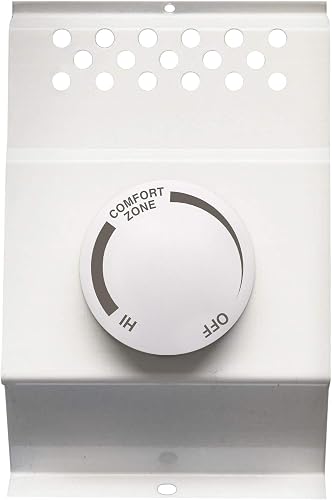
The Cadet F Series Double Pole Built-In Baseboard is the most direct fit when your heater is a Cadet F Series model. Its thermostat mounts at either end of the heater and replaces the detachable end plate, avoiding extra wiring for that installation.
It is rated for 22 A at 120, 208 or 240 V and uses a twist dial with a stated temperature range of 45°F to 80°F. The built-in position keeps the control at the heater instead of adding a separate wall thermostat.
Cadet identifies this control for F Series electric baseboard heaters only. Check the heater label and its existing control before ordering, since the voltage range alone does not make it a universal replacement.
Choose this model when you want a simple built-in dial on a compatible Cadet heater. For a wall-mounted control or another heater brand, compare the line-voltage options below.
Honeywell Home 5-2 Day Programmable Thermostat Electric: Best for weekday and weekend schedules
- 240 V line-voltage heat
- 3,500 W maximum at 240 V
- 5-2 day programming
- Silent TRIAC switching
Separate weekday and weekend schedules suit a routine that changes on weekends. Confirm your heater is a 240 V line-voltage system within the thermostat’s load limits.
Pros
- Separate weekday and weekend programs
- 4 periods per day
- Backlit digital display
Cons
- For 240 V line-voltage heat only
- Not for central heating or loads outside its limits
The Honeywell Home 5-2 Day thermostat fits a 240 V electric heating system when its load stays within the stated limits. Its schedule separates weekdays from weekends, with four daily periods for wake, leave, arrive and sleep.
The control is rated up to 3,500 W at 240 V, or 14.6 A resistive, with a 2 A minimum load. It supports electric baseboards, convectors, radiant ceilings and fan-forced heaters, and its TRIAC switching is described as silent.
This model is for line-voltage heating only. It cannot be used with central heating, a system driven by a contactor or relay, or a resistive load below its minimum or above its maximum.
Choose it if your routine changes between workdays and weekends and your circuit is a compatible 240 V system. For more options from the same brand, see best Honeywell baseboard heater thermostats.
Comfort Zone Baseboard Space Heater with Digital: Best for a portable heater with controls
- 1,500 W portable convection heater
- Digital adjustable thermostat
- Two heat settings
- Tip-over and overheat protection
This is a complete portable heater with its own digital thermostat, not a replacement wall control. Consider it when you need room heating without replacing a hardwired thermostat.
Pros
- Digital temperature display
- Two heat settings
- Tip-over switch and overheat protection
Cons
- A heater, not a wall thermostat replacement
- Floor placement needs space
The Comfort Zone is a portable electric baseboard space heater with an integrated digital thermostat. It does not replace a wall thermostat, but it can suit a room where you need a separate floor-standing heat source.
It has a 1,500 W heating element, two heat settings and a temperature display. The stated safety features include a tip-over switch, overheat protection and a stay-cool body.
Its thermostat adjusts the portable heater itself. That distinction matters if you are shopping for a replacement control connected to a hardwired baseboard, since this unit is a heater and corded appliance rather than a wall control.
Choose it when portable room heating is the goal. If you need a wired replacement thermostat, focus on the voltage and load ratings of the other picks.
Sensi Smart Thermostat: Best for compatible central HVAC
- Wi-Fi app and voice control
- Flexible scheduling
- C-wire not required in most applications
- Designed for common HVAC equipment
Sensi is a smart thermostat for compatible HVAC equipment. The information does not guarantee compatibility with line-voltage electric baseboards, so check your system before considering it.
Pros
- Remote access and usage reports
- Flexible scheduling
- C-wire not required in most applications
Cons
- Compatibility with electric baseboards is not established
- Made for HVAC equipment, not identified as a line-voltage control
Sensi is intended for common home HVAC equipment and offers Wi-Fi access, scheduling and usage reports. Its supplied compatibility details do not guarantee support for line-voltage electric baseboard heaters, so it is not a safe default choice for this roundup’s main use.
The thermostat supports app, button and voice control. Its installation information says a C-wire is not required in most applications, but that refers to compatible HVAC systems and does not confirm compatibility with a baseboard circuit.
Do not confuse a smart thermostat’s wireless features with electrical compatibility. Electric baseboards require a thermostat made for the system’s line voltage and load.
Choose Sensi only if your heating equipment is compatible HVAC, not as a presumed baseboard replacement. For a different thermostat category, our best digital thermostat for home guide can help you compare options.
Mysa Smart Thermostat LITE for Electric Baseboard: Best for smart scheduling on line voltage
- 120/240 V line-voltage heat
- Up to 1,900 W at 120 V or 3,800 W at 240 V
- Wi-Fi scheduling and app control
- Requires 4 wires
Mysa adds app control and daily scheduling to compatible 120 V or 240 V electric heat. Check the wiring first because it needs 4 wires and will not work with a 24 V furnace or central heat pump.
Pros
- Works with 120 V or 240 V electric heat
- Daily scheduling and remote control
- HomeKit, Alexa and Google support
Cons
- Needs 4 wires, including neutral or a second live wire
- Not for 24 V systems
The Mysa Smart Thermostat LITE is a strong smart option for compatible 120 V or 240 V electric baseboard heat. It supports daily scheduling, app control, geofencing and voice assistants, with no subscription required for those listed features.
Its maximum output is 1,900 W at 120 V or 3,800 W at 240 V. Mysa requires four wires, including a neutral or second live wire, and says it will not work with a two-wire switch loop, 24 V furnace or central heat pump.
Turn off power at the breaker before wiring work. Mysa advises hiring an electrician where code requires it or if you are not comfortable working with high voltage.
Choose it if you want smart scheduling and your wiring, voltage and heater load all match. If programming matters more than app control, compare programmable baseboard heater thermostats.
YeloDeer 240V Only 4-Wire Manual Electric Baseboard: Best for manual 240 V control
- 240 V line-voltage heat
- Up to 20 A and 4,800 W
- Manual dial
- 40°F–80°F range
This manual thermostat is for 240 V electric heat and offers a simple dial instead of schedules or app controls. Match the voltage and load, and confirm the wiring at the thermostat box.
Pros
- Manual dial for direct adjustment
- 20 A maximum load
- Heating indicator light
Cons
- 240 V only
- No schedule or remote control
This YeloDeer thermostat is a manual option for a 240 V electric baseboard system. It is rated up to 20 A and 4,800 W, with a dial range of 40°F to 80°F.
The dial provides continuous adjustment, and indicator lights show the connection point and whether the heater is running. The control is non-programmable, so it suits buyers who prefer a direct temperature adjustment over schedules or an app.
YeloDeer identifies compatibility with electric baseboards, convectors and fan-forced heaters. Check the system voltage, total load and wire configuration before installing it.
Choose this model if your system is 240 V and you want manual control. For the wider stated voltage range, the next YeloDeer option may fit more circuits, subject to its own load and wiring limits.
YeloDeer 110V-265V 4-Wire Manual Electric Baseboard Heater: Best for manual 120 V or 240 V setups
- 110–265 V range
- Up to 20 A
- 2,400 W at 120 V or 4,800 W at 240 V
- Manual dial
This manual model covers a stated 110–265 V range, with separate wattage limits at 120 V and 240 V. Verify the exact system voltage, load and 4-wire connection before choosing it.
Pros
- Supports the stated 110–265 V range
- Manual dial and heating indicator
- Maximum output is specified by voltage
Cons
- No programming or smart control
- Requires compatible 4-wire line-voltage wiring
The YeloDeer 110V–265V model is a manual thermostat for compatible electric heating systems across its stated voltage range. Its output limit differs by voltage: 2,400 W at 120 V and 4,800 W at 240 V, with a 20 A maximum.
It uses a dial with a 40°F to 80°F range and indicator lights for connection and heating status. The control is non-programmable, which keeps operation straightforward but does not provide scheduling or remote adjustments.
The thermostat requires compatible line-voltage wiring. Verify the actual circuit, the heater’s total load and the available conductors rather than relying on the broad voltage range alone.
Choose it if you need a manual control and your measured system details fall within its limits. For a digital wall control, compare our best digital thermostat for baseboard heater guide.
meross Matter Smart Thermostat for Electric Baseboard: Best for Matter smart home control
- 120–240 V electric heating
- Matter and Wi-Fi
- App scheduling and energy monitoring
- Open-window detection
Meross combines line-voltage baseboard control with Matter, app scheduling and energy monitoring. It is not for 24 V HVAC systems or electric underfloor heating.
Pros
- Matter support across several smart home platforms
- Energy monitoring in the app
- Open-window detection
Cons
- Not compatible with 24 V HVAC
- Not for electric underfloor heating
The meross Matter thermostat suits compatible 120–240 V baseboard, convector and fan-forced heating systems. It combines Wi-Fi app control and voice control with Matter support, scheduling and energy monitoring.
Its app includes a 24/7 visual schedule, historical electricity-use data and open-window detection that pauses heating when a window is detected open. These features can help you manage heating routines, but the key first check is still the electrical match.
Meross says this thermostat is not compatible with 24 V HVAC systems or electric underfloor heating. Confirm that your heater type and circuit fall within the stated compatibility before choosing it.
Choose meross if smart home integration and energy-use monitoring are priorities. If you want a non-smart manual thermostat, the YeloDeer options above avoid app setup.
Cadet Single Pole Built-In Thermostat Kit: Best for a Cadet F Series single-pole control
- Made for Cadet F Series baseboards
- 22 A
- 120/208/240 V
- 45°F–80°F dial range
This built-in single-pole kit is for Cadet F Series baseboards. Check the heater model and existing control type before choosing a replacement.
Pros
- Made for Cadet F Series heaters
- Mounts at either end
- Simple dial control
Cons
- Not a general-purpose wall thermostat
- Compatible only with Cadet F Series baseboards
The Cadet Single Pole Built-In Thermostat Kit is made for Cadet F Series electric baseboard heaters. Like the double-pole Cadet option, it mounts at either end of the heater and uses a dial with a low setting.
It is rated 22 A at 120, 208 or 240 V, with a stated dial range of 45°F to 80°F. Cadet’s compatibility limit is specific: this kit is for F Series baseboards, so confirm the heater model before choosing it.
The single-pole label is one part of the match. Check the existing thermostat and heater instructions, and have an electrician confirm the wiring if you are unsure which kit your circuit needs.
Choose it for a compatible Cadet F Series heater that calls for this built-in single-pole kit. For battery-powered controls in other applications, see our best battery powered thermostat guide.
What should you check before replacing a baseboard thermostat?
Check the heater voltage, total wattage or amperage, thermostat wiring and heater compatibility before buying. These details determine whether a control can safely operate the heating circuit.
Start with the heater label and the old thermostat’s model information. If you cannot identify the circuit or confirm the load, ask a qualified electrician to inspect it.
Does a 240 V baseboard need a 240 V thermostat?
Yes, use a thermostat rated for the system voltage and load. The Honeywell model here is for 240 V line-voltage heating, while Mysa and the YeloDeer models list different voltage ranges and output limits.
Do not treat wattage and amperage as interchangeable without checking the voltage. Compare the heater’s total load with the thermostat’s maximum rating.
Do single-pole and double-pole controls work the same way?
No, they switch the circuit differently, and the right replacement depends on the heater and wiring. Some controls in this roundup are labeled single-pole, while the Cadet built-in option is identified as double-pole.
Match the control type to the existing setup and manufacturer instructions. If the wiring does not clearly identify the right type, have an electrician verify it.
Can a 24 V thermostat control electric baseboards?
A typical 24 V HVAC thermostat should not be assumed to work with line-voltage baseboards. The Mysa and meross compatibility details specifically exclude 24 V HVAC systems, and the Sensi details describe common HVAC equipment rather than baseboard compatibility.
Choose a control explicitly made for your electric heating system. A shared feature such as Wi-Fi does not mean two thermostat types use the same electrical circuit.
Which thermostat type fits your baseboard setup?
Choose a built-in thermostat when your heater’s model calls for a matching control, and select a wall thermostat when its voltage, load and wiring match the circuit. Smart features make sense only after those electrical checks pass.
For Cadet F Series heaters, compare the two Cadet kits by the required pole type. For a 240 V schedule, the Honeywell has weekday and weekend programming; for smart control, Mysa or meross are candidates when their wiring and load requirements fit.
Pick a manual YeloDeer model if you want a dial and your circuit is within its ratings.
Choose the Comfort Zone only if a portable heater, rather than a wall thermostat replacement, meets your need. For another thermostat type, see our mechanical heat pump thermostat guide.
Our top 3 picks at a glance
-
1
Best for Cadet F Series heaters
Cadet F Series Double Pole Built-In Baseboard
9.6/10 our score
See it on Amazon -
2
Best for weekday and weekend schedules
Honeywell Home 5-2 Day Programmable Thermostat Electric
9.5/10 our score
See it on Amazon -
3
Best for a portable heater with controls
Comfort Zone Baseboard Space Heater with Digital
9.4/10 our score
See it on Amazon
Frequently asked questions
Can I use a smart thermostat with an electric baseboard heater?
Yes, if it is made for line-voltage electric heat and matches your heater’s voltage, load and wiring. Mysa and meross are smart options in this roundup, but their wiring and system limits differ.
A 24 V HVAC thermostat such as Sensi is not established as compatible with line-voltage baseboards.
How do I know what voltage my baseboard thermostat needs?
Check the heater label, existing thermostat, wiring diagram or installation manual for the system voltage. Electric baseboards commonly use line voltage, and the correct replacement must match the actual circuit and load.
Turn off the circuit at the breaker before inspecting wiring, and use an electrician if you are unsure.
What does double-pole mean on a baseboard thermostat?
A double-pole thermostat can disconnect both supply conductors, while a single-pole control switches one. The right type depends on the existing circuit, heater instructions and local electrical requirements.
Do not choose by the pole label alone.
Confirm the wiring and replacement requirements for your specific heater.
Can I replace a built-in baseboard thermostat with a wall thermostat?
Sometimes, but compatibility depends on the heater, wiring, voltage and installation requirements. Cadet’s built-in kits here are specifically for Cadet F Series heaters, while wall thermostats have their own load and wiring limits.
Have an electrician check the circuit if you are changing the control location or are uncertain about the wiring.
Is a thermostat for a portable baseboard heater the same as a wall thermostat?
No. A portable baseboard space heater can include its own thermostat, while a wall thermostat controls a separate hardwired heating circuit.
The Comfort Zone pick here is a complete portable heater with digital controls.
It does not replace a wall-mounted line-voltage thermostat.