Space Heater vs Radiant Heater: How They Compare (November 2026)
Pick a forced air space heater for fast whole room warmth and a radiant heater for direct warmth on people and objects. In this space heater vs radiant heater comparison, the right choice depends on where you sit, how you use the room and which fuel you can use safely.
On this page (13 sections)
- Space heater vs radiant heater: the quick verdict
- How radiant heat differs from forced air heat
- Coverage and heat output side by side
- Which feels warmer in a small bedroom?
- Which suits a garage, workshop or cabin?
- Fuel and power: electric, propane or natural gas
- Controls and thermostats compared
- Safety features and indoor use
- Noise, airflow and comfort trade-offs
- Size, weight and where each one fits
- Portability and setup for daily use
- Who should buy which model
- Space heater vs radiant heater: final decision
Pick a forced air space heater for fast whole room warmth and a radiant heater for direct warmth on people and objects. In this space heater vs radiant heater comparison, the DREO and Lasko use forced air to warm room air, while the 2 Mr.
Heater models use radiant heat that goes straight to what is in front of them.
Our score weighs specs, features and buyer feedback against what you're shopping for. We compared heat output, coverage, fuel, controls and safety features for each model.
A space heater is not the opposite of a radiant heater. Radiant is one way a space heater can work, and forced air is another.
That overlap is why the names confuse so many buyers.
Space heater vs radiant heater: the quick verdict
Forced air wins for a small bedroom or office, and radiant wins for a garage, a seat you stay in or a power outage. The DREO covers 200 sq.ft with 1500 watts of forced air, while the Mr.
Heater Portable Buddy covers 225 sq. ft. with 9,000 BTU of radiant propane heat.
If you sit in one chair for hours, direct radiant warmth can feel like sunshine on you without heating the whole room. If you move around a bedroom, a tower that blows warm air will reach more of the space.
Both approaches have a place in one home. Many people keep a forced air tower for a bedroom and a radiant propane unit for a garage or emergency use.
Our guide to a space heater for home helps you match the type to the room before you compare models.
How radiant heat differs from forced air heat
Radiant heat warms people and objects directly, while forced air warms the air that then warms you. Radiant tiles in the Mr.
Heater models send energy to surfaces in front of them, so you can feel warm even if the far wall stays cool.
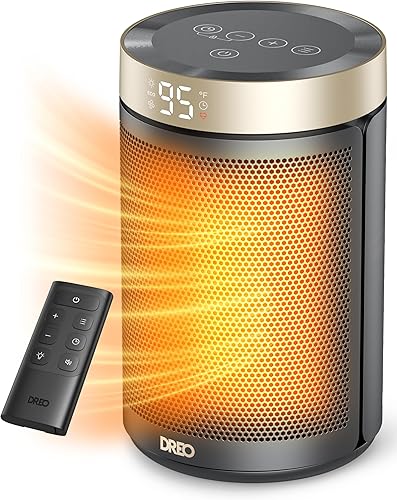
Forced air uses a fan to push warm air through a PTC ceramic element. The DREO uses a 1500W PTC system with a heat funnel, and Lasko uses a 1500W ceramic element with oscillation.
That difference changes how a room feels. Forced air can create a light draft, and it can also dry the air feels more noticeable in a small room.
Radiant heat feels still, but it only warms what it points at.
A what is an infrared space heater guide explains one radiant form in more detail. Infrared is a subset of radiant heating, not a separate category from all radiant units.
Coverage and heat output side by side
The table below shows the practical gap in size and power between these 4 models. The DREO lists 200 sq.ft coverage, Lasko lists 150, the Portable Buddy lists 225 sq. ft., and the larger Mr.
Heater lists 1,000 square feet.
Output follows a similar pattern. The electric towers both list 1500 watts, the Portable Buddy lists 9,000 BTU, and the larger radiant unit lists 30,000 BTU/hr.
Coverage figures are maker figures for the stated space, not a promise for every room shape. Ceiling height, drafts, insulation and furniture layout all change the result you feel.
| Product | Best for | Heat Output | Heating Coverage | Heating Element | Our score |
|---|---|---|---|---|---|
| DREO Space Heater | quiet bedrooms | 1500 watts | 200 sq.ft | PTC Ceramic | 9.7 |
| Mr. Heater | garages and outages | 9000 british thermal units | 225 | Radiant | 9.6 |
| Lasko 23" Ceramic Tower Space Heater | wider rooms | 1500 watts | 150 | Ceramic | 9.5 |
| Mr. Heater | large spaces | 30000 british thermal units | 1000 | Radiant | 9.2 |
For a typical bedroom under 200 sq.ft, either electric tower fits the stated range. For a garage or cabin over 500 sq.ft, only the larger radiant unit lists coverage in that range.
Which feels warmer in a small bedroom?
Forced air usually feels warmer faster in a bedroom because it raises the air temperature around the bed. The DREO is built for that use, with a thermostat you can set from 41 to 95F in 1F steps and a 12-hour timer.
Lasko takes a simpler approach with 2 heat settings, a 7-hour timer and oscillation. Its max temperature setting is 85F and its min is 60F, so control is less precise than the DREO.
Radiant heat in a bedroom can feel pleasant when it points at the bed, but it will not warm the whole room as evenly. You may feel warm on one side and cool on the other.
Noise matters at night. DREO lists 34dB with a brushless DC motor, while Lasko describes its settings as quiet without listing a decibel figure.
Check the exact tone before you order if you are a light sleeper.
Which suits a garage, workshop or cabin?
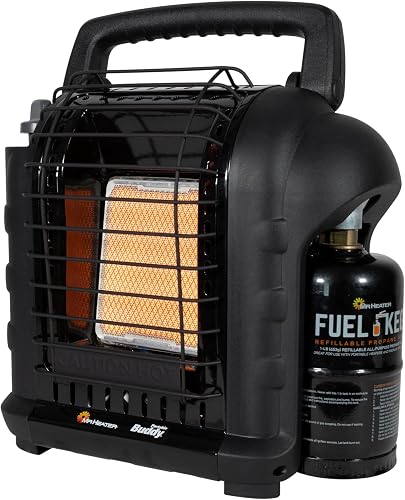
Radiant propane and natural gas units suit garages and cabins better than electric towers. The Portable Buddy works without electricity, which helps in a power outage or a detached shop with no outlet nearby.
It offers 4,000 or 9,000 BTU settings and up to 5.4 hours of runtime on a 1 lb. propane tank. With a 20 lb. cylinder and an optional hose, runtime extends to up to 108 hours.
The larger Mr. Heater lists 30,000 BTU/hr for up to 1,000 square feet.
It uses natural gas, needs no electricity and needs no outdoor venting, with battery operated ignition included.
Electric towers still work in a garage if you have a suitable outlet, but their stated coverage of 150 to 200 sq.ft is much smaller. A large, drafty garage will need a different plan than a small bedroom.
Fuel and power: electric, propane or natural gas
Electric is simplest for indoor rooms, while propane and natural gas give you radiant heat without a power outlet. The DREO and Lasko are electric and indoor only, with 12.5 A draw listed for both.
The Portable Buddy is propane, gas powered and listed for indoor and outdoor use, with the Canada and Massachusetts exception noted above. The larger Mr.
Heater is natural gas, indoor only, and lists corded electric as a power source in its specs even though it says no electricity required for heat.
Fuel choice also affects storage. Propane tanks need space and care, and natural gas needs a suitable connection.
Electric needs only an outlet, but a 1500W unit draws a steady load.
For most bedrooms and offices, electric is the easiest first choice. For outages, workshops and large spaces, radiant fuel units fill a gap electric cannot fill without power.
Controls and thermostats compared
The DREO gives the most precise electric control, while the larger radiant unit gives thermostat control for a big space. DREO sets heat from 41 to 95F in 1F increments, with ECO, Power heat and Fan Only modes.
It also includes a remote control, a 12-hour timer, mute, child lock and a memory function. Those extras help if you change settings from bed.
Lasko includes a remote for heat settings, oscillation and a 7-hour timer. Its thermostat range is narrower, from 60 to 85F, and it has 2 heat settings.
The Portable Buddy has 2 speeds and works with 4,000 or 9,000 BTU settings rather than a precise temperature dial. The larger Mr.
Heater includes a built-in adjustable thermostat, which is useful when you want the unit to cycle in a large room.
If you want a best infrared space heater with thermostat style control, compare the DREO range with the larger radiant unit range before you decide.
Safety features and indoor use
Each model here lists a different safety approach, so read the fuel and placement rules for the exact unit. DREO lists tilt-detection, V0 flame retardant materials, overheat protection and a safety plug, all certified by ETL.
Lasko lists a self-regulating ceramic element, overheat protection and a cool-touch housing, and it is ETL certified. Its tower form at 22.5 inches tall stands on the floor and needs clear space around it.
The Portable Buddy lists a Life Safety System with patented self-extinguishing protection, low oxygen shutoff, tip-over shut-down and flame-retardant materials. It also warns that unauthorized accessories may cause serious injury and will void the warranty.
The larger Mr. Heater lists a low oxygen safety shut-off and indoor safe use, with wall mounting hardware included.
Its blower fan kit is sold separately, so do not assume it is included.
Noise, airflow and comfort trade-offs
Forced air moves air and can feel drafty, while radiant heat feels still but more directional. DREO uses a winglet fan design to reduce turbulence and lists 34dB, which is a key reason it suits a bedroom.
Lasko uses wide oscillation to spread warm air to corners. That helps in a medium room, but the moving air may bother some people at a desk.
Radiant heat has no fan noise in the Portable Buddy, since it needs no electricity for heat. The larger unit also says no electricity required, though a separate blower fan kit exists if you want added air movement.
Comfort also depends on where you sit. Radiant warmth on your legs while your back stays cool can feel odd, while forced air can make one side of a bed feel warm and the other side cool if oscillation is off.
Our look at are infrared space heaters energy efficient explains why direct heat can reduce the need to warm a whole room, without claiming a saving for every home.
Size, weight and where each one fits
The electric towers are small and light, while the radiant units are larger and built for floor or wall use in bigger spaces. DREO measures 6.02 x 6.02 x 10 inches and weighs 3 pounds, so it fits on a desk or a small table.
Lasko measures 8.3 x 7.25 x 22.5 inches and weighs 2.5 pounds. Its taller tower shape suits a floor spot beside a bed or couch.
The Portable Buddy measures 8.39 x 13.39 x 15.16 inches and weighs 7.1 pounds. It has an easy-carry handle and a reinforced wire guard for portable use.
The larger Mr. Heater measures 23.75 x 11.25 x 27 inches and weighs 26.3 pounds.
It can be floor mounted or wall mounted, which suits a cabin or a large room where a small tower would not cover the area.
Portability and setup for daily use
Setup is simplest with the electric towers, while radiant fuel units need more care with fuel and placement. DREO is free standing with a portable handle, and it includes a remote control, the heater and a user manual.
Lasko is floor mount with a built-in carry handle, and it includes the tower, remote control and user manual. Both can move from room to room as needed.
The Portable Buddy includes the heater only, and it is designed for easy carry between a garage and an outdoor spot. Its included components list is just the heater, so check what you need for fuel and connection separately.
The larger Mr. Heater includes the thermostat and wall mounting hardware.
Battery operated electronic ignition has the battery included, which helps at startup.
Place any heater on a level surface, keep it clear of curtains and furniture, and follow the manual for clearances. Never leave a fuel heater unattended in a way the manual does not allow.
Who should buy which model
Buy the DREO for a quiet bedroom, the Lasko for a wider bedroom or office, the Portable Buddy for a garage or outage, and the larger Mr. Heater for a large natural gas space.
The DREO score of 9.7 reflects its precise thermostat, quiet running and safety list for indoor use.
The Portable Buddy score of 9.6 reflects its 9,000 BTU radiant output, no electricity need and safety system for portable use. The Lasko score of 9.5 reflects its 1500W ceramic heat, oscillation and remote for medium rooms.
The larger Mr. Heater score of 9.2 reflects its 30,000 BTU output for up to 1,000 square feet, balanced by its size and natural gas requirement.
Each score weighs specs and features against the space heater vs radiant heater question you asked.
Our roundup of best infrared space heaters includes more radiant options if you want to compare infrared models side by side.
Space heater vs radiant heater: final decision
Choose forced air for a small indoor room you move around in, and choose radiant for a fixed seat, a garage or a space without power. That rule covers most homes without forcing one type to do every job.
If your main need is a bedroom, start with the DREO for thermostat precision at 34dB. If your main need is a workshop or emergency kit, start with the Portable Buddy for 9,000 BTU of propane radiant heat.
If you have natural gas and a large room, the 30,000 BTU unit covers up to 1,000 square feet with a built-in thermostat. If you want a simpler electric tower with oscillation, the Lasko covers 150 sq.ft with a remote.
Measure the room, note your fuel options and check the safety rules for your area before you buy. Then pick the heater that matches how you actually use the space, not just the largest output number.
Frequently asked questions
Is a radiant heater better than a space heater?
A radiant heater is better when you want direct warmth on a person or a specific spot, while a forced air space heater is better for warming the air in a whole small room quickly. Your seating position, room size and fuel access should decide between them.
What is the difference between a space heater and a radiant heater?
A space heater is a broad category that includes forced air, ceramic and radiant models, while a radiant heater is one specific type that sends heat directly to objects and people. Many electric space heaters use forced air, and the radiant models here use propane or natural gas.
Are infrared heaters the same as radiant heaters?
Infrared heaters are a type of radiant heater that uses infrared energy to warm objects directly. Our guide to what is an infrared space heater explains how that differs from other radiant and forced air designs.
Which heats a room faster, radiant or forced air?
Forced air models such as the DREO and Lasko can warm the air in a small room within seconds, while radiant models warm people and surfaces first and the room air more slowly. If you need the whole room to feel warm quickly, forced air often suits better.
Can I use a propane radiant heater indoors?
The Mr. Heater Portable Buddy is designed and approved for indoor and outdoor use, but indoor use is not approved in Canada or Massachusetts.
Follow the local rules, keep ventilation in mind and use the safety features built into the unit.