Can You Install a Ceiling Fan in a Drop Ceiling?
You can install a ceiling fan in a drop ceiling only when the fan is supported by the building structure, not the ceiling tiles or grid. Use a fan-rated electrical box and have the support and wiring checked before installation.
On this page (11 sections)
- Can you install a ceiling fan in a drop ceiling?
- Why can't the ceiling grid hold the fan?
- What support does a drop ceiling fan need?
- How do you prepare the ceiling tile?
- Which low profile fan should you consider?
- How much clearance does a drop ceiling fan need?
- Is a low profile ceiling fan for drop ceiling spaces a good choice?
- What should you check before wiring the fan?
- Do ceiling fans with lights work in drop ceilings?
- How do remote controls affect the installation?
- What is the safest way to decide?
You can install a ceiling fan in a drop ceiling, but the fan must be supported by the structural ceiling above, never by the ceiling tile or grid. A fan-rated electrical box, suitable brace, and safe wiring are required before you choose a low profile ceiling fan for drop ceiling spaces.
The visible tile only creates an opening for the fan. It does not provide the strength needed to hold a vibrating motor.
Plan the support first, then select a fan that fits the room and leaves safe clearance below.
Can you install a ceiling fan in a drop ceiling?
Yes, but the installation needs independent support above the suspended ceiling. The fan should connect to a fan-rated box or mounting system that is secured to a joist, beam, or other approved structural support.
A drop ceiling usually has lightweight tiles held by a grid. Cutting a tile can make room for a fan canopy, but it does not turn the tile into a load-bearing surface.
Before work begins, identify the structural ceiling, the electrical route, and the space between the tile and the structure. If you cannot see or reach a suitable support point, ask an electrician or qualified installer to inspect it.
The Fans: The Complete Buying Guide explains how room size, airflow, controls, and mounting style affect a fan choice.
Why can't the ceiling grid hold the fan?
The grid is designed to hold ceiling panels, not a moving appliance. A ceiling fan adds weight and vibration, while the motor also creates movement as the blades rotate.
A tile-supported installation can crack the tile, bend the grid, loosen the fan, or allow the fixture to fall. Even a small fan needs a support path that transfers its weight and movement into the building structure.
The support should also keep the fan from rubbing against the grid or tile. Leave enough room for the canopy, wiring, and any brace required by the installation method.
What support does a drop ceiling fan need?
A drop ceiling fan needs a fan-rated electrical box or approved support brace attached to the structure above. The exact hardware depends on the ceiling construction, the distance above the tile, and the fan's mounting instructions.
Do not assume that a box used for a light fixture can support a fan. Fan-rated boxes are made for the weight and movement of ceiling fans, but the box must still be secured correctly.
A professional should confirm:
- The support connects to a joist, beam, or approved framing.
- The electrical box is rated for ceiling fan use.
- The brace does not rest on the ceiling tile or grid.
- The fan canopy covers the opening neatly.
- The wiring and grounding follow local requirements.
- The finished fan has enough clearance from walls and obstructions.
The National Electrical Code information from the NFPA can help explain why electrical work must follow applicable safety rules, but local requirements and the fan instructions control the actual installation.
How do you prepare the ceiling tile?
Remove the tile, measure the fan location, and cut only the opening needed for the mounting hardware and canopy. Keep the fan's support separate from the tile.
Mark the fan center after locating the structural support above. Check that the blades will not strike the grid, nearby lights, ductwork, pipes, or tall furniture.
Do not use the tile as a washer or spacer for the fan. If the finished opening needs reinforcement for appearance, that reinforcement should remain separate from the fan's structural support.
A low profile design can help in a room with limited height, but it does not make an unsafe mounting point acceptable. Measure the distance from the structural ceiling to the finished floor before choosing the fan.
Which low profile fan should you consider?
The right choice depends on the available height, room size, controls, and whether you need a light. These three options all use a low profile or flush-style design, but their dimensions and controls differ.
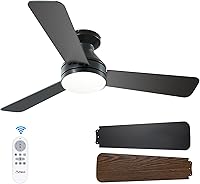
The Amico 42 Inch Black Low Profile Ceiling Fans with Lights and Remote measures 42 in wide and 9.3 in high. It has 6 fan speeds, a reversible DC motor, a dimmable LED light with 3 color temperatures, and a remote with 1, 2, and 4 hour timing.
Its black and walnut blade sides give you two visible color choices.
The remote controls the fan and light separately. Amico also says the fan is intended for indoor and covered outdoor spaces, but it should not be exposed directly to rain.
Do not connect it to a dimmer switch, fan speed switch, or smart switch. Use a standard on/off wall switch with the remote.
The Depuley Modern Ceiling Fan with Light has a 42 in diameter, 5 black blades, and a 9.25 in height. It uses a brushless DC motor, 6 power levels, a remote, and a dimmable LED light with 3 color temperatures from 3000K to 6000K.
Depuley lists this fan for indoor and covered outdoor use, including patios and pergolas protected from direct rain and moisture. Its recommended room size is 129 to 215 sq. ft.
Like the Amico, it should use a standard on/off wall switch rather than a wall dimmer, fan speed switch, or smart switch.
The ZMISHIBO Low Profile 19.7'' Ceiling Fans with Lights and Remote, Black measures 19.7 in wide and 5.7 in high. It has 7 blades, 6 speeds, a reversible DC motor, and a dimmable 2200-lumen LED light with 3 color temperatures from 3000K to 6000K.
This model is for indoor use and includes remote control. Its control options include Bluetooth app control and smart voice control with Alexa or Google Home.
The fan and light can be controlled separately, and the remote has a 2 hour timer.
How much clearance does a drop ceiling fan need?
Leave enough clearance for the blades, canopy, wiring, and people moving below the fan. The exact clearance depends on the fan instructions, room layout, and local rules.
A low profile fan reduces the distance from the structural mounting point to the fan body, but it does not eliminate blade clearance needs. Check for nearby walls, beams, light fixtures, vents, and sprinkler equipment.
Measure from the finished floor to the lowest part of the fan. In a room used by tall people, a lower fan may create a safety concern even when the ceiling looks high enough.
If the fan would sit directly below a grid member or light, move the mounting point before cutting the tile. A centered installation is not useful if the blades cannot rotate freely.
Is a low profile ceiling fan for drop ceiling spaces a good choice?
It can be a good choice when the room has limited height and the structural support is accessible above the tiles. The compact ZMISHIBO is the shortest of these options, while the Amico and Depuley are wider 42 in fans for small rooms.
Compare the fan's total height, not only its blade diameter. A 42 in fan can provide broader coverage, but its 9.25 in height may require more vertical space than a 19.7 in fan that measures 5.7 in high.
For more context, read What Is a Low Profile Ceiling Fan? before measuring your ceiling. If you want a wider range of compact models, see Best Low Profile Ceiling Fans.
What should you check before wiring the fan?
Confirm the circuit, box, grounding, controls, and support before connecting the fan. Turn off power at the breaker and verify that the circuit is de-energized before any work.
Check whether the existing switch is a standard on/off switch. The Amico and Depuley product information says not to use a wall dimmer, fan speed switch, or smart switch.
The ZMISHIBO adds app and smart voice control, but the electrical installation still needs to follow the fan instructions.
Do not rely on a remote as a substitute for safe wiring. Keep the manual with the fan, and ask an electrician to resolve unclear wiring, missing grounding, or an unsuitable box.
The guide to What Is a Low Voltage Thermostat? Explained covers a different type of home control circuit.
A thermostat circuit is not a substitute for the power wiring a ceiling fan needs.
Do ceiling fans with lights work in drop ceilings?
A ceiling fan with a light can work below a drop ceiling when the support and wiring are installed correctly. The light adds another electrical load and another control function, so the box and circuit should be checked as part of the same installation.
The Amico has a 2000-lumen LED downlight with adjustable white color settings. Depuley has a dimmable LED light with 3000K, 4500K, and 6000K settings.
ZMISHIBO has a dimmable 2200-lumen LED light with 3 color temperatures.
Read Is a Ceiling Fan a Light Fixture? if you are replacing an existing ceiling light. The answer affects how you think about the electrical box, switch, mounting point, and clearance.
How do remote controls affect the installation?
A remote can simplify daily operation, but it does not change the structural requirements. The fan still needs a supported box, safe wiring, and enough room for the blades and canopy.
Remote features differ. Amico and Depuley offer 6 fan speeds, adjustable lighting, and timer functions.
ZMISHIBO offers 6 speeds, separate fan and light control, a 2 hour timer, Bluetooth app control, and smart voice control.
If you plan to use a wall switch as well, check the exact control limits for the chosen fan. The Amico and Depuley instructions specifically exclude dimmer, fan speed, and smart switches.
For general remote questions, see Are Ceiling Fan Remotes Universal?.
For light options, compare Best Low Profile Ceiling Fans with Lights. For remote-focused choices, see Best Low Profile Ceiling Fans with Remotes.
What is the safest way to decide?
Choose the mounting location and support before choosing the fan. If the structure above the drop ceiling cannot support a fan-rated box or brace, do not install a ceiling fan in that opening.
Pick the Amico if you want a 42 in fan with a light, remote timing, reversible airflow, and separate black or walnut blade sides. Pick the Depuley if the 42 in size and 129 to 215 sq. ft. room recommendation fit your space.
Pick the ZMISHIBO if vertical space is the main concern and you want a 19.7 in semi-flush fan with app and smart voice control. In every case, measure first and have the support and wiring checked before cutting the ceiling tile.
Frequently asked questions
Can you mount a ceiling fan directly to a drop ceiling tile?
No. A drop ceiling tile and its metal grid are not suitable as the only support for a ceiling fan.
The fan must attach to a fan-rated electrical box or support system connected to the structural ceiling above.
Have the support checked before installation.
What kind of box does a ceiling fan need?
A ceiling fan needs an electrical box rated for fan support and fastened to the building structure. A standard light-fixture box may not be strong enough.
The box, brace, wiring, and final connections should follow local electrical rules and the fan instructions.
Is a low profile ceiling fan suitable for a drop ceiling?
A low profile ceiling fan can suit a room with limited height after proper structural support is installed. Its short mounting design helps preserve headroom, but it does not remove the need for a fan-rated box above the drop ceiling.
Should an electrician install a ceiling fan above a drop ceiling?
An electrician should handle the work if you are unsure about the support, wiring, junction box, switch, or local code. Drop ceilings can hide structural and electrical obstacles, so professional advice is worthwhile before cutting a tile or connecting power.