Fans: The Complete Buying Guide
Choose a fan by where you need airflow and what you want it to do: circulate air through a room, create a breeze nearby, move air through a window, or ventilate a specific area. Match the fan type to the space, then check its size, controls, noise and placement.
On this page (10 sections)
- What does an air circulator fan do?
- Which type of fan fits your room?
- What should you check before buying a fan?
- Which fan works for a window?
- Which fan styles suit common home needs?
- When should you use a floor fan or a box fan?
- Can fans help with a forced air system?
- What other fan features and accessories should you compare?
- Explore fans by topic
- How do you choose the right fan?
An air circulator fan moves air around a room, while other fans focus airflow on a person, push air through a window or move air across a work area. Choose by the job you need the fan to do, then match its size and controls to the space.
A fan can help you feel cooler by moving air over your skin, but it does not cool a room the way an air conditioner does. A window fan can exchange indoor and outdoor air when conditions are suitable.
This guide compares common home fan types, explains what to check before buying, and points to focused guides for each kind. Start with where the fan will sit and where you want the air to go.
What does an air circulator fan do?
An air circulator fan moves air through a room to help mix air in different areas. It can be useful when you want more than a breeze directed at one seat.
Room shape, furniture and fan placement affect how air moves. A fan aimed toward a wall or open area may move air through a room differently from one pointed straight at a person.
The term “air circulator” describes a goal, not one single fan shape. Pedestal, floor and table fans can all move air around a room; compare their airflow direction and controls instead of relying on the label alone.
If you need a fan for a large work area, the Amazon Basics 20-inch floor fan has 3 speeds and an adjustable tilt head.
Which type of fan fits your room?
The best fan type depends on the airflow path you need: across a room, toward a nearby person, through a window or from above. Consider the fan's footprint and whether you can place it safely where it will work.
| Fan type | Best fit | Check before choosing |
|---|---|---|
| Ceiling fan | Broad airflow from above | Ceiling height, mounting and room coverage |
| Box fan | Direct airflow from a portable, square fan | Floor or window placement and clearance |
| Oscillating fan | Airflow that sweeps across a wider area | Sweep range, height and where people sit |
| Pedestal fan | Adjustable height and directed airflow | Base footprint, tilt and reach |
| Floor fan | Stronger directed airflow near floor level | Airflow settings, noise and placement |
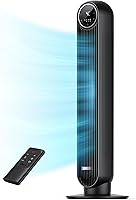
| Tower fan | Tall, narrow footprint | Controls, cleaning access and airflow direction |
| Table or desk fan | Breeze close to one person | Desk space, reach and noise |
| Window fan | Moving air through an open window | Window fit, airflow direction and outdoor conditions |
A ceiling fan stays in one place and moves air from overhead. Compare a ceiling fan vs box fan if you're deciding between fixed overhead airflow and a portable fan.
Box fans and oscillating fans also serve different layouts. Our box fan vs oscillating fan comparison explains how their airflow patterns affect placement.
A window fan can draw air in, exhaust air out or, on some models, do both. The window fan vs box fan guide helps you choose between window airflow and a portable room breeze.
What should you check before buying a fan?
Check the fan's airflow job, physical fit and controls first. A fan that reaches the right spot and has usable settings is easier to live with than one chosen by size or appearance alone.
How much area should an air circulator cover?
Choose a fan that can reach the area where you spend time, with settings you can adjust to your comfort. Check any stated airflow capacity, but remember that a number alone doesn't describe how the breeze will feel in your room.
For a small room or desk, a compact fan may be easier to place. For a large room, garage or workshop, a higher-velocity floor fan may be more appropriate, though it can feel too forceful at close range.
Should you choose fixed or oscillating airflow?
A fixed fan keeps air aimed in one direction. An oscillating fan sweeps airflow across an area, which can suit a room where people sit in different places.
Neither mode is right for every layout. If you want one steady breeze at a desk, fixed airflow may be simpler; if you want airflow to move across several seats, oscillation may help.
Do remote controls, timers and modes matter?
Remote controls are useful when the fan is across the room or placed where reaching its controls is awkward. Timers and multiple modes can also make routine adjustments easier, but check which settings the remote actually controls.
For an existing fan, a remote switch may be an option if it matches the fan and wiring. See our best remote switch for fan guide before buying one.
How important are noise and safety?
Noise matters most in bedrooms, home offices and other spaces where you need quiet. Check whether the fan has speed settings that let you lower airflow, and consider its distance from where you sleep or work.
Keep portable fans on stable surfaces and away from places where cords can trip people. Follow the manufacturer's placement and care instructions, and avoid using a fan in wet conditions unless it is rated for that use.
Which fan works for a window?
Choose a window fan when you want to move air through an open window. Look for a model that fits the window style and size, and decide whether you need intake, exhaust or both.
The Bionaire window fan has independent blade control and can draw in outside air, exhaust indoor air or run both functions at once. It fits double-hung and vertical slider windows 24 to 37 inches wide, and includes a remote control.
The Genesis twin fan has 3 speeds, a built-in thermostat and reversible airflow. Its expandable side panels can extend up to 6.5 inches on each side, and it has removable legs for use standing on its own.
A window fan depends on outdoor conditions. When it's hotter or more humid outside than inside, bringing outdoor air in may make the room less comfortable.
If you are deciding between a fan and an air conditioner, read window fan vs AC. For more models, see our best window fans for cooling guide.
Which fan styles suit common home needs?
Match the fan style to its location: a pedestal fan for adjustable height, a tower fan for a narrow footprint, or a table fan for a nearby breeze. The exact choice depends on clearance, controls and how widely you want airflow to travel.
Is a pedestal fan a good choice for a living room?
A pedestal fan can direct airflow from a taller position, and many models offer height adjustment and oscillation. Measure the base area and check whether the fan can tilt toward the seating area.
Compare a box fan vs pedestal fan when choosing between a flat, portable design and an adjustable stand. If the fan will be your main room fan, our best pedestal fan for home guide covers options for indoor use.
Does a tower fan save floor space?
A tower fan has a tall, narrow shape that can fit beside furniture where a wider fan base may not. Check its height, controls and cleaning instructions, and make sure it can reach the area you want to cool.
If you want to compare styles, see tower fan vs floor fan, tower fan vs pedestal fan and tower fan vs desk fan. For a specific model category, our best oscillating tower fan guide can help you narrow the options.
When is a table fan enough?
A table fan suits a nearby person when you have a stable surface and don't need airflow to reach across a large room. Check its footprint, speed settings and noise where you plan to use it.
For ideas, see our best table fan cooling guide. If you want a portable fan that sweeps across a wider area, compare options in best portable oscillating fan.
What fan works in a bedroom?
A bedroom fan should have settings that suit your preferred airflow and a placement that leaves the walkway clear. Noise is personal, so check for a low setting and consider where the fan will sit relative to the bed.
Our best quiet bedroom fan guide focuses on bedroom use. If you want airflow across more of the room, see best oscillating fans for indoors.
When should you use a floor fan or a box fan?
Use a floor or box fan when you want portable, directed airflow. A floor fan may tilt toward a work area, while a box fan can sit on the floor or fit in some window setups.
The Amazon Basics 20-inch floor fan has a metal housing, 3 speeds and a tilt head. Its stated airflow capacity is 3,542 CFM at high speed, making it a candidate for larger indoor spaces where directed airflow is useful.
For room circulation from a standing position, the Amazon Basics 16-inch pedestal fan has adjustable height, tilt and a remote. It also offers 3 speeds and 3 modes.
See best floor fan for floor models and best 20 inch box fan for box fan options.
A box fan may be easier to carry or store than a pedestal model, depending on its shape and weight. Compare floor fan vs pedestal fan if you want to choose between directed airflow at floor level and adjustable height.
Can fans help with a forced air system?
A fan can move room air, but it does not replace a forced air system. A forced air system uses ducts to distribute heated or cooled air from HVAC equipment.
If a room feels uneven, first check vents and filters, then consider whether a fan can help move air within the space. Our [What Is a Forced Air System?
Plainly Explained](/what-is-a-forced-air-system/) guide explains how ducted heating and cooling works.
A register booster fan is designed to increase airflow at a vent, while a duct booster fan is installed in ductwork. Those options are more specific than a portable room fan, so check compatibility with your HVAC setup.
For a baseboard vent, see register booster fan fit.
For targeted airflow, see our best register booster fan and best duct booster fan guides. A bathroom fan with a humidity sensor serves a separate ventilation role; compare choices in best bathroom fan with humidity sensor.
What other fan features and accessories should you compare?
Compare fan accessories only when they solve a specific fit or control need. For a ceiling fan, parts such as a downrod, light kit or replacement remote must match the fan's model and installation.
For model-specific steps, see how to replace an Artika ceiling fan remote.
A low-profile ceiling fan can suit rooms with limited overhead clearance, while a downrod changes how far the fan hangs from the ceiling. Check your ceiling height and the fan's installation instructions before choosing parts.
Explore best low profile ceiling fans, best 52 inch ceiling fan and best ceiling fans with lights. If you're replacing a part, see best ceiling fan downrod, best universal remote for ceiling fan, best ceiling fan light kit and best ceiling fan blades replacement.
Explore fans by topic
- Best Fans with Remote Controls
- Best Dreo Tower Fans
How do you choose the right fan?
Choose by airflow path, then confirm fit and controls. A window fan moves air through an opening, an oscillating fan sweeps across a room, and a floor or pedestal fan directs airflow where you need it.
- Decide whether you need a personal breeze, room circulation or window air exchange.
- Measure the floor, window or mounting space.
- Choose fixed or oscillating airflow based on where people sit.
- Check speed settings, noise, controls and cleaning access.
- Follow installation and safety instructions for that fan type.
For an outdoor seating area, choose a fan designed for the conditions where it will be used. Our best outdoor oscillating fan guide focuses on that use.
A fan does not make cold air. For more on the difference between airflow and cooling, read tower fans that blow cold air.
Pick a window fan if you want to exchange air through a suitable window, and choose a portable fan when you need directed airflow indoors. For the room-wide options in this guide, start with our best air circulator fan guide.
If your next choice involves indoor humidity, see when to use a warm mist humidifier for a separate guide to warm mist humidifiers.
Frequently asked questions
What is an air circulator fan?
An air circulator fan moves air around a room to help mix warmer and cooler pockets. Fan shape alone does not guarantee circulation; placement, direction, room layout and airflow all matter.
Use a fan that can reach across the space, and adjust it if the breeze feels too strong where you sit.
Is an air circulator different from a regular fan?
Air circulator is a description of what a fan is meant to do: move air through a space. Many pedestal, floor and table fans can also circulate air, while a window fan is designed to move air through an open window.
Compare airflow direction and placement before relying on the label.
Can a fan cool a room?
A fan can make people feel cooler by moving air across their skin, but it does not lower room temperature like an air conditioner. A window fan may exchange indoor and outdoor air when outdoor conditions suit your plan.
Close windows and use air conditioning when outside air is hotter or more humid than indoors.
What size fan should I buy?
Choose a fan based on the area you want to reach, its placement and the airflow you can comfortably tolerate. Check the room layout and the fan's dimensions, controls and stated airflow where available.
A larger or higher-velocity fan can be a poor fit for a small bedroom or desk.
Are box fans or oscillating fans better?
A box fan directs air from a fixed position, while an oscillating fan sweeps its airflow across a wider area. Choose a box fan for a straightforward directional breeze or window placement, and an oscillating model when people sit in different spots.
Room layout and safe placement can change the choice.