Floor Fan vs Pedestal Fan: Which Should You Choose? (November 2026)
Choose a floor fan for strong, low-positioned airflow and a pedestal fan for adjustable height and room-wide comfort. Your available space, preferred airflow level and daily routine should guide the choice.
On this page (10 sections)
- Floor fan vs pedestal fan: what is the main difference?
- Which design gives you stronger airflow?
- Where should each fan stand?
- Which fan suits a bedroom?
- Which fan is easier to control?
- What are the best floor fan choices?
- What are the best pedestal fan choices?
- How should you match the fan to your room?
- How do you set up and care for either fan?
- Floor fan vs pedestal fan: which should you choose?
Choose a floor fan for stronger, low-positioned airflow and a pedestal fan for adjustable height and room-wide comfort. In this floor fan vs pedestal fan comparison, your room layout and preferred airflow matter more than the fan shape alone.
Floor fans sit low and usually aim air across the room, toward a doorway or at a particular hot spot. Pedestal fans raise the fan head above the floor, which can make airflow more useful at bed, desk or seating height.
The 4 products below cover both designs. We compared their airflow capacity, controls, placement options and stated features against common room-cooling needs.
 Best for strong directional airflow
Lasko WINDMACHINE High Velocity Pivoting Floor Fan
Floor fan vs pedestal fan: what is the main difference?
A floor fan gives you direct, low-positioned airflow, while a pedestal fan gives you height and broader positioning options. The right choice depends on where you want the air to travel.
A floor fan works well when you want to move air across a room, push stale air toward an opening or aim a breeze at a work area. Its head is close to the floor, so you need a clear path for the airflow.
A pedestal fan places the fan head higher. That can help direct air over furniture and toward people sitting or lying down, while oscillation can spread the breeze across a wider area.
The distinction is not absolute. The DREO pedestal fan also works as an air circulator, while the Lasko floor fan has a pivoting head for room circulation.
For broader fan basics, see our guide to air circulator fans. It explains how direct airflow differs from whole-room circulation.
Which design gives you stronger airflow?
The floor fans in this comparison offer the highest listed airflow capacities. Choose one when fast, forceful air movement matters more than a raised breeze or remote control.
The Lasko WINDMACHINE has a 20 in blade and a listed airflow capacity of 2000 CFM. Its 3 speeds and 360° pivoting head let you change both airflow strength and direction.
The Amazon Basics 20 in high-velocity floor fan has a listed capacity of 3542 CFM. It also has 3 speeds, a tilt head, metal housing and aluminum blades, making it the strongest airflow choice among these products by the stated capacity.
The DREO pedestal fan has a listed capacity of 1150 CFM. That is lower than the 2 floor fans here, but it offers 9 speeds, 4 modes and horizontal oscillation for more gradual adjustment.
The Amazon Basics 16 in pedestal fan does not include an airflow capacity in the supplied product facts. It has 3 speeds, 3 modes and a 60W AC motor for everyday indoor airflow.
If you are also weighing a box fan, our box fan vs pedestal fan comparison covers the differences in shape, placement and airflow direction.
Where should each fan stand?
Use a floor fan on open floor space where its low airflow can travel freely, and use a pedestal fan where height helps clear furniture. Measure the placement area before choosing.
The Lasko measures 23.8 in deep, 7.1 in wide and 25.1 in high. Its low, stand-alone shape suits a floor position beside a wall, near a doorway or in front of an open area.
The Amazon Basics high-velocity floor fan measures 23.43 in wide, 9.45 in deep and 23.82 in high. Its free-standing design and tilt head make it practical for a garage, gym or large indoor work area.
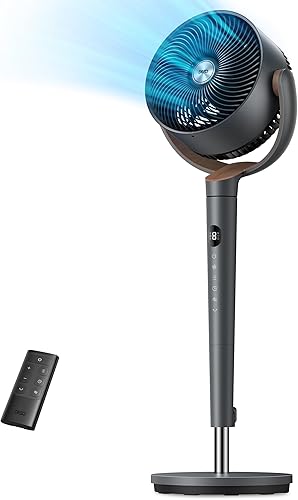
The DREO pedestal fan measures 11.08 in deep, 11.81 in wide and 42 in high. Its height adjusts from 37 to 42 in, so you can change the fan head position as your room setup changes.
The Amazon Basics 16 in pedestal fan measures 15.75 in deep, 17.72 in wide and 53.15 in high. It takes more vertical space and has a wider stated footprint than the DREO.
A floor fan may fit below a desk or beside a low piece of furniture, but the airflow path can be blocked easily. A pedestal fan needs more open vertical space and a stable base, especially when placed near a walkway.
Which fan suits a bedroom?
A pedestal fan is usually the better bedroom choice when you want raised airflow, a remote or timed adjustments. A floor fan can still work well if you prefer strong airflow aimed across the room.
The DREO is designed for bedroom use and has a remote control, 9 speeds, 4 modes and an 8-hour timer. Its horizontal oscillation can cover a wider area, while its vertical tilt is adjusted manually.
The Amazon Basics 16 in pedestal fan also suits bedrooms, living rooms and offices. It includes a remote control, adjustable height, a tilt head, 3 speeds, 3 modes and a timer.
A floor fan may suit you if the bed is near an open floor area and you want airflow directed at a specific angle. The Lasko has a 360° pivoting head, while the Amazon Basics high-velocity model has an adjustable tilt head.
For another design comparison, read tower fan vs floor fan if you need to balance low placement against a slimmer upright form.
Which fan is easier to control?
Pedestal fans offer the strongest control convenience here because both pedestal models include remote controls. Floor fans give you direct manual adjustment at the unit.
The DREO uses a remote control and also has a large LED display. Its 9 speeds and 4 modes give you more adjustment steps than the other products in this comparison.
The Amazon Basics 16 in pedestal fan uses a remote control with 3 speeds, 3 modes and timer settings. Its controls suit everyday room cooling when you want to adjust the fan without standing up.
The Lasko uses manual controls and has 3 speeds. That keeps operation direct, but you need to reach the fan to change the setting.
The Amazon Basics high-velocity floor fan uses push-button controls and has 3 power levels. It suits a work area where the fan can stay within easy reach.
If you are choosing between 2 upright designs, our tower fan vs pedestal fan comparison explains how height, oscillation and room placement differ.
What are the best floor fan choices?
The Lasko WINDMACHINE is the better floor fan for strong airflow with flexible direction, while the Amazon Basics high-velocity model is better for the highest listed airflow and metal construction.
The Lasko WINDMACHINE has a gray plastic body, a 20 in blade and a listed noise level of 44 dB. Its carry handle makes it easier to move between indoor rooms, and it includes the fan and user manual.
Choose it when you want a floor fan that can aim air in many directions. Its 2000 CFM capacity is substantial for home cooling, while the pivoting head gives you more placement flexibility than a fixed low breeze.
Read why a floor fan can be loud if noise is a major concern. Fan position, speed and the room surface can all affect how noticeable airflow sounds.
The Amazon Basics 20 in high-velocity floor fan has a black aluminum construction, 3 blades and 3 speeds. It uses push-button controls and has a free-standing design.
Choose it when the main goal is moving a large volume of air. The 125W rating and industrial form make it a more heavy-duty choice, but it does not provide pedestal height or remote control.
The tilt head lets you aim airflow upward or downward. Measure the space around the fan before placing it so the metal body and power cord do not create an obstruction.
What are the best pedestal fan choices?
The DREO is the better pedestal fan for fine speed control and quiet bedroom circulation, while the Amazon Basics 16 in model suits simple everyday cooling with a remote.
The DREO has a gray plastic body, a plastic blade and a 1150 CFM airflow capacity. Its brushless DC motor operates quietly at low speeds, according to the product information, and the fan includes a remote.
Choose it when you want more speed steps than a basic 3-speed fan. The adjustable height helps you position airflow around a bed, desk or seating area, while horizontal oscillation spreads the breeze.
The vertical tilt is adjusted manually, so set the up-and-down angle before settling into your routine. Its 8-hour timer can also suit bedroom use when you do not want the fan running continuously.
The Amazon Basics pedestal fan has a black metal and plastic body with dual-layered plastic blades. It has a 15.75 in depth, 17.72 in width and 53.15 in height.
Choose it when you want familiar controls without the extra speed options of the DREO. Its remote can adjust speed, mode and timer settings, while the oscillating function helps circulate air around an indoor room.
The taller maximum height can help clear some furniture, but it also means you need enough vertical clearance. Check the space above and around the fan before placing it near shelves, curtains or doors.
How should you match the fan to your room?
Match the fan to the airflow path first, then check height, controls and placement space. A powerful fan cannot help much if furniture blocks the direction you need.
For a garage, gym or large work area, the Amazon Basics high-velocity floor fan offers the highest listed airflow capacity. The Lasko is a better fit when you want strong airflow with a 360° pivoting head and a carry handle.
For a bedroom, the DREO offers the most speed settings and a stated height range of 37 to 42 in. The Amazon Basics 16 in pedestal fan is a simpler choice with 3 speeds, 3 modes and a remote.
For a desk or seating area, a pedestal fan can place the airflow at a more useful height. For a low doorway or floor-level hot spot, a floor fan can aim air directly across the open space.
If you need both cooling and warmth in one appliance, compare the options in best floor fan and heater combos. A ceiling fan heater is another room-level option, but it uses a different installation approach.
How do you set up and care for either fan?
Place either fan on a stable indoor surface, keep its airflow path open and follow the operating instructions for its exact model. Unplug the fan before cleaning or moving it.
Keep cords away from walkways and avoid placing a fan where it can be knocked over. Do not block the front or rear airflow openings with furniture, fabric or stored items.
Clean dust from the exterior and guard with a suitable dry or slightly damp method. Keep moisture away from electrical controls and allow surfaces to dry before reconnecting power.
The Lasko includes a user manual, while the DREO and Amazon Basics pedestal fan include remote controls. The Amazon Basics high-velocity model includes a cord.
Keep each included item with the fan so controls and setup information remain available.
If a floor fan develops a motor problem, our guide to floor fan motor replacement explains what to check before deciding whether repair makes sense.
Floor fan vs pedestal fan: which should you choose?
Pick a floor fan if you want stronger direct airflow, low placement or a pivoting head. Pick a pedestal fan if you want raised airflow, remote control, oscillation or adjustable height.
Choose the Lasko WINDMACHINE for strong directional airflow with a 20 in blade and 2000 CFM capacity. Choose the Amazon Basics high-velocity model when its 3542 CFM capacity and metal construction fit your larger indoor space.
Choose the DREO for bedroom-friendly adjustment, 9 speeds and adjustable height. Choose the Amazon Basics 16 in pedestal fan for straightforward remote-controlled comfort with 3 speeds, 3 modes and a 60W AC motor.
The best floor fan vs pedestal fan choice is the one that places air where you need it without blocking the room. Mark the fan's footprint, identify the airflow path and then choose the design that fits your daily routine.
Frequently asked questions
Is a floor fan or pedestal fan better?
A floor fan is better for strong airflow aimed across a room or toward a hot spot, while a pedestal fan is better when you want the breeze raised to bed, desk or seating height. Choose the floor design for power and the pedestal design for height and oscillation.
Which takes up less space, a floor fan or pedestal fan?
A floor fan usually keeps its height low but may have a wide body, while a pedestal fan uses vertical space and needs a stable base. Compare the full dimensions, not just the fan head, and leave room for airflow, controls and safe movement around the unit.
Can a floor fan cool a bedroom?
Yes, a floor fan can cool a bedroom when you aim its airflow across the room or toward the bed. A pedestal fan may be easier for bedroom use if you want remote control, oscillation, adjustable height or lower-speed airflow near the sleeping area.
Do pedestal fans move as much air as floor fans?
Some pedestal fans move substantial air, but the models compared here vary widely. The DREO has a listed capacity of 1150 CFM, while the Lasko floor fan has 2000 CFM and the Amazon Basics high-velocity floor fan has 3542 CFM.