Tower Fan vs Pedestal Fan: Which Should You Choose? (November 2026)
Choose a tower fan for a slim footprint and a pedestal fan for adjustable height and aim. In a tower fan vs pedestal fan comparison, airflow direction and where you have room matter as much as fan style.
On this page (7 sections)
Choose a tower fan for a slim footprint and a pedestal fan for adjustable height and aim. In a tower fan vs pedestal fan comparison, airflow direction and where you have room matter as much as fan style.
A tower fan has a tall, narrow body that can fit beside a desk or bed. For a desk-size alternative, see tower fans vs desk fans.
If you're comparing cooling options, see window fan vs AC.
A pedestal fan puts its fan head on a stand, which can help you direct airflow from a particular height.

Tower fan vs pedestal fan: which should you choose?
Pick a tower fan when floor space is limited; pick a pedestal fan when height and tilt matter more. Either type can oscillate, so compare the controls and movement on the model you plan to use.
A slim tower can sit near a wall or furniture without a wide head above its base. A pedestal fan has a larger head that may need more clearance as it turns.
For a general look at fan styles and airflow, see our guide to air circulators. If you're comparing other shapes, our tower fan vs floor fan guide covers another common choice.
How much space does each fan need?
Tower fans usually need less floor area, while pedestal fans need room for their base and moving head. Measure the spot and the full arc where the fan will oscillate.
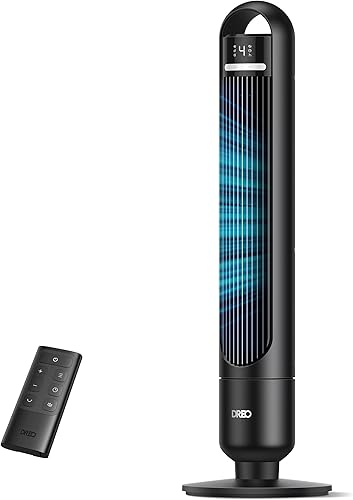
The DREO tower fans here have bases measuring 11.81 inches square and 8.03 inches square. The DREO pedestal fan measures 11.08 inches deep by 11.81 inches wide, but its head extends above the stand.
These dimensions are for the fan bodies, not a recommended clearance zone. Leave enough space for stable placement, safe movement around the fan, and any oscillation.
Is a tower fan better in a small room?
A tower fan can work well in a small room when you need airflow from a narrow corner. For what a tower fan can do about air temperature, see whether tower fans blow cold air.
Its vertical shape may be easier to place beside furniture than a wide fan head.
The DREO tower fan with the narrower base has an 8.03-inch square footprint. Consider where its air outlet will face, since a narrow base does not help if a wall or cabinet blocks the airflow.
Does a pedestal fan need more clearance?
A pedestal fan needs space around its head if you use oscillation. It also needs enough floor room for its base and the path people use through the room.
A compact base does not mean the fan head is compact. Check the full area it sweeps and keep the blades and grille away from curtains, bedding and furniture.
Which fan gives you more control over airflow?
Pedestal fans generally offer more control over height and direction, while tower fans give you a fixed-height stream with oscillation. Check the specific adjustments rather than assuming every model has the same controls.
The DREO pedestal fan adjusts from 37 to 42 inches, tilts vertically by hand, and oscillates horizontally. The Amazon Basics pedestal fan also has adjustable height and a tilt head.
The tower fans have 90° oscillation. They stand at fixed heights of about 36 inches, so you can't raise or lower their air outlet to match a chair or bed.
When does adjustable height help?
Adjustable height helps when the fan needs to direct air over a desk, toward a seated person or across a bed. It also lets you change the airflow position without moving the fan base.
The DREO pedestal model has 120° of manual vertical tilt and 120° horizontal oscillation. Its height range is 37–42 inches, which gives you more positioning choices than a fixed-height tower.
If you want a specific pedestal model with broad adjustment, read our Woozoo 360 pedestal fan reviews. Check the model's controls and dimensions against your room before choosing.
Can a tower fan direct air at a bed or desk?
A tower fan can direct air toward a bed or desk if its fixed outlet height lines up with the target. Rotate or reposition the body, then use oscillation if you want air to sweep across a wider area.
If the outlet sits too low or too high for your setup, a tilt-adjustable pedestal fan may give you more control. Place either fan where the airflow reaches you without blowing directly into papers or loose fabric.
How do their airflow and speed settings compare?
The listed airflow capacities for these DREO examples are close, so shape alone doesn't identify a stronger fan. Room layout, fan position and your preferred breeze also affect what you feel.
The DREO tower lists 1,158 CFM, while the DREO pedestal lists 1,150 CFM. These numbers are close and don't tell you how evenly air will reach each part of your room.
The tower models offer 8 and 4 speeds, respectively. The DREO pedestal has 9 speeds, while the Amazon Basics pedestal has 3, so the right range depends on how finely you want to adjust the breeze.
Does oscillation matter more than fan shape?
Oscillation matters when you want airflow to move across more than one spot. The DREO tower models turn through 90°, and the DREO pedestal model has 120° horizontal oscillation.
A wider sweep can reach more positions, but it doesn't guarantee even airflow around a room. Think about where you sit and sleep, then aim the fan so it moves air through the useful part of the space.
If you're looking at airflow from a vent, see battery-powered register booster fans.
If you'd like to compare a box fan's broad face with a pedestal fan's adjustable head, see box fan vs pedestal fan. For more fan comparisons, our floor fan vs pedestal fan guide covers height and placement.
Is more speed always better?
More speed settings give you more steps between a gentle breeze and stronger airflow. They don't guarantee more airflow at the top setting, and they don't tell you how quiet a fan will be.
The DREO pedestal has 9 speeds, while the Amazon Basics pedestal has 3. The DREO tower options have 8 and 4 speeds, so compare the exact controls if you regularly adjust a fan through the day.
Which fan is easier to clean and maintain?
Choose a fan whose grille and controls you can keep clean with the care method in its manual. Fan shape doesn't tell you how easily its interior can be reached.
The DREO tower fan has a removable rear grille and impeller for cleaning. The listed information for the pedestal models doesn't specify a matching removable-grille design, so check their care instructions before buying if access matters to you.
Dust can collect on either kind of fan, especially around the grille and base. Unplug it before cleaning and follow the manual, keeping liquids away from the motor and controls.
Which fan suits a bedroom?
For a bedroom, compare speed controls, oscillation, outlet height and the sound level that matters to you. No fan style is automatically quieter in every room.
The DREO tower model with 4 speeds lists a 28 dB noise level, while the other DREO tower model offers a Sleep mode. The DREO pedestal fan is described as quiet at low speeds, but no sound figure is given here.
The Amazon Basics pedestal includes a remote, so you can adjust speed, mode and timer without getting up. Choose based on the controls you'll use at night and whether its head can aim where you sleep.
Which fan is right for your room?
Choose a tower fan if a narrow footprint and fixed-height airflow suit your space; choose a pedestal fan if you need adjustable height or tilt. Compare the base, sweep and controls before deciding.
For a narrow spot and several speed choices, consider the DREO Tower Fan for Bedroom no, the tower fan's product box is below. If you want a pedestal fan with a slim base and broad angle adjustment, the DREO Pedestal Fan for Bedroom is a relevant option.
For another adjustable pedestal option, compare the Amazon Basics box fan range only if you are considering a box fan instead. A box fan with remote control or a box fan with stand may suit a different room setup, but check its placement and controls before buying.
Pick a tower fan for compact placement and a pedestal fan for more control over airflow height and angle. If you're still deciding between a tower and another low-profile design, use our tower fan vs floor fan comparison to narrow the choice.
Frequently asked questions
Is a tower fan better than a pedestal fan?
A tower fan is a better fit when floor space is tight and you want a slim profile. A pedestal fan is a better fit when you need adjustable height or want to tilt the head toward a bed, chair or desk.
Room layout and airflow direction decide which works better.
Which fan moves more air, a tower fan or a pedestal fan?
Fan shape alone doesn't determine airflow. These DREO models list airflow capacities of 1,158 CFM for the tower and 1,150 CFM for the pedestal, but those figures don't show how air will feel from your seat or across your particular room.
Do tower fans take up less space?
Tower fans often have a narrow footprint, and the DREO tower models here have bases measuring 11.81 inches square and 8.03 inches square. Pedestal fans need a round or broad base and space for their head to oscillate, so measure the whole area you'll use.
Can you adjust the height of a tower fan?
The tower fans in this comparison have fixed heights, while the DREO pedestal fan adjusts from 37 to 42 inches. If airflow needs to reach a specific height, a pedestal model with height adjustment may be easier to position.
Are pedestal fans easier to aim?
Pedestal fans are often easier to aim because their heads can tilt, and some let you change the height as well. The Amazon Basics model has adjustable height and a tilt head, while the DREO pedestal fan also has manual vertical tilt and horizontal oscillation.