Convection Heater vs Baseboard Heater: Which to Choose? (November 2026)
Pick a portable convection panel heater for flexible, room-by-room warmth and a baseboard heater for permanent, low-profile heat along a wall. In this convection heater vs baseboard heater comparison, your room, power outlet and need to move the heater decide the winner.
On this page (14 sections)
- Convection heater vs baseboard heater: what is the real difference?
- Quick verdict: which should you choose?
- Side by side: the four picks compared
- Portable convection heat: the De'Longhi panel
- Plug-in baseboard heat: the Comfort Zone 1500W units
- Permanent baseboard heat: the Cadet F Series
- Output and room size: how much heat do you need?
- Controls and timers: daily comfort decides
- Noise, airflow and fan vs natural convection
- Setup, placement and care in daily use
- Safety features that matter in bedrooms and offices
- Cost to run and zone heating
- Who should buy which?
- Verdict: convection heater vs baseboard heater
Pick a portable convection panel heater for flexible, room-by-room warmth and a baseboard heater for permanent, low-profile heat along a wall.
In this convection heater vs baseboard heater comparison, your room, power outlet and need to move the heater decide the winner.
The De'Longhi DeLonghi Convection Panel Heater is a portable 1500W panel that can stand on the floor or mount on a wall. The Cadet F Series 36" Electric Baseboard Heater is fixed along a wall and runs at 750 watts on 240 volts.
 Best for portable flexibility
De'Longhi DeLonghi Convection Panel Heater
 Best for low-profile plug-in heat
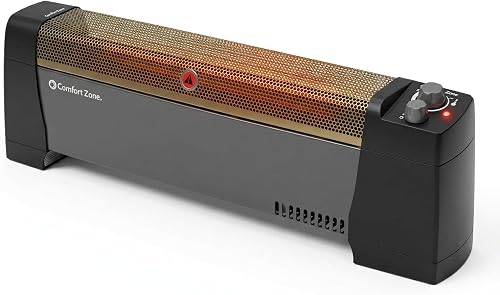
COMFORT ZONE Convection Baseboard Space Heater
Convection heater vs baseboard heater: what is the real difference?
A convection heater moves warm air through natural circulation, while a baseboard heater is a fixed low unit that also uses convection to warm a room from the wall line.
Many baseboard units are convection heaters by method, so shape and setup matter more than the label.
The De'Longhi panel uses a dual lateral fan system to move air more evenly. Comfort Zone baseboard units use natural air circulation for even warmth.
Choose by placement first. A portable convection heater follows you to a bedroom, office or basement.
A baseboard heater stays in one room as part of the wall line.
Our guide to a space heater for home helps you match output and placement to room size before you choose a shape.
Quick verdict: which should you choose?
Choose the De'Longhi panel for flexibility and the Cadet for installed baseboard heat.
The two Comfort Zone units sit between them as plug-in baseboard options with simpler controls.
If you rent, move furniture often or need heat in more than one room, a portable panel wins. You can carry it to the room you use at night and store it when the season ends.
If you own the home and want heat in one room without cords across the floor, an installed baseboard heater wins. The Cadet is 36 inches long and mounts at the baseboard line.
If you want baseboard shape without wiring work, the plug-in Comfort Zone units are the middle path. They sit low along a wall and plug into a standard outlet.
Side by side: the four picks compared
The De'Longhi leads on controls and flexibility, while the Cadet leads on permanent installation.
Power alone does not settle the choice, because placement and wiring change how each unit fits your home.
| Model | Power | Coverage listed | Controls | Placement |
|---|---|---|---|---|
| De'Longhi Convection Panel Heater | 1500W | Small to medium spaces | Digital thermostat, timer | Freestanding or wall mount |
| COMFORT ZONE Convection Baseboard Space Heater | 1500 watts | 150 sq. ft. | Manual dial, 2 settings | Floor, baseboard shape |
| Cadet F Series 36" | 750/563 Watt | 125 sq ft | Wall thermostat use | Fixed baseboard mount |
| Comfort Zone Electric Baseboard Space Heater | 1500W | 300 sq. ft. | Adjustable thermostat, 2 settings | Floor, baseboard shape |
Read coverage figures with care. Each maker lists coverage in its own way, so treat the numbers as a guide for room size rather than a promise for every layout.
A room with high ceilings, a leaky door or a cold exterior wall may need more heat than the same square footage with good insulation.
Portable convection heat: the De'Longhi panel
The De'Longhi DeLonghi Convection Panel Heater is the best pick when you want portable convection heat with a wall-mount option.
It is a white 1500W panel, model HCX9115E, built for medium to large rooms. You can use it freestanding on pre-assembled feet or mount it with the included kit, which helps when floor space is tight.
Controls are digital, with an adjustable thermostat, multiple heat settings and a delayed on/off 24-hour timer. The ECO PLUS function adjusts heat and power for comfort and economy.
Safety features include a thermal shutoff and an internal tip-over switch that turns the unit off if it falls over. Cool-touch controls let you move it during or after use.
For basements or vacation homes, the anti-freeze setting switches on below 41 degrees F to help protect pipes. See our roundup of best convection heaters wall mounted for more panel styles.
Plug-in baseboard heat: the Comfort Zone 1500W units
The two Comfort Zone plug-in units give you baseboard shape without permanent wiring.
Both are 1500W, both sit low along a wall, and both use convection for even warmth.
The COMFORT ZONE Convection Baseboard Space Heater, model CZ600BK, lists 150 sq. ft. coverage. It has 2 heat settings and a manual thermostat dial that is simple to use.
Its housing is designed to stay cool to the touch while operating. Dent-resistant end panels protect the ends from bumps and daily wear.
The weighing in at 1500W with 2 heat settings and an adjustable thermostat. It is described for medium-sized rooms with quiet operation.
Both units include a tip-over cutoff switch and overheat protection. Those safety features matter most in bedrooms, where a heater may run for hours while you sleep.
The main trade-off is floor space. A 29-inch baseboard unit needs a clear stretch of wall.
Measure that stretch before you order, and keep bedding and curtains back from the front.
Permanent baseboard heat: the Cadet F Series
The Cadet F Series 36" Electric Baseboard Heater is the pick for fixed, installed baseboard heat.
It is 36 inches long, white, and runs at 750 watts on 240 volts or 563 watts on 208 volts. Output is 2560/1925 BTU, with listed coverage of 125 sq ft.
Installation uses universal wiring and pre-punched knockouts to simplify mounting along a baseboard. It still requires permanent wiring.
Because it is fixed, there is no cord across the floor and no unit to carry between rooms. That is the core advantage over portable convection heat.
The trade-off is commitment. You need the right voltage and a suitable wall location.
A 750W unit may be light for a large or drafty room. See our guide to best baseboard heaters with thermostat for control options.
Output and room size: how much heat do you need?
Match watts to room size and heat loss, not to the heater shape.
A 1500W unit at full heat draws more power per hour than a 750W unit, so it can warm a larger area faster.
The De'Longhi panel lists small to medium spaces at 1500W. The Comfort Zone CZ600 lists 300 sq. ft., the CZ600BK lists 150 sq. ft., and the Cadet lists 125 sq ft at 750 watts.
That lower Cadet output reflects a fixed unit meant to run steadily in one room rather than boost heat quickly.
A small bedroom with a closed door needs less heat than an open living room with tall ceilings. Runtime also matters.
A baseboard heater suits a room used all day, while a portable panel with a timer suits use at set times. Our guide to the best baseboard heaters with thermostat 120v helps if a 120-volt plug-in setup fits better than a 240-volt installed unit.
Controls and timers: daily comfort decides
Digital controls with a timer suit portable use, while a simple dial suits a heater that stays in one room.
The De'Longhi has the most control features of the four picks. It offers digital controls, an adjustable thermostat, multiple heat settings and a delayed on/off 24-hour timer.
The ECO PLUS function adjusts settings automatically for comfort and economy.
The Comfort Zone units have 2 heat settings and a manual or adjustable thermostat. That is enough for many users who set a level and leave it.
The Cadet is a fixed heater. Its comfort control depends on the thermostat you pair with it during installation, rather than controls built into the unit.
Timers help with safety and cost. A heater that shuts off on schedule is less likely to run all day in an empty room.
Manual dials help with simplicity. If you dislike menus and digital panels, the Comfort Zone dial is easier to explain to anyone in the house.
Noise, airflow and fan vs natural convection
Natural convection is quieter than fan-forced heat, but some convection panels add a fan to spread air faster.
The De'Longhi uses a dual lateral fan system to improve heat distribution. That fan helps warm a room faster and move air more evenly.
It also means the panel is not purely silent, even though it is marketed for quiet room use.
The Comfort Zone baseboard units rely on natural air circulation. Their quiet operation suits bedrooms and offices where fan noise can be distracting.
If you are comparing fan-based heat, our convection heater vs fan heater guide explains when a fan helps and when natural circulation is enough.
Airflow also affects placement. Keep vents and intake areas clear so warm air can rise and circulate through the room.
Setup, placement and care in daily use
A portable panel needs the least setup, while a fixed baseboard heater needs the most planning.
The De'Longhi arrives with pre-assembled feet and a wall-mount kit. You can set it on the floor in minutes or mount it where it stays out of the way.
The plug-in Comfort Zone units need a clear floor spot along a wall and a nearby outlet. Their cords are part of the setup, so plan the route to avoid walkways.
The Cadet needs permanent wiring to a 240-volt or 208-volt circuit. That work should be done by a qualified person, and the location should be chosen before the wall is opened.
For any electric heater, keep the front clear. Bedding, curtains, papers and clothing should stay away from the unit while it runs.
Dust the heater when it is off and cool. Keep the vents clear so air can circulate and the overheat protection is less likely to trip.
Safety features that matter in bedrooms and offices
Look for tip-over shutoff and overheat protection on any heater you run unattended.
All four models here include at least one of those safety features.
The De'Longhi has a thermal shutoff and an internal tip-over switch. The Comfort Zone units have tip-over switches and overheat protection sensors.
The Comfort Zone units also have stay-cool housings or bodies. That design reduces burn risk if someone brushes against the unit.
Safety features do not replace clearances. Follow the manual for distance from walls, furniture and fabrics, and never cover a heater.
Use the heater on a stable surface. A panel on uneven feet or a baseboard unit crowded by furniture cannot work as designed.
For bedrooms, choose quiet operation and simple controls. A heater that cycles on and off at a set temperature is easier to live with than one that needs constant adjustment.
Cost to run and zone heating
Zone heating one room usually costs less than turning up heat for a whole home.
A portable heater lets you lower the main heat and warm only the room you use. That strategy works best at night and in daytime work areas.
Running cost still follows watts and hours. A 1500W heater at full heat uses more electricity per hour than a 750W heater at full heat.
Thermostats and timers help control that cost. Set the temperature you need, then let the heater cycle rather than running at full heat all day.
The De'Longhi ECO PLUS function and timer support that approach. The Comfort Zone thermostats let you hold a steady level in one room.
Fixed baseboard heat can also zone a room, but it stays in that room. If your needs change by season, a portable panel adapts more easily.
Who should buy which?
Buy the De'Longhi panel if you want portability, the Cadet if you want installed heat, and a Comfort Zone if you want plug-in baseboard shape.
That rule covers most homes.
Choose the De'Longhi panel if you rent, move often or need heat in several rooms. Its wall-mount option also suits a small bedroom or office.
Choose the Cadet F Series if you own your home and want a fixed heater along a baseboard, with steady heat and no cord to move.
Choose the COMFORT ZONE Convection Baseboard Space Heater for a simple manual dial, low-profile shape and 150 sq. ft. coverage for a smaller room.
Choose the Comfort Zone Electric Baseboard Space Heater for 1500W quiet heat in a bedroom or office, with 300 sq. ft. coverage for a medium room.
Avoid a fixed unit if you are unsure about wiring or voltage. Avoid a portable panel if you have no safe floor or wall spot with a clear outlet nearby.
Verdict: convection heater vs baseboard heater
In this convection heater vs baseboard heater match, portability wins for most renters and installed heat wins for most owners.
The right answer depends on where the heater will live and how you use the room.
If you need heat that follows you, the De'Longhi panel is the strongest pick. It offers 1500W, freestanding or wall-mount use, a timer and an anti-freeze setting.
If you need heat that stays put, the Cadet F Series is the clearest pick. It mounts along a baseboard and provides steady convection heat in one room.
If you want baseboard shape with plug-in simplicity, the Comfort Zone units are solid middle options. They trade advanced controls for a simple dial and quiet natural circulation.
Measure your wall or floor space, check your outlet or voltage, and choose the placement first. Then match watts to the room size.
Frequently asked questions
Is a convection heater better than a baseboard heater?
A convection heater is better when you need portability and easy rollout setup. A baseboard heater is better when you want permanent, low-profile heat in one room.
The De'Longhi panel moves or mounts, while the Cadet is fixed along a wall.
Can a baseboard heater heat a whole room?
A baseboard heater can heat a room when sized to the space and run long enough for convection air to circulate. The Comfort Zone CZ600 is 1500W and lists 300 sq. ft. coverage, while the Cadet F Series is 750 watts and lists 125 sq ft.
Which is safer, a convection heater or a baseboard heater?
Both can be safe when you follow clearances and safety features. The models here include tip-over switches, overheat protection and stay-cool housings on some units.
Keep curtains, bedding and papers away from any electric heater.
Do convection heaters cost less to run than baseboard heaters?
Running cost depends on watts, hours and thermostat use more than shape alone. A 1500W unit uses more power per hour than a 750W unit at full heat.
Zone heating one room can cost less than heating a whole home.