9 Best Baseboard Heaters with Thermostats (November 2026)
The best baseboard heaters with thermostat include the Cadet Double Pole Line Voltage Thermostat for replacing a wall thermostat, the COMFORT ZONE Convection Baseboard Space Heater for a plug in bedroom heater, and the Honeywell Home 5-2 Day Programmable Thermostat Electric for weekday and weekend schedules.
On this page (8 sections)
- The best baseboard heaters with thermostats for different setups
- How the best baseboard heaters with thermostat compare
- Are baseboard heaters with thermostats safe in a bedroom?
- Which thermostat type fits your wiring?
- How much wattage do you need for your room size?
- Plug in baseboard heater or hardwired baseboard heater: which is better?
- How do you install and care for a baseboard heater with a thermostat?
- Verdict: which baseboard heater with thermostat should you buy?
The best baseboard heaters with thermostat for most homes are a hardwired Cadet heater paired with a wall thermostat, or a 1,500 watt plug in baseboard unit with a built in dial. Hardwired systems give steady heat along a wall, and plug in units give movable zone heat for one room.
Our score weighs specs, features and buyer feedback against what you are shopping for.
Baseboard heat warms a room by convection, so air near the floor rises and circulates. That makes it a good fit for a space heater for home when you want low, silent warmth along a wall rather than a fan blowing across the room.
We compared complete plug in units, hardwired heaters without controls, and standalone thermostats. Some picks are heaters, and some picks are the thermostats that control hardwired heaters, so read the badge and specs before you choose.
Our picks at a glance
-
1
 Best for replacing a wall thermostat
Cadet Double Pole Line Voltage Thermostat
9.6/10 our score
See it on Amazon -
2
 Best for a plug in bedroom heater
COMFORT ZONE Convection Baseboard Space Heater
9.6/10 our score
See it on Amazon -
3
 Best for weekday and weekend schedules
Honeywell Home 5-2 Day Programmable Thermostat Electric
9.5/10 our score
See it on Amazon
- 4
 Check it
Cadet F Series 36 in Electric Baseboard Heater
Best for a hardwired wall installation - 5
 Check it
Comfort Zone Electric Baseboard Space Heater
Best for quiet plug in heat - 6
 Check it
Mysa Smart Thermostat LITE for Electric Baseboard
Best for app and voice control - 7
 Check it
YeloDeer 240V Only 4-Wire Manual Electric Baseboard
Best for a simple 240 volt dial - 8
 Check it
Cadet Single Pole Built-In Thermostat Kit
Best for Cadet F Series heaters - 9
 Best for a portable baseboard unitCheck it
The best baseboard heaters with thermostats for different setups
The top picks split into two groups. Wall thermostats control permanent hardwired heat, and plug in baseboard heaters carry their own dial.
Choose the group that matches your wiring and room plan first.
Cadet Double Pole Line Voltage Thermostat: Best for replacing a wall thermostat
- Double pole, 4-wire design
- 22 amp rating
- 40 to 80 degree dial
- For 120, 208 and 240 volt heaters
A simple mechanical wall control for hardwired baseboard, wall and convector heaters. It switches both legs of the circuit when heat cycles off.
Pros
- Handles up to 5,280 watts at 240 volts
- No batteries or programming
- Positive off position
Cons
- Wall mounted, so it needs line voltage wiring
- Only manual dial control
The Cadet Double Pole Line Voltage Thermostat suits a home that already has hardwired baseboard, wall or convector heaters. It is a wall control, not a heater, so it works best as a replacement for an old or failing thermostat.
Its double pole design switches both legs of the circuit when heat cycles off. That adds safety compared with a single pole control, and the mechanical dial needs no batteries or programming.
Cadet rates it for 22 amps, with up to 5,280 watts at 240 volts or 2,640 watts at 120 volts.
The dial runs from 40 to 80 degrees Fahrenheit with a tight 3 to 6 degree comfort range. That narrow swing helps hold a room steady instead of letting it drift far above and below your setting.
A positive off position shuts the connected heater down completely.
Color-coded wires and a standard wall box make this a DIY replacement for many homeowners. Still, line voltage wiring carries risk, so follow local code and call an electrician if you are unsure.
It suits homes, apartments, offices and workshops where a clean white non-programmable control is enough.
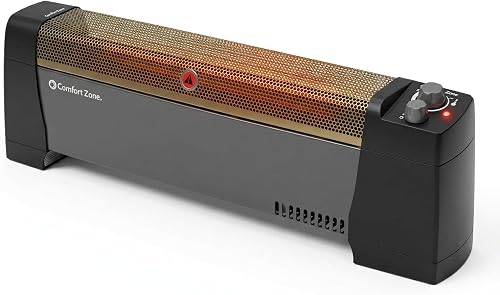
COMFORT ZONE Convection Baseboard Space Heater: Best for a plug in bedroom heater
- 1,500 watts
- Manual thermostat dial
- 2 heat settings
- Tip-over cutoff and overheat protection
A low profile plug in baseboard heater that uses natural air circulation. It suits a bedroom or office that needs targeted heat.
Pros
- Built in manual thermostat
- Stay-cool housing
- Dent-resistant end panels
Cons
- Plug in cord limits placement
- Only 2 heat settings
The COMFORT ZONE Convection Baseboard Space Heater suits a bedroom, living area or office that needs plug in heat. It sits flat along a wall and uses natural air circulation for even warmth.
Its manual thermostat dial and 2 heat settings let you set a temperature and switch power level. At 1,500 watts and 12.5 amps, it draws standard corded heater power for a listed 150 sq. ft. coverage.
That size fits one person or a small seating area better than a whole open plan room.
Dent-resistant end panels help it survive bumps from daily use. The stay-cool housing keeps the casing safe to touch while it runs, and a tip-over cutoff switch shuts power off if it is knocked over.
An overheat protection sensor also powers the unit down at unsafe internal temperatures.
The trade-off is placement. A cord means it stays near an outlet, and manual control means no schedule or remote change.
For temporary zone heat, that simple setup is often the point, since you can move it to the room you use that night.
Honeywell Home 5-2 Day Programmable Thermostat Electric: Best for weekday and weekend schedules
- 5-2 day programming
- 240 volt line voltage use
- 3,500 watts at 240 volts
- Silent TRIAC switching
A digital programmable control for electric baseboards, convectors and fan-forced heaters. It gives separate weekday and weekend schedules.
Pros
- 4 program periods per day
- Backlit display
- Temporary temperature override
Cons
- 240 volt only
- Needs a compatible line voltage circuit
The Honeywell Home 5-2 Day Programmable Thermostat Electric suits a 240 volt hardwired system with a set weekday and weekend routine. It controls electric baseboards, convectors, fan-forced heaters and radiant ceilings within its load limits.
Its 5-2 day programming gives separate weekday and weekend schedules, with 4 periods per day for wake, leave, arrive and sleep. You can lower heat while you are out and warm the room before you return.
A temporary bypass lets you change temperature without changing the saved program.
Honeywell Home rates this control for 3,500 watts at 240 volts and 14.6 amps resistive load. That limit matters, so check the total heater wattage on the circuit before you buy.
TRIAC switching gives silent operation and helps avoid temperature swings.
The 2-wire non-polarized connection keeps installation simpler than a 4-wire control. A backlit display and instructions inside the front panel help with programming.
The trade-off is clear: this is 240 volt line voltage only, and it will not control a central heating system or a system driven by a contactor or relay.
Cadet F Series 36 in Electric Baseboard Heater: Best for a hardwired wall installation
- 36 inch length
- 750 watts at 240 volts
- Convection heat
- Universal wiring and pre-punched knockouts
A 36 inch hardwired baseboard heater for steady convection warmth along a wall. Pair it with a separate line voltage thermostat.
Pros
- Low profile wall design
- Simple wiring with knockouts
- Limited lifetime warranty
Cons
- Heater only, thermostat sold separately
- Fixed length may not fit every wall
The Cadet F Series 36 inch Electric Baseboard Heater suits a permanent wall installation in a small to medium room. It is a heater only, so you must pair it with a wall thermostat or a built in kit.
At 750 watts on 240 volts, or 563 watts on 208 volts, it delivers 2,560 or 1,925 BTU. Cadet lists 125 sq. ft. coverage, which helps you judge fit for a bedroom or bathroom.
Delivery is 3.13 amps, so it draws far less than a 1,500 watt plug in unit.
Convection heat circulates warm air through the room without a fan. Universal wiring and pre-punched knockouts simplify installation, and the white 36.3 inch unit sits low along the wall at 7 inches high.
Cadet backs it with a limited lifetime warranty.
The fixed 36 inch length is the main limit. A short wall section may need a shorter heater, and a long cold wall may need more total watts.
Check window placement and room loss before you choose length, since one 750 watt unit may run for long periods in a drafty room.
Comfort Zone Electric Baseboard Space Heater: Best for quiet plug in heat
- 1,500 watts
- Adjustable thermostat
- 2 heat settings
- Tip-over switch and overheat protection
A white plug in baseboard heater built for medium rooms and quiet use. It adds tip-over and overheat safety to a simple dial control.
Pros
- Quiet convection operation
- Dent-proof end panels
- Stay-cool body
Cons
- Corded placement only
- Manual control, no schedule
The Comfort Zone Electric Baseboard Space Heater suits a medium room where quiet plug in heat matters. It is the white version of a 1,500 watt convection baseboard design with an adjustable thermostat.
Its 2 heat settings plus an adjustable thermostat give you control over power and temperature. At 12.5 amps, it fits standard corded use for focused room heat.
Comfort Zone describes silent operation, which suits reading, TV or conversation without fan noise.
Safety features include a tip-over switch, a stay-cool body and an overheat protection sensor. Dent-proof end panels help the low profile unit keep its shape after bumps.
The heater measures 29.25 inches wide and weighs 4.8 lb, so it can move between rooms in the same home.
The trade-off is scope. One corded unit heats the room it sits in, and it does not replace a central system for a whole house.
Manual control also means you set it each time rather than using a schedule. For cost control, that focus can help, since you heat the occupied room and lower heat elsewhere.
Mysa Smart Thermostat LITE for Electric Baseboard: Best for app and voice control
- WiFi smart thermostat
- 120 or 240 volt line voltage
- 7-day scheduling
- Works with HomeKit, Alexa and Google
A smart line voltage thermostat for electric baseboard and related heaters. It adds schedules, geofencing and remote control.
Pros
- No subscription for core features
- Geofencing and vacation mode
- Monthly runtime report email
Cons
- Needs 4 wires including neutral or second live wire
- Not for 24 volt central systems
The Mysa Smart Thermostat LITE suits a hardwired electric baseboard system where schedules and phone control matter. It is a wall thermostat, so it pairs with existing baseboard, fan-forced, wall or convector heaters.
Its 120 or 240 volt line voltage rating covers up to 1,900 watts at 120 volts or 3,800 watts at 240 volts. That range fits many residential circuits, but you must check total heater load before you order.
Mysa says local codes vary, so confirm wiring rules for your area.
App control joins 2.4 GHz WiFi with no hub. You can use 7-day scheduling, geofencing, away mode and vacation mode, plus voice control through HomeKit, Alexa or Google Home.
Mysa says scheduling can save up to 26% on heating costs when you lower heat while out.
The key check is wiring. This model needs 4 wires, including a neutral or a second live wire.
It will not work on a two-wire switch loop or on 24 volt furnaces and central heat pumps. Use the compatibility checker before you buy, and turn power off at the breaker for install.
YeloDeer 240V Only 4-Wire Manual Electric Baseboard: Best for a simple 240 volt dial
- 240 volt only
- 4-wire manual control
- 40 to 80 degree range
- Max 4,800 watts at 240 volts
A non-programmable wall thermostat for 240 volt baseboard, convector and fan-forced heaters. The large dial gives continuous adjustment.
Pros
- Smooth continuous dial
- Flush wall design
- Indicator light for heating
Cons
- 240 volt only
- No programming or app control
The YeloDeer 240V Only 4-Wire Manual Electric Baseboard thermostat suits a simple 240 volt hardwired heater circuit. It is a wall control with manual dial operation and no scheduling.
Its 40 to 80 degree range and continuous dial let you set temperature without 5 degree steps. The printed numbers are reference marks, so you set by feel and room comfort.
An indicator light shows when heating is taking place.
YeloDeer rates the 240 volt version for a max of 20 amps and 4,800 watts. That capacity fits many baseboard circuits, but you still need to match the existing heater load and wiring.
The white unit sits flush against the wall with a large knob.
The trade-off is voltage and function. This model is 240 volt only, non-programmable and manual, so it will not help if your circuit is 120 volt.
It also gives no app, voice or schedule features. For a basic replacement dial at 240 volts, that simplicity can be an advantage.
Cadet Single Pole Built-In Thermostat Kit: Best for Cadet F Series heaters
- Single pole, 2-wire
- 45 to 80 degree range
- Mounts to either end of heater
- For Cadet F Series only
A built in dial kit made only for Cadet F Series baseboard heaters. It mounts at the heater end and removes extra wall wiring.
Pros
- No extra wall wiring
- Large twist dial
- White finish matches heater
Cons
- Compatible only with Cadet F Series
- No wall control location
The Cadet Single Pole Built-In Thermostat Kit suits a Cadet F Series baseboard heater that needs a control at the heater itself. It is a kit, not a standalone wall thermostat.
Its single pole, 2-wire design mounts to either end of the Cadet heater. That removes the need for extra wall wiring and a separate wall box.
The large twist dial covers 45 to 80 degrees Fahrenheit, and the white finish blends with the heater.
Cadet rates the kit for 22 amps across 240, 208 and 120 volt use. When the dial turns fully counterclockwise, the thermostat sits in its low position.
That control location suits a small room where you adjust heat at the unit.
The limit is compatibility. Cadet makes this kit for Cadet F Series electric baseboard heaters only, and heaters are sold separately.
It also places control at the heater end, which can be less handy than a wall control across the room. If you already own a Cadet F Series heater, this is a direct add-on.
EZ-HEAT: Best for a portable baseboard unit
- 1,500 watts
- Adjustable thermostat
- 2 heat settings
- Tip-over switch and overheat protection
A portable 1,500 watt baseboard heater with a thermostat dial and safety shutoffs. It suits one room you use most.
Pros
- Portable corded design
- Quiet operation
- Stay-cool body
Cons
- Heats one room at a time
- Manual controls only
The EZ-HEAT 1,500 Watt Baseboard Space Heater suits a portable, plug in setup for one room. It copies the same basic format as other 1,500 watt baseboard units, with a thermostat dial and safety shutoffs.
Its 2 heat settings and adjustable thermostat let you choose power level and target temperature. At 12.5 amps, it draws standard heater power for medium room zone heat.
The low profile body sits along a wall without taking much floor space.
A tip-over switch cuts power if the unit is knocked over. The stay-cool body reduces burn risk during handling, and an overheat protection sensor shuts the heater down if it gets too hot.
Dent-proof end panels help protect the ends from bumps.
The trade-off is that it heats one room at a time and needs an outlet. Manual control means no schedule, app or remote change.
For a guest room, office or bedroom that needs heat only at certain times, portable placement can beat a fixed install.
How the best baseboard heaters with thermostat compare
A side by side view makes the split clear. Wall thermostats control hardwired heat, plug in units carry their own dial, and the Cadet F Series heater needs a control added.
Check voltage and total watts before you compare features.
| Product | Best for | Type | Voltage | Amp rating | Our score |
|---|---|---|---|---|---|
| Cadet Double Pole Line Voltage Thermostat | replacing a wall thermostat | Wall thermostat | 120, 208, 240 volt | 22 amp | 9.6 |
| COMFORT ZONE Convection Baseboard Space Heater | a plug in bedroom heater | 9.6 | |||
| Honeywell Home 5-2 Day Programmable Thermostat Electric | weekday and weekend schedules | Programmable wall thermostat | 240 volt | 9.5 | |
| Cadet F Series 36 in Electric Baseboard Heater | a hardwired wall installation | 9.4 | |||
| Comfort Zone Electric Baseboard Space Heater | quiet plug in heat | 9.4 | |||
| Mysa Smart Thermostat LITE for Electric Baseboard | app and voice control | Smart wall thermostat | 9.2 | ||
| YeloDeer 240V Only 4-Wire Manual Electric Baseboard | a simple 240 volt dial | Manual wall thermostat | 240 volt | 9.1 | |
| Cadet Single Pole Built-In Thermostat Kit | Cadet F Series heaters | Built-in thermostat kit | 240, 208, 120 volt | 22 amp | 8.6 |
| EZ-HEAT | a portable baseboard unit | 8.2 |
We compared specs from wattage, voltage, amp limits and size. We also checked controls, safety features and what each item includes, since a heater without a thermostat and a thermostat without a heater solve different jobs.
Are baseboard heaters with thermostats safe in a bedroom?
Yes, when you choose a unit with overheat protection, a tip-over shutoff and a stay-cool housing, and you keep it clear of bedding and curtains. Plug in models such as the COMFORT ZONE and Comfort Zone units list those safety features.
Keep the heater on the floor or wall as directed, and do not cover it. A thermostat cycles heat on and off, but it does not replace clearance rules.
If you use a hardwired heater, check that the wall thermostat and heater load match.
Built in dials for plug in units
A built in dial puts control on the heater. That works well for a guest room or office where you set heat when you enter.
Move the unit to the room you use, then set the dial there.
Wall thermostats for hardwired heat
A wall thermostat puts control at a set height and location. That suits permanent heat for a bedroom or living room.
Double pole models switch both legs of the circuit, which adds safety for 240 volt circuits.
Which thermostat type fits your wiring?
Line voltage thermostats control 120, 208 or 240 volt electric heat directly. Low voltage thermostats control a furnace or central system through 24 volt wiring, and they do not fit baseboard circuits.
Our guide to What Wires Does a Smart Thermostat Need? helps you check that split before you buy.
Hardwired baseboard heat often uses 240 volts. If your circuit is 120 volts, choose a control rated for 120 volts, such as the Cadet Double Pole model at 120 volts or the Mysa LITE at 120 volts.
A 240 volt only control will not fix a 120 volt mismatch.
If you are shopping for 120 volt systems, our best baseboard heaters with thermostat 120v guide narrows the options by voltage and load.
Manual dials
Manual dials are simple, battery free and easy to learn. They suit a room that stays at one temperature most of the time.
The Cadet Double Pole and YeloDeer models use this approach.
Programmable and smart controls
Programmable controls lower heat on a schedule. The Honeywell Home model gives 5-2 day schedules, and the Mysa LITE adds app control, geofencing and voice control.
For central systems, What Is a Heat Pump Thermostat? The Complete Guide explains a different wiring setup that does not apply to baseboard circuits.
How much wattage do you need for your room size?
Wattage sets how fast a heater adds heat. A 750 watt hardwired unit lists 125 sq. ft. coverage, while 1,500 watt plug in units list about 150 sq. ft. and up.
Room size is only a start, since insulation, windows and ceiling height change the need.
A drafty room with large windows may need more watts than the listed coverage suggests. A well insulated interior room may need less.
If a heater runs nonstop and still feels cool, the unit may be undersized or the room may lose heat too fast.
Convection heat spreads warm air through the room, so placement along an exterior wall can help counter cold air from windows. Our convection heater vs baseboard heater comparison explains how the two styles differ in air flow and placement.
Small rooms and bedrooms
For a small bedroom, a 750 watt hardwired heater or a 1,500 watt plug in unit on a lower setting often fits. Keep the unit away from bedding and set the thermostat to a steady temperature.
A built in dial or a wall control both work here.
Larger living rooms
For a larger living room, one plug in unit may not keep up. A hardwired system with enough total watts, or two zone heaters in different spots, can spread heat better.
Check total circuit load before you add wattage.
Plug in baseboard heater or hardwired baseboard heater: which is better?
A plug in baseboard heater is better for temporary, movable heat. You can move it between rooms, set it with a built in dial and unplug it when the season ends.
That suits renters and rooms that need heat only some nights.
A hardwired baseboard heater is better for permanent, steady heat. It mounts along the wall, connects to a line voltage circuit and uses a wall thermostat.
That suits a bedroom or living room that needs heat every cold day.
If you want a portable option, start with a plug in baseboard unit. If you already have hardwired baseboards, focus on the thermostat that controls them.
Cost and setup trade-offs
Plug in units need no wiring, but they draw 1,500 watts while they run and need an outlet. Hardwired units need wiring and a breaker, but they can provide permanent heat with a wall control.
Choose by wiring access and how often you need heat.
Related heat styles to consider
Some buyers compare baseboard heat with other portable styles. Are convection heaters energy efficient? looks at efficiency questions for convection units, and Best 120 Volt Electric Wall Heaters with Thermostats covers wall mounted fan forced options.
How do you install and care for a baseboard heater with a thermostat?
Turn power off at the breaker before you touch line voltage wiring. Match voltage, wattage and amp limits, then follow the wiring diagram for the heater and thermostat.
If you are not comfortable with high voltage wiring, hire an electrician.
For a plug in unit, keep it on a flat surface near an outlet, route the cord so it cannot trip anyone, and keep bedding, papers and curtains away. Dust the vents and housing with a dry cloth when the unit is cool and unplugged.
Test the thermostat after install. Set a temperature a few degrees above room temperature, confirm heat starts, then set it back to your comfort level.
A steady cycle with a narrow swing usually means the sensor and controls are working as intended.
Safety checks before first use
Check that the circuit breaker rating matches the total load. Confirm that the thermostat switches power off completely when you turn it to off.
For plug in units, check that the tip-over switch and overheat protection are present as described for the model.
Care during the season
Wipe dust from the housing and vents, and keep the area around a hardwired heater clear. Watch for unusual smells, repeated breaker trips or a heater that runs without cycling.
Turn it off and get a qualified electrician if you see those signs.
Other rooms may need different heat types. Oil Filled Radiators for Greenhouses: How to Choose One covers a separate use case where slow radiant heat matters more than baseboard convection.
Verdict: which baseboard heater with thermostat should you buy?
Pick the Cadet Double Pole Line Voltage Thermostat if you need a safe, simple replacement for a hardwired wall control. Pick the Honeywell Home model for 240 volt schedules, or the Mysa LITE for app and voice control after you check the 4-wire requirement.
Pick a plug in COMFORT ZONE, Comfort Zone or EZ-HEAT unit if you want movable heat with a built in dial and safety shutoffs. Pick the Cadet F Series heater if you are building a hardwired system, then add a wall thermostat or the Cadet built in kit made for that heater.
The best baseboard heaters with thermostat come down to one choice: permanent hardwired heat with a wall control, or portable plug in heat with a dial on the unit. Match voltage, wattage and room size first, and the right pick gets much clearer.
Our top 3 picks at a glance
-
1
Best for replacing a wall thermostat
Cadet Double Pole Line Voltage Thermostat
9.6/10 our score
See it on Amazon -
2
Best for a plug in bedroom heater
COMFORT ZONE Convection Baseboard Space Heater
9.6/10 our score
See it on Amazon -
3
Best for weekday and weekend schedules
Honeywell Home 5-2 Day Programmable Thermostat Electric
9.5/10 our score
See it on Amazon
Frequently asked questions
Do baseboard heaters with thermostats use a lot of electricity?
Electric baseboard heat uses 1 watt per hour for each watt of heater power while it runs. A 1,500 watt plug in unit uses 1.5 kWh per hour, and a 750 watt hardwired unit uses 0.75 kWh per hour.
A thermostat cycles heat on and off, so actual use depends on room loss and setting.
Can I add a thermostat to an existing baseboard heater?
Yes, if the heater and circuit allow it. Hardwired heaters often pair with a wall line voltage thermostat or a built in kit made for that heater model.
Check voltage, wattage and amp limits first, and turn power off at the breaker before wiring.
What is the difference between a plug in baseboard heater and a hardwired baseboard heater?
A plug in unit has a cord and a built in dial, so you can move it between rooms. A hardwired unit mounts to the wall and connects to a line voltage circuit, often with a separate wall thermostat.
Hardwired heat suits permanent whole room use, while plug in heat suits temporary zone heat.
How do I know what size baseboard heater I need?
Start with room size, ceiling height, insulation and window exposure. A 750 watt Cadet unit lists 125 sq. ft. coverage, while 1,500 watt plug in units list about 150 to 300 sq. ft. depending on the model.
Undersized heat runs longer, and oversized heat can cycle too often.
Are convection baseboard heaters quiet?
Most convection baseboard heaters have no fan, so they make little operating noise. Comfort Zone and EZ-HEAT describe quiet operation for their plug in units.
Hardwired convection heaters also run without fan noise, though ticking can occur as metal parts warm and cool.