Box Fan vs Oscillating Fan: Which Should You Choose? (November 2026)
Choose a box fan for strong, fixed airflow and an oscillating fan for wider room coverage. Your best choice depends on whether you want air aimed at one spot or spread across the room.
On this page (9 sections)
- Box fan vs oscillating fan: what is the main difference?
- Which fan fits a small bedroom?
- Which fan spreads air across a living room?
- Which box fan is easier to move?
- Does a box fan move more air than an oscillating fan?
- Which fan is quieter for sleeping?
- How should you choose between fixed and sweeping airflow?
- What should you check before setting up either fan?
- Which fan should you choose?
Choose a box fan for strong, fixed airflow and an oscillating fan for wider room coverage. The box fan vs oscillating fan decision depends on your room layout, where you sit or sleep, and whether you want direct or sweeping airflow.
A box fan sends air forward from a compact square frame. An oscillating fan turns through a set angle, helping move air toward different parts of the room during operation.
We compared the listed features, controls, sizes and placement styles of these fan types. Our score weighs specs, features and buyer feedback against what you're shopping for.

Box fan vs oscillating fan: what is the main difference?
A box fan keeps its airflow aimed in one direction, while an oscillating fan moves airflow across a wider angle. That difference affects comfort more than the name of the fan.
A fixed box fan works well when your chair, desk or bed stays in one place. You can aim the front of the fan toward that spot and adjust the speed without waiting for the fan head to sweep back around.
An oscillating fan suits shared spaces or rooms where people sit in different locations. Its moving head or tower distributes air across a wider section, although the airflow at any one spot changes as the fan turns.
The best air circulator can also help when your goal is to move air through a room rather than aim a breeze at one person. Check the difference between direct cooling and broader circulation before you buy.
Which fan fits a small bedroom?
An oscillating tower fan usually fits a small bedroom better when floor space and broad coverage matter. A box fan can still work well if you have a stable surface near the bed or another place to aim it safely.
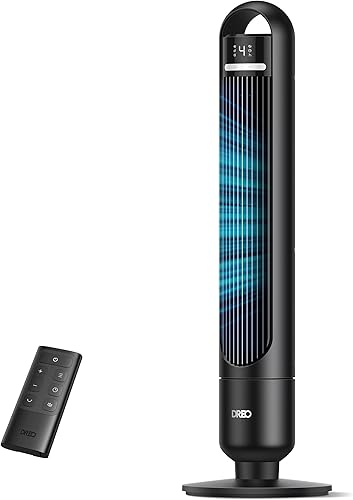
The DREO Tower Fan for Bedroom is 36.26 in high with an 8.03 in by 8.03 in footprint. It offers 90° oscillation, 4 speed settings, 3 modes and an 8-hour timer, with a listed noise level of 28 dB.
Its tall, narrow shape keeps the fan's footprint small, but you still need a stable, clear place for the tower. The included remote and touch controls can help when you want to change settings without getting up.
A box fan takes more width but can sit on the floor, a table or another flat surface. Measure the space where you plan to place the fan, including room for the cord and safe airflow.
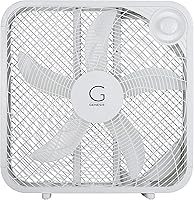
Genesis 20 in Box Fan: fixed airflow for one area
The Genesis 20 in Box Fan suits a bedroom, office or other area where you want airflow aimed at one main spot. Its 20 in blade length and 3 speed settings give you a simple choice between lower and stronger airflow.
The fan has a white finish, a carry handle and a copper motor. It is designed for indoor floor use, but its flat-surface placement also lets you use it on a dresser or table when the surface is stable and suitable.
Its controller is a knob, so changing speed is direct. Choose it when fixed airflow matters more than a narrow tower footprint or remote control.
Which fan spreads air across a living room?
An oscillating fan is usually the better choice for a living room shared by several people. Sweeping airflow can reach different seats without requiring you to keep repositioning the fan.
The DREO Tower Fan for Bedroom offers 90° oscillation and airflow described as reaching up to 33 ft. Its 26 ft/s air speed, 4 speed settings and 3 modes give you more ways to adjust the breeze than a basic 3-speed box fan.
The DREO Fan for Bedroom takes a different approach. It offers 90° horizontal oscillation, a 105° pivoting head and adjustable height from 38 to 42 in, so you can direct air across the room and change the height for different seating positions.
DREO Fan for Bedroom: adjustable whole-room airflow
The DREO Fan for Bedroom suits a living room, bedroom or kitchen where you want both sweeping and adjustable airflow. Its 1000 CFM air flow capacity and claimed circulation distance of up to 90 ft are designed for larger air movement, while the 8 speeds give you more control than a basic fan.
It has a black plastic body, a brushless motor and a remote control. The fan also includes an auto mode that adjusts fan speed as room temperature changes, according to the product information.
Its detachable design lets you remove the blade, front grille and rear grille separately for cleaning. The built-in aroma pad is an extra feature, but it shouldn't decide the purchase if your main need is simple air movement.
Which box fan is easier to move?
A lighter box fan with a carry handle is the easiest choice when you move airflow between rooms. Compare weight, handle design and the surface where the fan will stand.
The Amazon Basics 3-Speed Box Fan for Bedroom weighs 5.8 lb and has a top carry handle. Its dimensions are 6.8 in deep, 20.86 in wide and 21.33 in high.
It has 3 speeds, 5 plastic blades, extra-large feet and a freestanding design. The feet help keep the fan stable during operation, while the handle makes it easier to move between a bedroom, living area, kitchen or home office.
Amazon Basics 3-Speed Box Fan for Bedroom: light room-to-room use
The Amazon Basics 3-Speed Box Fan for Bedroom is a practical match for readers who want a lightweight box fan that can move between rooms. Its 67 W power figure, corded electric design and standard North American 2-prong connection describe a straightforward setup.
The black plastic fan uses knob control and has 5 blades. Its wide body needs more horizontal space than a tower, so measure a table, dresser or floor area before choosing it.
Pick this model when portability and simple controls matter more than oscillation, remote access or a tall narrow shape.
Does a box fan move more air than an oscillating fan?
You can't determine airflow from fan shape alone. Compare the exact model's airflow information, speed settings and intended use instead of assuming that every box fan is stronger.
The Genesis box fan has a 20 in blade length and 3 speed settings, but the information does not give a matching airflow figure. The Amazon Basics box fan also has 3 speeds, 5 blades and a 67 W power figure, but power does not by itself tell you how much air reaches your room.
The DREO Tower Fan for Bedroom lists an air flow capacity of 24.99 cubic feet per second. The DREO Fan for Bedroom lists 1000 CFM, along with a claimed circulation distance of up to 90 ft.
These figures use different units and should not be treated as a direct performance ranking. A fan's position, speed, grille design and the distance between the fan and you also change how strong the breeze feels.
If you want a direct breeze at a desk, choose the model that can sit safely near that area and aim forward. If the room has several seating positions, oscillation may make the airflow feel more even.
Which fan is quieter for sleeping?
The DREO Tower Fan for Bedroom is the clearest choice here for shoppers who prioritize a published quiet-operation figure. Its listed noise level is 28 dB, and it includes a sleep mode.
The tower also has a timer of up to 8 hours, which can suit a bedtime routine. Its narrow profile may help in a bedroom where a wide box fan would use valuable floor or table space.
The DREO Fan for Bedroom lists a 28.2 dB noise level and includes an 8-hour timer. It also has a mute option for beep sounds through the remote, according to the product information.
The box fan data does not provide a matching noise measurement. That doesn't mean either box fan will be too loud, but it means you should avoid choosing by fan type alone when quiet sleep is your main goal.
Keep any fan stable and clear of bedding, curtains and other items that could block its grille. Follow the exact manual for safe placement and operation.
How should you choose between fixed and sweeping airflow?
Choose fixed airflow when one person needs a steady breeze, and choose sweeping airflow when several areas need coverage. Room layout is the simplest decision rule.
A box fan works well beside a desk, near a bed or in front of a particular seating area. Its forward airflow is predictable, and you can redirect it by changing its position.
An oscillating fan works better when the room has multiple seats, a wide bed or a work area that changes during the day. The airflow reaches different positions, but it may feel less constant at any single spot.
If you're also comparing a box fan vs pedestal fan, focus on height adjustment and the space beneath the fan. A pedestal-style fan may place airflow higher, while a box fan offers a wider, lower frame.
For rooms with a ceiling fan, compare ceiling fan vs box fan placement and airflow direction. A ceiling fan moves air from above, while a box fan can target a lower seating or sleeping area.
A window setup changes the decision again. Read the window fan vs box fan comparison if you want to think about airflow through the window rather than airflow aimed at one person.
What should you check before setting up either fan?
Measure the placement area, confirm the electrical connection and keep the airflow path clear. A fan that fits its footprint can still be awkward if the cord, controls or nearby furniture block safe use.
For a box fan, check the width and depth of the table, dresser or floor area. The Genesis model is described as suitable for flat surfaces, while the Amazon Basics model has extra-large feet for a stable freestanding setup.
For an oscillating fan, check the full sweep area. The tower needs space to turn through 90°, and the DREO standing fan needs room for its adjustable head and height.
Keep controls reachable without placing the fan where people may knock it over. Use the correct power connection, and don't run a cord where it creates a trip hazard.
Clean the grille and blades according to the manual. The DREO standing fan's detachable design can make separate cleaning of the blade and grilles more direct, while other models may require a different cleaning method.
Don't add a filter to a fan unless the fan and filter setup are designed to work together. Our guide to a box fan HEPA filter explains the airflow and safety questions to consider.
Which fan should you choose?
Choose the Genesis 20 in Box Fan for direct airflow and simple 3-speed control, or choose the DREO Tower Fan for Bedroom for quiet, sweeping airflow in a narrow footprint. The Amazon Basics box fan is the better fit when low weight and a carry handle matter most.
Choose the DREO Fan for Bedroom when you want adjustable height, 90° horizontal oscillation, a pivoting head and stronger whole-room circulation features. Its 8 speeds give it the widest adjustment range in this comparison.
For rooms with a low ceiling or unusual overhead layout, a floor fan may be easier than adding another ceiling fixture. Before planning that change, review what a ceiling fan downrod is and compare best low profile ceiling fans with lights if overhead clearance is your concern.
If the room has a drop ceiling, read about a low-profile ceiling fan for drop ceiling before choosing a ceiling solution.
The final box fan vs oscillating fan choice is simple: pick fixed airflow for one target area, and pick oscillation when the room needs broader coverage.
Frequently asked questions
Is a box fan better than an oscillating fan?
A box fan is better when you want direct airflow aimed at one area, while an oscillating fan is better when several parts of the room need moving air. Compare placement, room shape, noise and controls before choosing.
Neither design is best for every room.
Does an oscillating fan cool a room better?
An oscillating fan can spread airflow across more of a room, but it doesn't lower the room temperature like air conditioning. A box fan may feel stronger at one position because its airflow stays aimed in one direction.
Choose based on coverage and comfort.
Are box fans quieter than tower fans?
Noise depends on the exact model and speed. The DREO Tower Fan for Bedroom lists a 28 dB noise level, while the box fan data here does not give a matching noise figure.
Compare published noise information at the speeds you plan to use.
Can a box fan circulate air across a whole room?
A box fan can move air across a room when aimed carefully, but it does not sweep from side to side. Place it where its fixed airflow reaches the main seating or sleeping area, or use it near a window when the setup and manual allow.