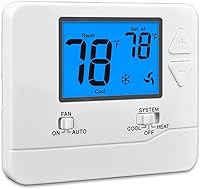
9 Best Digital Thermostat with Probe (November 2026)
The best digital thermostats with probes include the VIVOSUN Digital Heat Mat Thermostat Controller for seed starting and heat mats, the BN-LINK Digital Cooling Thermostat Temperature Controller Outlet for cooling fans and ventilation, and the Inkbird WiFi ITC-308 Digital Temperature Controller Thermostat for Wi-Fi heating and cooling control.
On this page (7 sections)
- The best digital thermostat with probe picks for every setup
- How do I choose heating, cooling or dual control?
- How long should the probe and cord be?
- What watt limit and range do I need?
- Do I need Wi-Fi, dual zones or timers?
- How should I place the probe and set it up?
- Which digital thermostat with probe should you buy?
The best digital thermostat with probe for most buyers is the VIVOSUN Digital Heat Mat Thermostat Controller, because it covers the common heat mat range with simple controls and a 1000W limit. If you need cooling, dual zones or Wi-Fi, the picks below change that answer fast.
A digital thermostat with probe is different from a room thermostat. The controller sits at the outlet, and the probe sits at the spot you care about.
That split is the whole point of this guide.
If you are new to this category, start with What Is a Digital Thermostat? Tips and Guidance.
It explains the basics before you choose heating, cooling or dual modes.
Our score weighs specs, features and buyer feedback against what you are shopping for. Higher scores here reflect a close match between the probe, watt limit and control mode for the jobs in this guide.
Our picks at a glance
-
1
 Best for seed starting and heat mats
VIVOSUN Digital Heat Mat Thermostat Controller
9.7/10 our score
See it on Amazon -
2
 Best for cooling fans and ventilation
BN-LINK Digital Cooling Thermostat Temperature Controller Outlet
9.7/10 our score
See it on Amazon -
3
 Best for Wi-Fi heating and cooling control
Inkbird WiFi ITC-308 Digital Temperature Controller Thermostat
9.5/10 our score
See it on Amazon
- 4
 Check it
BN-LINK Reptile Thermostat Temperature Controller
Best for reptile heat mats and terrariums - 5
 Check it
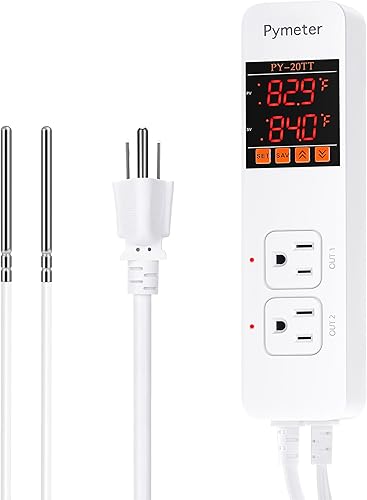
Pymeter Digital Temperature Controller Dual Probe Reptile
Best for dual zones and two tanks - 6
 Check it
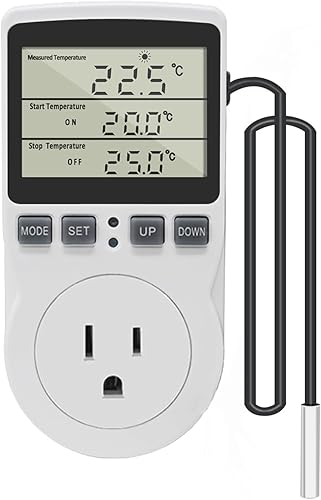
KETOTEK Digital Thermostat Outlet Plug
Best for wide range and timer modes - 7
 Check it
Zoo Med ReptiTemp Digital Thermostat
Best for reptile enclosures - 8
 Check it
Inkbird ITC308 Freezer Thermostat Heating Cooling Plug
Best for freezer and fridge conversion - 9
 Check it
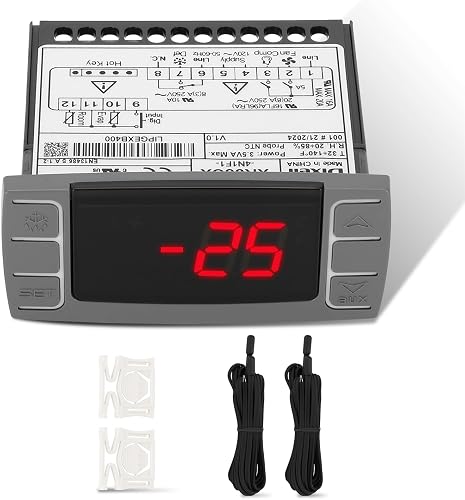
Anrain for Dixell XR06CX-4N1F1 Temperature Controllers
Best for commercial refrigeration installs
The best digital thermostat with probe picks for every setup
The top two picks score 9.7 for opposite reasons. VIVOSUN heats, and BN-LINK cools.
Most buying mistakes in this category come from choosing the wrong mode first, not from choosing the wrong brand.
How we compared these probe controllers
We compared control range, watt limit, probe length, heating or cooling mode, alarms, timers and setup complexity. We also checked whether each model suits a heat mat, a fan, a freezer or a reptile tank.
Probe placement matters as much as the probe itself. A probe taped to a mat, tucked at a root zone or mounted in a tank will read differently from a probe left in open air.
We did not test these units hands on. We checked the specs, features and buyer patterns, and we flag limits that change the buying decision.
Timer and calibration features also matter for some readers. KETOTEK adds timer modes, and Inkbird and KETOTEK add calibration, while simpler models keep setup to three buttons.
VIVOSUN Digital Heat Mat Thermostat Controller: Best for seed starting and heat mats
- 40 to 108°F control range
- 1000W limit
- Sensor probe
- 3-button setup
- Fahrenheit and Celsius display
A simple heating-only controller for heat mats, seedlings, germination, incubation and fermentation, with a probe to track root zone temperature.
Pros
- Simple 3-button setup
- Hanging tab and wall mount
- Angled socket helps cord layout
Cons
- Heating only
- No app or dual outlet
VIVOSUN suits seed starting, seedlings, germination, incubation and fermentation with a heat mat. Its 40 to 108°F control range covers most root zone and incubation targets in those jobs.
The display range runs from 32 to 210°F, while the control range stays at 40 to 108°F. That gap matters if you expect the controller to switch devices outside the control range.
A sensor probe lets you track the temperature of plant roots rather than the air near the outlet. Place the probe where roots sit, then let the controller cycle the mat around that reading.
Setup uses just 3 buttons, with Fahrenheit and Celsius switching in seconds. A hanging tab, wall mount and angled socket help keep cords neat on a shelf or wall.
It works with any heat mat and plugs in to any North American outlet. VIVOSUN rates it at 1000W, so add up your mat wattage before you plug in a second device.
The trade-off is clear. This is heating only, with no cooling outlet, no app and no second zone.
Choose it for heat mats first, and choose a dual model if you also need a fan or freezer.
BN-LINK Digital Cooling Thermostat Temperature Controller Outlet: Best for cooling fans and ventilation
- 40 to 108°F control range
- 8.3A 1000W max loading
- 4.92 ft temperature probe
- 3.94 ft power cord
- LED cooling and power indicators
A cooling-only outlet that turns on fans and ventilation devices when temperature climbs, for greenhouses, garages, attics and coops.
Pros
- Large 3-button interface
- Easy to read in low light
- ETL listed
Cons
- Cooling only
- Probe must not go in water
BN-LINK cooling outlet suits attic fans, exhaust fans, ventilation fans and swamp coolers. Its 40 to 108°F control range matches the heating picks, but the logic runs in reverse.
You set a temperature, and the controller turns cooling equipment on when the probe reaches it. That suits a greenhouse, garage, attic, chicken coop or fermentation setup that gets too warm.
The sensor probe has a 4.92 ft length, with a 3.94 ft 3 prong power cord. That reach lets you place the probe high in an attic or across a greenhouse without moving the outlet.
A large 3-button interface and bright LED display make setup quick. LED cooling and power indicators show status even in total darkness, which helps in attics and coops.
BN-LINK rates it at 120VAC 60Hz and 8.3A 1000W. For motor driven appliances, the guidance in the data limits safe use to 400W, so check your fan rating first.
The trade-off is that this model is cooling only. It will not run a heat mat or heater.
Do not put the probe in water, and choose it when heat is the problem, not cold.
Inkbird WiFi ITC-308 Digital Temperature Controller Thermostat: Best for Wi-Fi heating and cooling control
- Wi-Fi app control for iOS and Android
- 2.4 GHz Wi-Fi
- Dual relay outputs for heating and refrigeration
- High and low temperature alarm
- 1100W at 110V max output
- Temperature calibration
A plug and play Wi-Fi controller that can run heating and refrigeration equipment, with alarms and remote app control.
Pros
- Heating and cooling outlets
- Remote app control
- Alarm for high, low and sensor faults
Cons
- Needs 2.4 GHz Wi-Fi
- App adds setup steps
Inkbird WiFi ITC-308 suits buyers who want remote control and both heating and cooling in one unit. It has dual relay outputs, so it can turn on refrigeration and heating equipment as conditions change.
Wi-Fi runs on 2.4 GHz with the INKBIRD app for iOS and Android. You can check and change settings remotely, which helps for a freezer, fermenter or breeding setup away from the outlet.
A high and low temperature alarm sounds when the temperature reaches preset limits or the sensor malfunctions. That alarm matters more for food, eggs or animals than for casual seed starting.
The maximum output load is 1100W at 110V. That covers many heaters, coolers and heat mats, but you still need to add up connected devices before you plug them in.
Plug and play design, Celsius or Fahrenheit readings and temperature calibration make daily use simpler. Calibration helps if your probe sits in a different spot from the device it controls.
The trade-off is setup. Wi-Fi adds steps, and a 2.4 GHz network is required.
Choose this model for app control and dual modes, or choose a 3-button model if you want the fastest start.
BN-LINK Reptile Thermostat Temperature Controller: Best for reptile heat mats and terrariums
- 40 to 108°F control range
- 1000W max loading
- 4.92 ft temperature probe
- 3.94 ft power cord
- ETL listed
- LED heating and power indicators
A heating-only controller for reptile heating pads, seedling heat mats, heat lamps, incubators and fermentation, with a bright LED display.
Pros
- Simple 3-button setup
- Hanging tab
- Works with heat lamps and mats
Cons
- Heating only
- Heat mat not included
BN-LINK reptile controller suits reptile heating pads, seedling heat mats and heat lamps. Its 40 to 108°F control range and 1000W limit cover most terrarium and seed starting heaters.
Setup uses just 3 buttons to set temperature or switch between Fahrenheit and Celsius. A bright LED display and heating and power indicators show status in the dark.
The sensor probe has a 4.92 ft length, with a 3.94 ft power cord. That reach suits a tank, greenhouse, incubator or brooder where the outlet stays away from the probe.
BN-LINK says this controller is intended for heating devices only. That includes reptile heating pads, seedling heat mats and heat lamps, and the total load must stay at or under 1000W.
It does not include a heat mat. You supply the mat, lamp or heater, and the controller switches it on and off around your set temperature.
The trade-off against VIVOSUN is small in specs and large in use case. Both are heating only at 1000W.
Choose BN-LINK for reptile tanks and heat lamps, and choose VIVOSUN when seed starting and fermentation lead your list.
Pymeter Digital Temperature Controller Dual Probe Reptile: Best for dual zones and two tanks
- Two outlets, each heating or cooling
- Two waterproof sensors
- Separate on and off setpoints per outlet
- High, low and difference alarms
- 10A 1200W
- Power-on delay
Two controllers in one unit for two heat lamps, two mats, two tanks or separate heating and cooling zones, each with its own setpoints.
Pros
- Two zones in one unit
- Separate setpoints per outlet
- Alarm functions
Cons
- More complex setup
- Larger unit
Pymeter suits two tanks, two heat lamps or two separate zones. It is 2 controllers in one unit, with two outlets that each support heating and cooling.
Two waterproof sensors let you set different temperatures for different areas. That helps with dual zones, two tanks or a heater in one spot and a fan in another.
Each outlet has its own on and off setpoints. For heating, set on lower than off.
For cooling, set on higher than off. That rule is easy to get backwards, so check it before you walk away.
High and low temperature alarms plus a temperature difference alarm add protection. The difference alarm sounds when the two sensors drift too far apart, which can flag a failed heater or a moved probe.
A power-on delay can protect a compressor from frequent on and off cycling. That matters when you convert a freezer to a refrigerator or run a fridge with a cooling outlet.
The trade-off is complexity and size. This unit is larger and has more settings than a single outlet plug.
Choose it for two zones, and choose a single plug if you only need one mat or one fan.
KETOTEK Digital Thermostat Outlet Plug: Best for wide range and timer modes
- -40 to 248°F range
- Max 15A at 120V
- 9.8 ft probe
- Heating and cooling modes
- Timer modes F01 to F04
- Temperature calibration
- Memory retains settings after power outage
A wide range heating and cooling plug with a long probe, cycle and countdown timing, and calibration for greenhouse, reptile and fermentation use.
Pros
- Widest range here at -40 to 248°F
- Long 9.8 ft probe
- Timer modes plus temperature control
Cons
- Timer and temperature control cannot run together
- More modes to learn
KETOTEK suits buyers who need a wide range, a long probe or timer modes. Its range runs from -40 to 248°F, far wider than the 40 to 108°F range on most picks here.
The probe is 9.8 ft long, which is about double the 4.92 ft probes on the BN-LINK models. That length helps in a large greenhouse, a freezer or a setup where the outlet is far from the sensor.
It switches between heating and cooling modes based on your start and stop temperatures. For heating, start must be lower than stop.
For cooling, start must be higher than stop.
Timer modes F01 to F04 add cycle timing and countdown control from 0 to 99 hours 59 minutes. Temperature control and timing cannot run at the same time, so pick the mode that matches the job.
Control accuracy is stated at ±1°C or ±2°F. Built in memory retains settings after a power outage, and calibration supports fine adjustments.
The trade-off is mode complexity. More modes mean more setup choices.
Choose KETOTEK for range, probe length and timers, and choose a simpler plug if you only need one fixed setpoint.
Zoo Med ReptiTemp Digital Thermostat: Best for reptile enclosures
- 50 to 122°F control range
- Remote sensor with 6 foot cable
- Up to 600W heating devices
- Up to 150W cooling devices
- Memory stores settings after power failure
- Alarm flashes and sounds at extreme levels
A reptile-focused thermostat with heat and cool modes, a 6 foot remote sensor, memory backup and high and low alarms.
Pros
- Heat and cool modes
- Memory backup
- Alarm for extreme levels
Cons
- Lower heating limit at 600W
- Cooling limit at 150W
Zoo Med ReptiTemp suits reptile and amphibian enclosures where heat and cool modes share one controller. It controls temperature by turning on heating devices in heat mode or cooling devices in cool mode.
The control range is 50 to 122°F, which starts higher than the 40°F low end on several other picks. That range suits most reptile enclosures, but check it if you need colder control.
A remote sensor has a 6 foot cable, so you can place the sensor inside the enclosure while the controller stays outside. That split keeps the reading at the animal's level.
It controls up to 600 watts of heating devices and up to 150 watts of cooling devices. Those limits are lower than the 1000W limit on VIVOSUN and BN-LINK, so check heater and fan ratings first.
Built in memory stores settings after a power failure. An alarm flashes and sounds when temperature reaches extreme high or low levels.
The trade-off is power headroom. Choose this model for a focused reptile setup with a 6 foot sensor.
Choose a 1000W model if your heater draws more than 600W or your fan draws more than 150W.
Inkbird ITC308 Freezer Thermostat Heating Cooling Plug: Best for freezer and fridge conversion
- Heating and cooling outlets
- Connect refrigeration and heating equipment at the same time
- Easy calibration
- Celsius or Fahrenheit display
- 110V, 1200W in title specs
A dual outlet plug for greenhouse heaters, coolers, reptile setups, brewing and fermentation, with calibration and a clear LCD.
Pros
- Heating and cooling at once
- Easy calibration
- Simple plug in setup
Cons
- No Wi-Fi on this version
- Fewer app features than the Wi-Fi model
Inkbird ITC308 suits freezer, fridge, greenhouse, brewing and fermentation setups. It can connect refrigeration and heating equipment at the same time through separate outlets.
Setup is simple. You plug it in, set the temperature ranges, place the probe and plug the heater or cooler in to the marked outlet.
That order reduces wiring mistakes.
It displays in Celsius or Fahrenheit on an LCD. Easy calibration helps you adjust the reading if the probe sits in a spot that runs warmer or cooler than the target area.
The title specs list 110V and 1200W. That gives more headroom than 1000W models, but you still need to check the rating on your actual heater or cooler.
This model covers fermentation, kombucha, greenhouse, reptile and brewing jobs. It also suits a freezer or kegerator where a cooling outlet does the main work.
The trade-off is connectivity. This version has no Wi-Fi app, unlike the Inkbird WiFi ITC-308.
Choose this plug for dual outlets without app setup, and choose the Wi-Fi version if remote control matters.
Anrain for Dixell XR06CX-4N1F1 Temperature Controllers: Best for commercial refrigeration installs
- Programmable digital thermostat
- Sensor probe included
- Three relay outputs for compressor, fan and defrost
- Two NTC probe inputs
- 32 x 74 x 60 mm external dimensions
- Mounting hardware included
A panel style controller for refrigerators and freezers, with separate outputs for compressor, fan and defrost and two sensor inputs.
Pros
- Compressor, fan and defrost outputs
- Two sensor inputs
- Includes mounting hardware
Cons
- Panel install, not a plug
- Built for refrigeration specialists
Anrain XR06CX-4N1F1 suits commercial refrigerators and freezers rather than heat mats. It is a programmable panel controller with a sensor probe and mounting hardware included.
It has three relay outputs for the compressor, the fan and the defrost. That structure suits refrigerated cases, beer machines, wine refrigerators and small freezers where more than one part needs control.
Two NTC probe inputs support temperature control and defrost terminal temperature. The fan can also be managed from the sensor reading for more accurate measurement.
External dimensions are 32 x 74 x 60 mm. That panel size tells you this is a fixed install, not a plug you move between rooms.
Precise control matters for food storage and commercial refrigeration. A panel controller lets you tune compressor and defrost behavior in ways a single outlet plug cannot.
The trade-off is installation. You need to wire and mount this unit, and check power supply stability before linking it.
Choose it for refrigeration installs, and choose a plug controller for heat mats, fans and terrariums.
How do I choose heating, cooling or dual control?
The fastest way to choose is to match the mode to the device you already own. Heating only suits heat mats, heating pads and heat lamps.
Cooling only suits fans, exhaust fans and swamp coolers.
Dual models suit freezers, fridges and rooms that swing between hot and cold. Inkbird, Pymeter and KETOTEK all cover both modes, but they do it with different outlets and apps.
If you are deciding between a built in sensor and a remote probe, read our integral thermostat versus remote guide. It explains when a probe at the target beats a sensor in the controller.
Heating only
VIVOSUN and the BN-LINK reptile controller are heating only. They are the simplest choice for seed starting, reptile tanks, incubators and fermentation with a heat source.
Cooling only
The BN-LINK cooling outlet is cooling only. It turns on a fan when the probe gets warm, which suits attics, garages, greenhouses and coops.
Dual heating and cooling
Inkbird models, Pymeter, KETOTEK and Zoo Med cover heating and cooling. Dual control helps when one device must handle both a heater and a cooler, or when seasons change.
How long should the probe and cord be?
Probe length decides where the controller can live. A 4.92 ft probe on BN-LINK models covers most tanks, mats and small greenhouses.
A 6 foot sensor on Zoo Med gives a little more reach inside an enclosure.
KETOTEK gives a 9.8 ft probe, which is the longest here. That length helps when the outlet is across the room from a freezer, incubator or large grow space.
Cord length matters too. BN-LINK models have a 3.94 ft power cord, so plan the outlet location before you mount the controller.
If you need a probe across a large space or a detached setup, check best thermostat outdoor use before you buy. Outdoor placement adds weather and cord questions that indoor picks do not solve.
Short probes for tanks and mats
Shorter probes work well when the probe sits close to the controller. Heat mats, reptile tanks and seed trays usually fit this pattern.
Long probes for freezers and greenhouses
Longer probes help when the sensor must reach a freezer, a high attic fan or the far end of a greenhouse. KETOTEK is the clear pick in this group for reach.
What watt limit and range do I need?
Add up the watts of every device you plan to plug in. VIVOSUN and BN-LINK heating models allow 1000W.
Inkbird Wi-Fi allows 1100W at 110V. KETOTEK allows 15A at 120V.
Zoo Med is stricter at 600W for heating and 150W for cooling. That limit can rule it out for a larger heater even if the range looks right.
Range is the second check. Most picks here control between 40 and 108°F.
KETOTEK runs from -40 to 248°F, and Zoo Med runs from 50 to 122°F.
If your job sits outside 40 to 108°F, range matters more than brand. Freezers, cold rooms and hot attics are the most common cases where the standard range falls short.
For a portable setup that moves between rooms, read What Is a Portable Thermostat? A Homeowner's Guide.
It helps you decide if a plug controller fits a temporary job.
Do I need Wi-Fi, dual zones or timers?
Wi-Fi matters when you cannot check the controller in person. The Inkbird WiFi ITC-308 lets you control temperature remotely through an app on a 2.4 GHz network.
Dual zones matter when one probe cannot cover the job. Pymeter gives two outlets and two waterproof sensors, each with its own setpoints.
Timers matter for cycles and countdowns. KETOTEK adds F01 to F04 modes for cycle timing and countdown on and off control.
If wireless control is the main goal, compare the best remote thermostat wireless picks. They focus on wireless sensors and room control rather than plug in probe outlets.
Wi-Fi for remote checks
Choose Wi-Fi for freezers, fermenters and breeding setups where a missed alarm costs more than extra setup time.
Dual probes for two zones
Choose dual probes for two tanks, two mats or separate heating and cooling areas. Pymeter is built for that job.
Timers for cycles
Choose timer modes for lighting-like cycles, countdown starts or repeated on and off runs. KETOTEK covers that pattern, but not at the same time as temperature control.
How should I place the probe and set it up?
Place the probe at the spot you need controlled, not where the outlet sits. For roots, place it at root level.
For a reptile tank, place it inside the enclosure at the animal's level.
Set heating with on lower than off. Set cooling with on higher than off.
That single rule prevents most first setup errors on dual models.
Use calibration if the reading feels off in your exact spot. Inkbird and KETOTEK both support calibration, which helps when the probe sits near a wall, a mat edge or a cold spot.
Keep the probe out of water unless the maker confirms it is safe for water. BN-LINK states its cooling probe must not go in water, so treat that as a warning for similar probes.
Which digital thermostat with probe should you buy?
Pick VIVOSUN if seed starting, heat mats and fermentation lead your list. Pick BN-LINK cooling if a fan or ventilation device needs to switch on when it gets warm.
Pick Inkbird WiFi ITC-308 if you want app control with heating and cooling outlets. Pick Pymeter if two tanks or two zones need separate setpoints.
Pick KETOTEK if you need the widest range, the longest probe or timer modes. Pick Zoo Med if a reptile enclosure needs heat and cool modes with a 6 foot sensor.
Pick the Inkbird ITC308 plug if freezer and fridge conversion matters without Wi-Fi. Pick the Anrain panel controller only for commercial refrigeration installs with compressor, fan and defrost outputs.
For the core basics behind every pick here, re-read What Is a Digital Thermostat? Tips and Guidance and match the mode, probe length and watt limit to your device before you order.
Our top 3 picks at a glance
-
1
Best for seed starting and heat mats
VIVOSUN Digital Heat Mat Thermostat Controller
9.7/10 our score
See it on Amazon -
2
Best for cooling fans and ventilation
BN-LINK Digital Cooling Thermostat Temperature Controller Outlet
9.7/10 our score
See it on Amazon -
3
Best for Wi-Fi heating and cooling control
Inkbird WiFi ITC-308 Digital Temperature Controller Thermostat
9.5/10 our score
See it on Amazon
Frequently asked questions
What is a digital thermostat with probe?
A digital thermostat with probe uses a separate sensor placed where you need the reading, while the controller switches a plug on or off. That lets a heat mat, fan or freezer respond to the temperature at the mat, tank or root zone, not at the wall outlet.
Can a digital thermostat probe go in water?
Do not assume a probe can go in water. BN-LINK says its cooling controller probe must not go in water.
Check the maker instructions for your exact model before placing a probe in an aquarium, fermenter or water dish.
Heating only or heating and cooling?
Heating only models like VIVOSUN and the BN-LINK reptile controller suit heat mats and lamps. Cooling only models like the BN-LINK cooling outlet suit fans.
Dual models like Inkbird and Pymeter can run heating and cooling equipment, which suits freezers and season changes.
How do I set heating and cooling setpoints?
For heating, the on temperature must be lower than the off temperature. For cooling, the on temperature must be higher than the off temperature.
KETOTEK and Pymeter state that rule clearly, and it prevents the device from cycling the wrong way.
What watt limit should I check?
Match the total watts of the device you plug in to the controller limit. VIVOSUN and BN-LINK heating models are rated at 1000W.
Zoo Med is rated at 600W for heating and 150W for cooling, so check that lower limit before adding a larger heater.