9 Best Thermostats with a Two Degree Temperature Swing (October 2026)
The best thermostats with a 2 degree temperature swing include the Suuwer Non-Programmable Thermostats for Home 1 Heat/1 for separate heat and cool swing settings, the Riseem NonProgrammable Thermostat for Home for basic single-stage controls, and the Google Nest Thermostat for app-based scheduling.
On this page (4 sections)
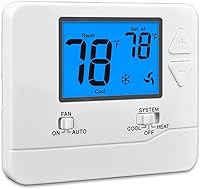
The best thermostat with 2 degree swing is the Suuwer S701 for compatible conventional single-stage systems. It specifies separate heating and cooling swing settings from 0.2°F to 2°F, so you can adjust each mode independently.
A temperature swing setting controls how far room temperature can shift around the target before the thermostat calls for heating or cooling. A wider swing may reduce frequent starts, but it can also mean a larger temperature change indoors.
Our picks at a glance
-
1
 Best for separate heat and cool swing settings
Suuwer Non-Programmable Thermostats for Home 1 Heat/1
9.7/10 our score
See it on Amazon -
2
 Best for basic single-stage controls
Riseem NonProgrammable Thermostat for Home
9.5/10 our score
See it on Amazon -
3

- 4
 Check it
ELECTECK 2 Pack Digital Non-Programmable Thermostat
Best for two compatible zones - 5
 Check it
Heagstat Non-Programmable Thermostat for Home Conventional Single-Stage
Best for a stated 2°F maximum - 6
 Check it
White-Rodgers 70 Series Classic
Best for single-stage heat only - 7
 Check it
Honeywell Home X2P Programmable Thermostat
Best for flexible scheduling - 8
 Check it
Honeywell TH1100DV1000/U Pro 1000 Vertical Non-Programmable Thermostat
Best for a vertical wall profile - 9
 Check it
Sensi Touch 2 Smart Thermostat Wi-Fi
Best for remote monitoring
Which thermostats have a 2 degree swing?
The Suuwer S701 and Heagstat H701 explicitly state adjustable swing ranges that reach 2°F. The other picks offer related control options, but their details do not confirm an adjustable 2°F swing.
We compared stated swing controls, system compatibility, power needs and useful control features. Our score weighs specs, features and buyer feedback against what you’re shopping for.
| Product | Best for | Swing range | System type | Power | Our score |
|---|---|---|---|---|---|
| Suuwer Non-Programmable Thermostats for Home 1 Heat/1 | separate heat and cool swing settings | 0.2°F to 2°F, separate heat and cool settings | Conventional single-stage, up to 1 heat/1 cool | 24VAC or 2 AAA batteries | 9.7 |
| Riseem NonProgrammable Thermostat for Home | basic single-stage controls | Single-stage, up to 1 heat/1 cool | 24VAC or 2 AA batteries | 9.5 | |
| Google Nest Thermostat | app-based scheduling | C-wire or compatible power accessory needed for some systems | 9.4 | ||
| ELECTECK 2 Pack Digital Non-Programmable Thermostat | two compatible zones | Single-stage 1 heat/1 cool; heat pump without auxiliary heat | 9.3 | ||
| Heagstat Non-Programmable Thermostat for Home Conventional Single-Stage | a stated 2°F maximum | 0.2°F to 2°F | 24V conventional single-stage, up to 1 heat/1 cool | 24VAC or 2 AAA batteries | 9.2 |
| White-Rodgers 70 Series Classic | single-stage heat only | Single-stage heat only | 9.0 | ||
| Honeywell Home X2P Programmable Thermostat | flexible scheduling | 1 heat/1 cool, plus specified 750 mV systems | 2 AA batteries; no C-wire required | 8.7 | |
| Honeywell TH1100DV1000/U Pro 1000 Vertical Non-Programmable Thermostat | a vertical wall profile | 8.6 | |||
| Sensi Touch 2 Smart Thermostat Wi-Fi | remote monitoring | Hardwired; C-wire required | 8.3 |
Best thermostats with a two degree temperature swing
The Suuwer and Heagstat are the clearest matches when an adjustable 2°F swing is your priority. The other models suit different needs, including app scheduling, two compatible locations or heat-only control.
Suuwer Non-Programmable Thermostats for Home 1 Heat/1: Best for separate heat and cool swing settings
- Separate heating and cooling swing settings from 0.2°F to 2°F
- Single-stage conventional systems up to 1 heat and 1 cool
- 24VAC or 2 AAA batteries
Separate heating and cooling swing controls give you room to set different cycle gaps for each mode. Confirm the system and wire limits before buying.
Pros
- Separate heat and cool swing settings
- No C-wire required on most systems
- Backlit display
Cons
- Not compatible with heat pumps or multistage systems
- Check existing wiring and base before buying
Suuwer’s S701 is the strongest match for this search because it specifies a 0.2°F to 2°F swing range for heating and cooling separately. That lets you choose different cycle gaps for each mode rather than applying one shared setting.
It is made for conventional single-stage systems with up to 1 heat and 1 cool. It does not support heat pumps, multistage equipment, mini splits, dual-fuel systems, PTAC units or 120–240V line-voltage baseboards.
The thermostat can use 24VAC power or 2 AAA batteries, and a C-wire is not required on most systems. Its blue backlight and large digital display may be useful if you want a clear readout.
Confirm the existing wiring and system type before choosing it. Suuwer advises checking the base for 2 to 5 wires and reviewing the wiring instructions before installation.
Riseem NonProgrammable Thermostat for Home: Best for basic single-stage controls
- Separate heating and cooling swing settings
- Single-stage systems up to 1 heat/1 cool
- 24VAC or 2 AA batteries
This simple digital thermostat includes separate swing controls and a backlit display. Its compatibility list excludes heat pumps, mini splits and multistage systems.
Pros
- Separate heat and cool swing controls
- No C-wire required on most systems
- Large backlit LCD
Cons
- Not suitable for heat pumps or mini splits
- Maximum 5 wires at the base
Riseem’s S3001 is a manual digital option for single-stage systems up to 1 heat and 1 cool. It has separate heating and cooling swing controls, so it can help if you want to adjust cycle behavior by mode.
It supports conventional heating and cooling, as well as several heat-only configurations. It does not support heat pumps, multistage systems, mini splits, 3-wire hydronic systems or 120–240V baseboard heat.
Power comes from 24VAC or 2 AA batteries. Riseem says a C-wire is not required on most systems, though heat-only and cooling-only systems require one.
The product information doesn’t give a numeric swing range, so don’t assume it reaches 2°F. Check that detail and confirm the maximum wire count of 5 before buying.
Google Nest Thermostat: Best for app-based scheduling
- Programmable schedule in the Google Home app
- Remote control from a phone, laptop or tablet
- Designed to work without a C-wire in most homes
The Nest suits buyers who want app scheduling and remote adjustments. The supplied product information does not specify an adjustable 2°F swing, so choose it for smart controls rather than a confirmed swing range.
Pros
- Remote temperature changes
- App-based schedule
- Can send HVAC alerts for eligible systems
Cons
- A C-wire or power accessory is needed for some systems
- No confirmed adjustable 2°F swing
Google Nest suits buyers who want app-based scheduling and remote temperature control. You can create a schedule in the Google Home app, adjust the thermostat from a phone, laptop or tablet, and receive HVAC alerts for eligible systems.
Google says the thermostat is designed to work without a C-wire in most homes. Some setups, including heating-only, cooling-only, zone-controlled and heat-pump systems, need a C-wire or another compatible power accessory.
This is a smart control, not a confirmed 2°F swing pick. The product details don’t specify an adjustable swing range, so choose it for app features only if the swing setting is not your deciding requirement.
Check system compatibility before installation, especially if your equipment has zones or a heat pump. A thermostat’s wireless features do not guarantee that its wiring and controls fit your HVAC system.
ELECTECK 2 Pack Digital Non-Programmable Thermostat: Best for two compatible zones
- Two thermostats in the pack
- Separate heating and cooling swing adjustments
- Single-stage systems, including heat pumps without auxiliary heat
The two-pack can suit a home replacing controls in two compatible areas. Check each system’s wiring and equipment type before installing.
Pros
- Two thermostats in one pack
- Separate heat and cool swing adjustments
- C-wire not required
Cons
- Not compatible with multistage systems
- Not suitable for 120–240V baseboard heat
ELECTECK’s two-pack provides two non-programmable thermostats, which may fit a home replacing controls in two separate compatible areas. Each supports a single-stage system with 1 heat and 1 cool.
Its listed system types also include heat pumps without auxiliary heat. It does not support multistage systems, 120–240V baseboards or RVs, so check each installation location before choosing the pack.
The thermostat has separate heating and cooling swing adjustments, a backlit LCD and large buttons. Its details don’t state that the swing adjustment reaches 2°F, so verify the range if that number is essential.
It can run on 24VAC or 2 AAA batteries, and a C-wire is not required. Use the wiring diagram for each location, since two thermostats in one pack still need to match both systems.
Heagstat Non-Programmable Thermostat for Home Conventional Single-Stage: Best for a stated 2°F maximum
- Adjustable swing from 0.2°F to 2°F
- Conventional single-stage systems up to 1 heat/1 cool
- 5-minute compressor delay protection
Heagstat states a swing adjustment range that reaches 2°F, plus a 5-minute compressor delay setting. Its system limitations rule out heat pumps, mini splits and multistage equipment.
Pros
- Stated 2°F maximum swing
- 5-minute compressor delay protection
- No C-wire required
Cons
- Not compatible with heat pumps or multistage systems
- Batteries are not included
Heagstat’s H701 is another direct match for the target swing range, with an adjustable 0.2°F to 2°F swing and a stated 5-minute compressor delay setting. It is built for conventional 24V single-stage systems with up to 1 heat and 1 cool.
Its 4.5 sq in backlit LCD and manual controls keep the interface simple. It can run on 24VAC or 2 AAA batteries, and Heagstat says a C-wire is not required.
Compatibility is the main limit. The H701 does not support heat pumps, multistage equipment, mini splits, dual-fuel systems, PTAC units or 120–240V baseboards.
Confirm the existing terminals and wire count before ordering. The manufacturer specifies standard RH, RC, W, Y, G and C terminals and says it does not support terminals such as W2, Y2, O/B or AUX.
White-Rodgers 70 Series Classic: Best for single-stage heat only
- Non-programmable digital control
- Single-stage heat-only compatibility
- Backlit display
This pick is for a compatible heat-only system and a straightforward digital display. Its supplied specifications do not confirm an adjustable 2°F swing.
Pros
- Backlit digital display
- Made for single-stage heat-only systems
Cons
- Heat only, not heating and cooling
- No confirmed adjustable 2°F swing
The White-Rodgers 70 Series Classic is for single-stage heat-only systems. For two-wire setups, compare heat-only thermostat options.
Its backlit digital display and non-programmable operation may suit a simple setup where cooling control is not needed.
The stated temperature control accuracy is ±1°F. The product details do not confirm a 2°F swing adjustment, so it is not a clear fit if that feature is required.
Check the system type carefully because this model’s stated compatibility is heat only. The information also notes use on 24V and millivolt systems, but says it is not compatible with electric baseboard heat and some other systems.
Choose this model only after confirming that your heating equipment matches its supported setup. For a broader overview of best thermostats for home, compare equipment compatibility before choosing by display or control style.
Honeywell Home X2P Programmable Thermostat: Best for flexible scheduling
- 5-2 day scheduling with a non-programmable option
- Compatible with 1 heat/1 cool systems
- Battery powered, with no C-wire required
The X2P offers weekday and weekend scheduling and can be set to non-programmable mode. Its information does not confirm a 2°F swing adjustment.
Pros
- Optional 5-2 scheduling
- Filter-change reminder
- Large display with clear font
Cons
- No confirmed adjustable 2°F swing
- Not compatible with electric baseboard heat
Honeywell Home’s X2P combines 5-2 day scheduling with a non-programmable option. It supports 1 heat and 1 cool systems, including forced air and hot water heat, and has a backlit display with a filter reminder.
The X2P runs on 2 AA batteries, and a C-wire is not required. Its stated compatibility excludes electric baseboard heat and multistage systems.
The available details don’t confirm an adjustable 2°F swing. Consider this model if scheduling flexibility matters more than a documented swing range.
The UWP wall plate is designed to simplify installation and future upgrades. Still, compare the wiring and equipment type with the thermostat’s instructions before replacing your current control.
Honeywell TH1100DV1000/U Pro 1000 Vertical Non-Programmable Thermostat: Best for a vertical wall profile
- Vertical design
- Non-programmable control
- Dimensions of 4 11/16 in high x 2 7/8 in wide x 1 1/8 in deep
The vertical form may suit a wall where that shape is preferred. The available information does not confirm the system compatibility or swing range, so verify both before choosing it.
Pros
- Vertical profile
- Non-programmable
Cons
- No confirmed adjustable 2°F swing
- Compatibility details need confirmation
Honeywell’s TH1100DV1000/U has a vertical profile and non-programmable control. Its stated dimensions are 4 11/16 in high, 2 7/8 in wide and 1 1/8 in deep.
The product details provided here do not confirm its adjustable swing range or supported HVAC system types. That makes it harder to recommend as a 2°F swing choice without checking those points first.
Use the model number to confirm compatibility and control settings in the installation instructions before buying. A familiar brand name or wall shape does not mean a thermostat works with your wiring.
Sensi Touch 2 Smart Thermostat Wi-Fi: Best for remote monitoring
- Wi-Fi remote access and usage reports
- Compatible with Sensi Room Sensors
- C-wire required
Sensi Touch 2 is a smart option with remote access, reports and optional room sensors. The information does not confirm a 2°F swing setting.
Pros
- Remote access and usage reports
- Works with Sensi Room Sensors
- Filter reminders and equipment alerts
Cons
- C-wire required
- No confirmed adjustable 2°F swing
Sensi Touch 2 is a smart thermostat for buyers who want remote access, usage reports and optional room sensors. It connects by Wi-Fi and supports app, touch and voice controls.
Sensi says it can help monitor HVAC performance and provide alerts and maintenance reminders. Its room sensors are sold separately, and the thermostat requires a C-wire.
The product information does not confirm a 2°F swing setting. Choose it for smart monitoring features only after checking its compatibility with your system and deciding that the C-wire requirement works for your installation.
If you’re comparing control placement, our guide to built-in vs remote thermostats explains how remote sensing can affect where temperature is measured. For another specialty setup, see what is a mini split thermostat.
What should you check before choosing a 2°F swing thermostat?
Confirm both the swing range and HVAC compatibility before buying. A thermostat can offer a 2°F setting and still be wrong for your system’s stages, voltage or wiring.
Does the thermostat support a 2°F swing?
Only two picks here explicitly state an adjustable range reaching 2°F: Suuwer S701 and Heagstat H701. Suuwer specifies separate heating and cooling settings, while Heagstat states an adjustable 0.2°F to 2°F range.
A separate heat and cool setting can help you tune each mode based on comfort and cycling needs. Read the model’s setup instructions so you understand whether the control applies to both modes or only one.
For a plain-language explanation of the control, read what temperature swing on a thermostat means. It helps distinguish a swing setting from a thermostat’s temperature accuracy.
Is it compatible with your HVAC system?
Check whether your system is single-stage, multistage, a heat pump, hydronic, line-voltage or mini split. Several models here are limited to conventional single-stage equipment, while others have different stated compatibility.
Thermostats are not universal. Compare the current thermostat’s wires and terminals with the new model’s installation guide, and check whether your system needs a C-wire.
If your equipment uses two heating or cooling stages, read what a two-stage thermostat does before selecting a single-stage model. For a brand-specific comparison, see best Lux thermostats for home.
How wide should the swing be?
A wider swing can mean fewer heating or cooling calls, while a narrower swing keeps temperature closer to the setpoint. The right setting depends on your comfort preference and equipment guidance.
Start with the thermostat maker’s recommended setting, then adjust gradually if the control allows it. Don’t use a wide swing to compensate for an HVAC problem or a poorly placed thermostat.
Keep the thermostat away from direct sunlight, drafts and heat-producing appliances when the manufacturer’s instructions allow placement choices. Those conditions can affect the temperature it senses.
Does a temperature swing setting work like a two-stage thermostat?
No. Swing controls determine how far temperature moves around the setpoint before a call, while stages refer to the heating or cooling equipment’s operating levels.
A two-stage system needs a thermostat designed for its wiring and stages. A single-stage thermostat with an adjustable swing is not a substitute.
Which thermostat with a 2 degree swing should you choose?
Choose the Suuwer S701 if you want explicitly stated separate heating and cooling swing controls up to 2°F and your system is compatible conventional single-stage equipment. Choose the Heagstat H701 for a stated 0.2°F to 2°F range with a compressor delay setting.
Pick ELECTECK if you need two compatible controls in one pack, or Nest and Sensi if app features matter more than a confirmed 2°F swing. Before deciding, verify system type, terminals and power needs, then compare best thermostats for home for a wider set of options.
The best thermostat with 2 degree swing is the one that combines the needed setting with confirmed compatibility for your HVAC equipment.
Our top 3 picks at a glance
-
1
Best for separate heat and cool swing settings
Suuwer Non-Programmable Thermostats for Home 1 Heat/1
9.7/10 our score
See it on Amazon -
2
Best for basic single-stage controls
Riseem NonProgrammable Thermostat for Home
9.5/10 our score
See it on Amazon -
3
Frequently asked questions
What does a 2 degree swing mean on a thermostat?
A 2°F swing is the temperature gap around the setpoint that a thermostat uses before calling for heat or cooling. The exact behavior depends on the thermostat’s control design and settings.
A wider swing can mean fewer calls, while a narrower one can keep room temperature closer to the setpoint.
Does a 2 degree swing reduce HVAC cycling?
It can reduce how often the system starts by allowing room temperature to move farther from the setpoint before the next call. The effect depends on the thermostat, equipment and home.
Use the HVAC maker’s guidance and avoid settings that create uncomfortable temperature changes.
Which thermostat in this roundup confirms a 2°F swing?
The Suuwer S701 and Heagstat H701 both state adjustable swing ranges that reach 2°F. Suuwer specifies separate heating and cooling settings, while Heagstat states a 0.2°F to 2°F adjustable range.
Confirm system compatibility before buying either one.
Can I use a thermostat with a 2 degree swing on a heat pump?
Only if the thermostat supports your specific heat pump setup. Several conventional models in this roundup exclude heat pumps, and a thermostat’s swing control alone does not guarantee compatibility.
Check the wiring terminals and equipment type before replacing the control.
How do I know if my thermostat is compatible?
Match the thermostat’s supported equipment with your HVAC system, then compare the existing wires and terminals with the installation instructions. System labels such as single-stage or heat pump matter, as do auxiliary heat and voltage.
For background, see are thermostats universal.