7 Best Heat Only Thermostats for Home (October 2026)
The best heat only thermostats for homes include the LUX PSD010B Non-Programmable 2-Wire Heat-Only Thermostat for simple 2-wire heating, the Suburban 161154 Wall Thermostat for a basic wall control, and the White-Rodgers Emerson M30 White Heat-Only Thermostat for 24V mechanical control.
On this page (5 sections)
The best heat only thermostat for many simple systems is the LUX PSD010B, a battery-powered 2-wire model for heating setups such as fireplaces, stoves and in-floor radiant heat. For electric baseboards, choose a line-voltage control such as the Honeywell Home RLV3120; for a low-voltage furnace, check that the thermostat matches the system's wiring and stages.
A heat-only thermostat controls heating without controlling air conditioning. The right choice depends on your equipment and its electrical setup, so identify whether you have line-voltage electric heat or a low-voltage furnace before comparing controls.
For a dual-fuel heat pump, see thermostats for dual-fuel heat pumps.
If you want a brand-specific shortlist, see our guide to the best Honeywell heat only thermostat. For screen-based controls, compare the best digital thermostat for heat only options.
Our picks at a glance
-
1
 Best for simple 2-wire heating
LUX PSD010B Non-Programmable 2-Wire Heat-Only Thermostat
9.7/10 our score
See it on Amazon -
2

-
3
 Best for 24V mechanical control
White-Rodgers Emerson M30 White Heat-Only Thermostat
9.5/10 our score
See it on Amazon
- 4
 Check it
Honeywell Home Digital Non-Programmable Thermostat for Electric
Best for electric baseboards - 5
 Check it
LUX PSD010BF Non-Programmable Vertical Heat-Only with Fan
Best for heat with a fan switch - 6
 Check it
Honeywell T87K1007 Heat Only Thermostat
Best for a classic 24V setup - 7
 Check it
White-Rodgers Mechanical Heat Only Thermostat
Best for single-stage low voltage
How we chose a heat only thermostat for each system
We compared each model's system type, voltage, wiring, control style and heat-only features against common home heating needs. Our score weighs specs, features and buyer feedback against what you're shopping for.
The products serve different systems, so their order does not mean one thermostat works across every furnace, baseboard heater and radiant setup. Check voltage and wiring first, then choose a control style.
| Product | Best for | System | Wiring | Power | Our score |
|---|---|---|---|---|---|
| LUX PSD010B Non-Programmable 2-Wire Heat-Only Thermostat | simple 2-wire heating | Heat-only | 2-wire | 2 AA batteries | 9.7 |
| Suburban 161154 Wall Thermostat | a basic wall control | Heat only | 9.6 | ||
| White-Rodgers Emerson M30 White Heat-Only Thermostat | 24V mechanical control | Heat only | 9.5 | ||
| Honeywell Home Digital Non-Programmable Thermostat for Electric | electric baseboards | Line-voltage electric heat only | 9.4 | ||
| LUX PSD010BF Non-Programmable Vertical Heat-Only with Fan | heat with a fan switch | Heat only with fan control | 2 AA batteries | 9.3 | |
| Honeywell T87K1007 Heat Only Thermostat | a classic 24V setup | Heat only | 3-wire, 24V | 9.2 | |
| White-Rodgers Mechanical Heat Only Thermostat | single-stage low voltage | Single-stage heat only | 9.1 |
The best heat only thermostats for home heating
The best fit depends on whether your equipment uses a simple 2-wire control, line-voltage electric heat or low-voltage furnace wiring. If you need a mechanical control for a heat pump, see mechanical thermostats for heat pumps.
Each pick below has a distinct use, but compatibility should guide the final choice.
LUX PSD010B Non-Programmable 2-Wire Heat-Only Thermostat: Best for simple 2-wire heating
- 2-wire heat-only compatibility
- Battery powered
- Large illuminated display
- For fireplaces, stoves and in-floor radiant heat
The 2-wire setup and battery power suit straightforward heat-only systems such as fireplaces, stoves and in-floor radiant heat.
Pros
- Does not require a fan switch
- Large illuminated display
- Batteries included
Cons
- Not for cooling systems
- Confirm compatibility with your heating equipment
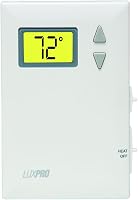
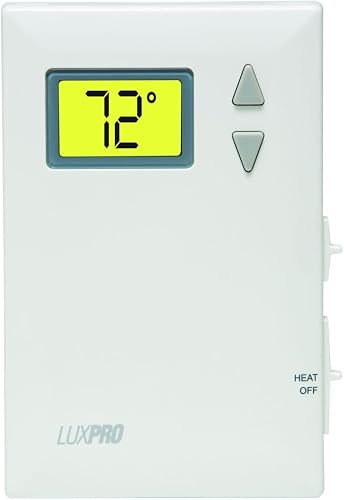
The LUX PSD010B is a strong match for a simple heat-only setup where a 2-wire control is appropriate. LUX names fireplaces, stoves and in-floor radiant heat as intended uses, and the thermostat does not need a fan switch.
Its large illuminated display is easy to read, and push buttons provide the controls. It runs on 2 AA batteries, which are included, so the setup does not rely on a thermostat power wire.
This is a non-programmable model, so you adjust the temperature directly instead of setting a schedule. Check the wiring at your current thermostat and your heater instructions before replacing it.
Choose it when your system matches its heat-only, 2-wire design and you want a readable display. If your system uses a fan control or different wiring, compare the LUX fan model or another thermostat matched to that setup.
Suburban 161154 Wall Thermostat: Best for a basic wall control
- Heat-only wall thermostat
- Mechanical knob
- Wall mount
This wall-mounted heat-only control has a mechanical knob for direct adjustment.
Pros
- Simple dial control
- Wall mount
Cons
- Limited system compatibility information
- Confirm intended use before buying
The Suburban 161154 has a mechanical knob and wall-mount design for direct adjustment. Its heat-only description makes it relevant to a home without cooling, but its compatible furnace voltage and wiring are not specified.
Compare your current thermostat terminals and equipment instructions before choosing it, and confirm the model is intended for your heating system. Its product description also discusses controlling a water heater from inside an RV, so confirm the intended use for your setup.
The control style is simple: turn the knob to adjust the setting. No programming schedule or digital display feature is specified, so this pick makes most sense when manual control is the priority.
Choose the Suburban if you need a basic wall-mounted heat-only control and can confirm system fit. Do not assume that its RV water-heater description means it is suitable for a residential furnace.
White-Rodgers Emerson M30 White Heat-Only Thermostat: Best for 24V mechanical control
- 24V
- Mechanical snap action
- Heat only
- Wall plate
The M30 is a 24V mechanical heat-only thermostat with a wall plate, suited to buyers seeking a direct manual control.
Pros
- 24V heat-only design
- Mechanical snap-action control
- Wall plate
Cons
- Voltage must match the system
- No programming features are specified
The White-Rodgers Emerson M30 is a 24V mechanical snap-action thermostat for heat-only use. Its voltage may fit a compatible low-voltage heating system, but it is not described for line-voltage baseboards.
The wall plate provides a mounting surface, and the mechanical design supports direct adjustment. No programming feature is specified, so consider it a manual control rather than a scheduled thermostat.
Compare the M30's 24V requirement with your furnace wiring and equipment instructions before buying. Verify the terminal requirements rather than guessing from wire count alone.
Choose this model when you need a 24V heat-only thermostat with mechanical operation. For other low-voltage choices, see low-voltage thermostats for heat only and 24-volt heat-only thermostats.
Honeywell Home Digital Non-Programmable Thermostat for Electric: Best for electric baseboards
- For 120V or 240V electric baseboards and convectors
- 2-wire non-polarized connection
- Silent TRIAC switching
- Digital controls
This digital control is designed for electric baseboards and convectors, with a 2-wire connection and silent TRIAC switching.
Pros
- Digital temperature control
- On-screen heating power indicator
- Supports loads from 200W to 2,000W at 240V
Cons
- Not for fan-forced convectors
- Must match the heater's voltage and load
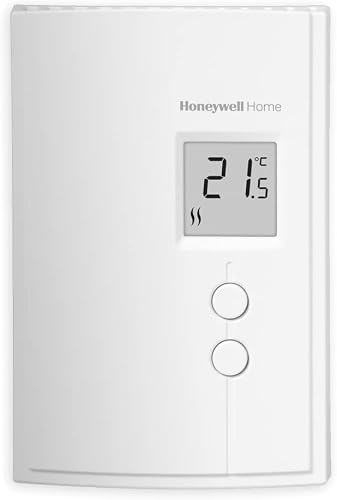
The Honeywell Home RLV3120 is designed for electric baseboards and convectors that use line voltage. It supports 120V or 240V heat-only systems and uses a 2-wire, non-polarized connection.
Its TRIAC switching is silent, avoiding the clicking noise associated with some switching controls. A heating-power indicator shows when the thermostat is using power, and the digital buttons let you adjust the setting.
Match the thermostat to the heater's voltage and load. The maximum load is 2,000W at 240V, with a minimum load of 200W at 240V; it cannot be used with a fan-forced convector.
Choose it for a compatible electric baseboard or convector, not a low-voltage furnace. If you need more display-focused options, our digital thermostat guide for heat only covers that category.
LUX PSD010BF Non-Programmable Vertical Heat-Only with Fan: Best for heat with a fan switch
- Heat-only control with fan switch
- Battery powered
- Large illuminated display
- Digital temperature control
The fan switch makes this LUX option a fit when your heating setup needs a separate fan control.
Pros
- Fan switch
- Large illuminated display
- Battery powered
Cons
- Confirm fan control compatibility
- Check that the thermostat matches your system
The LUX PSD010BF has a fan switch and runs on battery power. The fan switch may suit a heating setup that needs separate fan control, while the LUX PSD010B does not require a fan switch.
The thermostat has a large illuminated display and uses 2 AA batteries. Check your equipment instructions to confirm that its fan function is compatible with your system.
Choose the PSD010BF if you need a fan switch and your system supports it. If you want a manual control, compare single-stage heat-only thermostats for models intended for that configuration.
Honeywell T87K1007 Heat Only Thermostat: Best for a classic 24V setup
- 24V
- 3-wire
- No batteries required
- 40°F to 90°F temperature range
The T87K1007 is a 24V, 3-wire heat-only thermostat that needs no batteries.
Pros
- No batteries required
- 40°F to 90°F range
- Dial control
Cons
- Requires a compatible 3-wire, 24V system
- No programming features are specified
The Honeywell T87K1007 is described as a 24V, 3-wire heat-only thermostat that does not require batteries. It may suit a compatible 3-wire control in a low-voltage system.
Its temperature range is 40°F to 90°F, and the product description identifies it as a mercury-free model. Check the existing wiring and furnace instructions, because a 3-wire requirement differs from the simpler 2-wire setups used by some heat-only thermostats.
The description does not specify programming, so check the product instructions if that feature matters to you. Confirm the equipment voltage and terminals before replacing the existing thermostat, especially if it has a different number of wires.
Choose it for a matching 24V, 3-wire system. Our guides to Honeywell 2-wire heat-only thermostats and 2-wire programmable heat-only thermostats cover different wiring and schedule needs.
White-Rodgers Mechanical Heat Only Thermostat: Best for single-stage low voltage
- Single-stage heat-only systems
- Low voltage
- Mercury-free mechanical control
- 50°F to 90°F temperature range
This low-voltage mechanical thermostat is designed for single-stage heat-only systems and includes mounting hardware.
Pros
- Single-stage heat-only use
- Mercury-free
- Mounting hardware included
Cons
- Temperature range starts at 50°F
- Check whether your system is low voltage
The White-Rodgers 1C20-102 is a low-voltage mechanical thermostat for single-stage heat-only systems. Its 50°F to 90°F range and mercury-free design make it an option when those limits match your needs.
It includes mounting hardware and has an adjustable heat anticipator and bimetal thermometer. It also has snap-action contacts, and an optional wall plate can cover marks left by the old thermostat.
This model is intended for single-stage heating, so it does not fit a system that needs multiple heating stages or cooling control. Check your furnace wiring and voltage before replacing the existing thermostat.
Choose it when you have compatible low-voltage, single-stage heat and prefer a mechanical control. For a broader selection of single-stage heat-only thermostats, compare the system requirements before focusing on brand or appearance.
What should you check before buying a furnace thermostat for heat only?
Check the thermostat voltage, wire terminals and heating stages against your furnace instructions before buying. A heat-only label does not confirm that a control fits every furnace.
Low-voltage furnace controls differ from line-voltage thermostats used with many electric baseboards. The Honeywell Home RLV3120 is for line-voltage electric heat, while the White-Rodgers 1C20-102 is for low-voltage, single-stage heat-only systems.
If your current thermostat has 2 wires, that alone is not enough to identify the right replacement. See our guide to two-wire heat-only thermostats and compare the best 2-wire heat-only programmable thermostat if you want scheduled settings.
Are digital or mechanical heat-only controls a better fit?
Digital controls make the selected setting easy to read, while mechanical models offer direct knob adjustment. Choose the style you'll use comfortably, after confirming voltage and system fit.
The LUX PSD010B has an illuminated display and push-button controls, while the Suburban 161154 uses a mechanical knob. The Honeywell Home RLV3120 is also digital, with an on-screen heating-power indicator for compatible electric heaters.
For a traditional low-voltage furnace, the 24V White-Rodgers M30 or 3-wire Honeywell T87K1007 may be relevant if the equipment matches. See our best digital thermostat for heat only guide for more models with a screen.
Which heat-only thermostat should you choose?
Choose the LUX PSD010B for compatible 2-wire heat-only systems, Honeywell Home for electric baseboards or convectors, and White-Rodgers 1C20-102 for compatible single-stage low-voltage heat. For a heat-only furnace thermostat replacement, match the voltage, wires and stages before choosing a model.
Use a programmable thermostat for heat only if you want scheduled temperature changes. If you prefer manual control, compare the best non-programmable heat-only thermostat options.
Our top 3 picks at a glance
-
1
Best for simple 2-wire heating
LUX PSD010B Non-Programmable 2-Wire Heat-Only Thermostat
9.7/10 our score
See it on Amazon -
2
-
3
Best for 24V mechanical control
White-Rodgers Emerson M30 White Heat-Only Thermostat
9.5/10 our score
See it on Amazon
Frequently asked questions
What is a heat-only thermostat?
A heat-only thermostat controls a heating system without sending a cooling call. It may be made for low-voltage furnace wiring, line-voltage electric heat, or another specific setup.
Check your current thermostat wiring and heating equipment before choosing one, since heat-only does not mean every model fits every heater.
Can I use a heat-only thermostat with a furnace?
Yes, if its wiring and voltage match the furnace controls. Many furnaces use low-voltage thermostat wiring, while electric baseboards often need a line-voltage thermostat.
See our simple furnace thermostat guide for the basic system distinction, then confirm compatibility with your furnace documentation.
Are heat-only thermostats compatible with heat pumps?
Some heat pumps need controls designed for their heating and changeover functions, so a basic heat-only thermostat may not be suitable. Check your heat pump's wiring diagram and thermostat requirements before replacing a control.
Our guide to what a heat pump thermostat does explains the difference.
How do I choose between a programmable and non-programmable thermostat?
Choose a non-programmable model if you want to adjust the temperature manually. A programmable thermostat can follow a schedule, but it must support your system's voltage and wiring.
Compare non-programmable heat-only thermostats with programmable heat-only options to narrow the control style.
Does a 2-wire thermostat work with every heat-only furnace?
No. A 2-wire thermostat can suit some heat-only controls, but wire count alone does not confirm voltage or system compatibility.
Check the equipment instructions and existing thermostat terminals before buying.
For more options, see our guide to 2-wire heat-only thermostats.