9 Best Honeywell Home Thermostats (November 2026)
The best Honeywell Home thermostats include the Honeywell Wireless WiFi Thermostat for app control and 7-day schedules, the Honeywell TH6220WF2006/U Lyric T6 Pro Wi-Fi Programmable for staged systems, and the Riseem NonProgrammable Thermostat for Home for simple single-stage replacement.
On this page (4 sections)
The best Honeywell Home thermostat for most connected homes is the Honeywell Wireless WiFi Thermostat, with app management, Alexa support, 7-day programming and Energy Savings mode. That mix suits a home where comfort changes with daily activity rather than staying at one fixed setting.
Choose the T6 Pro for staged equipment, or pick a basic manual or non-programmable model when you only need direct temperature control. The thermostat must match the stages your heating and cooling equipment can actually use.
Honeywell Home choices range from a heat-only dial to Wi-Fi models you manage through an app. The range looks wide at first, but the main divide is simpler.
The right pick depends first on HVAC wiring and system type, then on whether you want schedules, remote control or simple buttons. Wiring comes first because a thermostat cannot create a stage or connection your equipment does not have.
A single-stage system needs a different match from a staged heat pump or conventional system. A heat-only system needs a different match again, and may not need cooling control at all.
Once the system match is clear, control style is the next choice. Some households want a schedule that changes temperature during sleep or work, while others prefer to set it by hand.
Remote control is part of that choice. App access helps when a change is needed away from the wall, but it does not replace a correct system match.
Voice control can fit some routines, especially when hands are busy at home. It works best as part of a connected setup rather than as the sole reason to replace a thermostat.
A basic manual control can still be right for a simple heating setup. Fewer menus can mean fewer choices to explain to guests, tenants or family members.
Set-up care also varies by model. Some options rely on batteries, some use system power, and some connected models need a C wire.
That is why wiring behind the wall matters before the box is opened. Turn off HVAC power before working on thermostat wiring, and keep old connections noted until the replacement is ready.
Professional installation is worth considering when system type or wiring is unclear. A short check can stop a thermostat that looks right from being wrong for the equipment.
For a furnace-focused comparison, see thermostats for home furnaces.
If you are comparing the wider market, start with our guide to the best thermostat for home. For automatic switching between heating and cooling, see the best auto changeover thermostat.
Our picks at a glance
-
1
 Best for app control and 7-day schedules
Honeywell Wireless WiFi Thermostat
9.6/10 our score
See it on Amazon -
2
 Best for staged systems
Honeywell TH6220WF2006/U Lyric T6 Pro Wi-Fi Programmable
9.6/10 our score
See it on Amazon -
3
 Best for simple single-stage replacement
Riseem NonProgrammable Thermostat for Home
9.5/10 our score
See it on Amazon
- 4
 Check it
Honeywell Home RTH111B Digital Non-Programmable Thermostat
Best for button-based simplicity - 5
 Check it
HONEYWELL TH4110U2005/U HONEYWELL-TH4110U2005/U-T4 Pro Thermostat
Best for flexible 1H/1C control - 6
 Check it
Honeywell Home CT30A1005 Standard Manual Economy Thermostat
Best for heat-only manual control - 7
 Check it
Honeywell Home X2P Programmable Thermostat
Best for 5-2 scheduling - 8
 Check it
Honeywell TH1100DV1000/U Pro 1000 Vertical Non-Programmable Thermostat
Best for vertical wall layouts - 9
 Check it
Honeywell Home RTH7600D 7-Day Programmable Touchscreen Thermostat
Best for broad system compatibility
The best Honeywell Home thermostats for different systems
The best Honeywell Home thermostat depends on your system stages and the kind of control you want each day. A thermostat matched to the wrong stages may not give you the control you expect, even if the display and buttons look familiar.
Wi-Fi models suit remote management, programmable models suit regular routines, and manual models suit basic heat-only use. Each style asks something different from the person using it at home.
A Wi-Fi model can help when no one is near the wall control. It still needs the right connection and system match before remote changes will help.
A programmable model can help when the week follows a pattern. It is less helpful when work, school or travel changes from week to week.
A manual model can help when the task is only to keep a heat-only space at a chosen temperature. It keeps the choice in front of you rather than in a schedule.
We compared the listed system support, control methods, power requirements, programming choices and display features. Those details show what each option can do in daily use.
Our score weighs specs, features and buyer feedback against what you're shopping for. That keeps the order focused on the match between the thermostat and the home.
The important trade-off is between ease and control. More settings can suit a busy household, while fewer settings can suit a home that needs one clear temperature choice.
Power is part of that trade-off as well. Some models use batteries, some use system power, and some need a C wire for connected use.
Display style matters too because it shapes how quickly you can read and change the setting. A backlit or touchscreen display may suit low light, while buttons and a dial may suit quick direct changes.
The best choice is the one that fits the wiring, the stages and the way you want to adjust the temperature. Start with the system, then let the control style follow from there.
| Product | Best for | Control | Programming | Mounting | Our score |
|---|---|---|---|---|---|
| Honeywell Wireless WiFi Thermostat | app control and 7-day schedules | Touchscreen and app | 7-day | Wall mount | 9.6 |
| Honeywell TH6220WF2006/U Lyric T6 Pro Wi-Fi Programmable | staged systems | 9.6 | |||
| Riseem NonProgrammable Thermostat for Home | simple single-stage replacement | Wall mount | 9.5 | ||
| Honeywell Home RTH111B Digital Non-Programmable Thermostat | button-based simplicity | Push buttons | 9.2 | ||
| HONEYWELL TH4110U2005/U HONEYWELL-TH4110U2005/U-T4 Pro Thermostat | flexible 1H/1C control | UWP mounting | 8.9 | ||
| Honeywell Home CT30A1005 Standard Manual Economy Thermostat | heat-only manual control | Manual dial | 8.8 | ||
| Honeywell Home X2P Programmable Thermostat | 5-2 scheduling | 8.7 | |||
| Honeywell TH1100DV1000/U Pro 1000 Vertical Non-Programmable Thermostat | vertical wall layouts | Push buttons | 8.6 | ||
| Honeywell Home RTH7600D 7-Day Programmable Touchscreen Thermostat | broad system compatibility | Touchscreen | 7-day, 4 periods per day | 8.0 |
Honeywell Home thermostat picks, from connected to manual
The picks below move from the highest-scoring connected and staged controls to simpler thermostat options. That order helps you see the full range before narrowing to a system match.
Confirm your wiring and HVAC type before replacing an existing thermostat. A simple checklist of stages, power and connections can save time during set-up.
Each pick below is aimed at a different kind of home and routine. Reading them in order makes it easier to spot where connected control, scheduling or manual use fits your needs.
Honeywell Wireless WiFi Thermostat: Best for app control and 7-day schedules
- Wi-Fi connectivity
- Total Connect Comfort app
- Alexa voice control
- 7-day programming
- Energy Savings mode
This connected Honeywell option combines Wi-Fi, app management, Alexa support and 7-day programming. It suits homes where remote comfort control matters.
Pros
- Remote app management
- Alexa support
- Alerts and reminders
- Energy Savings mode
Cons
- Requires professional installation
- Needs a C wire
The Honeywell Wireless WiFi Thermostat is the strongest all-around choice when you want remote control. Its Total Connect Comfort app lets you monitor and manage home comfort and energy use away from the wall control.
It also works with Alexa for voice control, although the Alexa device is sold separately. The 7-day programming feature lets you set a different routine for each day, while Energy Savings mode supports a more deliberate schedule.
The touchscreen has a custom display with on-screen comfort information. Alerts and reminders appear on the display and through the app, which can make routine maintenance prompts easier to notice.
This model uses Wi-Fi connectivity and mounts on the wall. Professional installation is called for, and the item type identifies it as the Honeywell TH9320WF5003 Wi-Fi 9000 Color Touchscreen Thermostat with a required C wire.
Choose it if app access and weekly scheduling are central to your decision. If your home has staged equipment, compare its needs with the T6 Pro before choosing a Wi-Fi model.
Honeywell TH6220WF2006/U Lyric T6 Pro Wi-Fi Programmable: Best for staged systems
- Wi-Fi programmable control
- Up to 2 heat and 1 cool for heat pumps
- Up to 2 heat and 2 cool for conventional systems
- 2 AA batteries
The T6 Pro is the strongest fit here for homes with staged heating or cooling. Its system support is broader than the single-stage models in this roundup.
Pros
- Supports staged systems
- Wi-Fi programmable design
- Battery powered
Cons
- System wiring must match the supported stages
- Less suited to buyers who want a basic manual control
The Honeywell TH6220WF2006/U Lyric T6 Pro is the better fit when system stages matter. It supports up to 2 heat and 1 cool for heat pumps, or up to 2 heat and 2 cool for conventional systems.
That makes it a more suitable choice for equipment that needs more than the basic 1 heat/1 cool setup. Its Wi-Fi programmable design also fits households that want scheduling alongside connected control.
The thermostat uses 2 AA batteries and has a stated product size of 5 x 2.3 x 6 inches. The model number is TH6220WF2006, and the product is branded Honeywell Home.
Before installation, compare your current wiring and system type with those stage limits. A thermostat that supports more stages is useful only when the HVAC equipment and wiring match the supported arrangement.
Choose the T6 Pro for staged heat pump or conventional systems. For a single-stage setup with no need for Wi-Fi, a simpler model may be easier to use.
Riseem NonProgrammable Thermostat for Home: Best for simple single-stage replacement
- Single-stage 1 heat/1 cool control
- Backlit LCD
- 24 VAC or 2 AA battery power
- No C wire required on most systems
- Separate heating and cooling swing
This Riseem model is a practical alternative for a conventional single-stage system. It has clear compatibility limits, so the wiring and system type need checking before installation.
Pros
- Backlit display
- Battery or 24 VAC power
- No C wire required on most systems
- Low-battery indicator
Cons
- Not for multistage or dual-fuel systems
- Not for 120–240 V electric baseboard heat
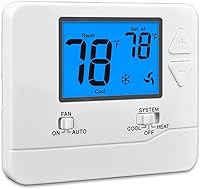
The Riseem NonProgrammable Thermostat for Home is designed for single-stage systems up to 1 heat and 1 cool. It supports single-stage heating and cooling, heat-only furnace or boiler systems, cooling-only systems and a 24-volt gas fireplace.
It does not support multistage heating or cooling, heat pumps with or without auxiliary heating, dual-fuel or hybrid multistage heating, mini-split systems, RV thermostats, convectors, radiant ceiling heat or 120–240 V electric baseboard heat.
The backlit LCD displays room temperature, and the control range is 44°F to 90°F. It can use 24 VAC power or 2 AA batteries, with no C wire required on most systems.
The base accepts a maximum of 2 to 5 wires.
Separate heating and cooling swing settings let you adjust the cycle rate. The model also includes a low-battery indicator, wall mounting and a rectangular digital design.
Choose it when your system is a compatible single-stage arrangement and you want a clear, non-programmable control. Do not use its broad general-purpose appearance as a substitute for checking the wiring limits.
Honeywell Home RTH111B Digital Non-Programmable Thermostat: Best for button-based simplicity
- Digital display
- Soft-touch buttons
- Battery powered
- Low-battery indicator
- Set point retained during power outage
The RTH111B keeps daily temperature changes simple with a digital display and soft-touch buttons. It fits buyers who do not need scheduling or app control.
Pros
- Easy-to-read display
- Simple buttons
- Retains the set point during a power outage
Cons
- Not for multistage systems
- Not for heat pumps with backup heat
The Honeywell Home RTH111B is a good choice for buyers who want a simple digital thermostat with soft-touch buttons. Its display keeps the information focused on temperature control rather than schedules or app features.
It works with heating, cooling and heat pumps without auxiliary heat options. It does not work with 120–240 V electric baseboard heat, heat pumps with backup heat or multistage heating and cooling.
The thermostat is battery powered and includes an easy-access battery compartment with a change-battery reminder. Its set point stays retained in memory during a power outage, which means you don't have to re-enter that setting after the power returns.
The RTH111B uses a wall mount, push-button control and a rectangular digital design. It includes the thermostat, mounting hardware and a user guide.
Choose it for straightforward daily changes in a compatible system. If you want a schedule, Wi-Fi or support for staged equipment, move up to another model in this roundup.
HONEYWELL TH4110U2005/U HONEYWELL-TH4110U2005/U-T4 Pro Thermostat: Best for flexible 1H/1C control
- Programmable or non-programmable operation
- 1 heat/1 cool
- 7-day, 5-2 or 5-1-1 programming
- Push-button programming
- Filter and low-battery reminders
The T4 Pro gives you a choice between scheduled and non-programmed operation. Its 1H/1C design works best when your system does not need multistage control.
Pros
- Multiple schedule options
- Programmable or non-programmable modes
- Filter reminders
Cons
- Limited to 1 heat/1 cool
- Uses push-button controls
The HONEYWELL TH4110U2005/U T4 Pro gives you a useful choice between programmable and non-programmable operation. Its 1H/1C design supports a 1 heat/1 cool heat pump or a 1 heat/1 cool conventional system.
When you use programming, it supports 7-day, 5-2 or 5-1-1 schedules. Push-button programming keeps the controls direct, while filter-change and low-battery reminders help with routine upkeep.
The thermostat uses 2 AA batteries and a UWP mounting system. It has a white finish, an LCD display and a button-control layout.
This flexibility makes the T4 Pro a good middle option. You can use a schedule if your routine is regular, or switch to non-programmable control if you prefer to make changes manually.
Choose it for a compatible 1H/1C system where you want schedule options without moving to Wi-Fi. It is not the right match for equipment that needs more than one heating or cooling stage.
Honeywell Home CT30A1005 Standard Manual Economy Thermostat: Best for heat-only manual control
- Heat-only operation
- Manual dial control
- Bimetal temperature sensor
- Mercury-free design
- Decorative backplate included
The CT30A1005 is the simplest pick for a low-voltage heat-only system. Its dial control avoids schedules, apps and digital menus.
Pros
- Simple dial control
- Heat-only design
- Mercury-free
- Decorative backplate included
Cons
- No cooling control
- No programmable schedule
- No off switch
The Honeywell Home CT30A1005 is the simplest pick for low-voltage heat-only control. Its manual dial and bimetal temperature sensor suit a home where you want direct heating control without programming or a digital menu.
The thermostat is mercury-free and includes a decorative backplate, thermostat and user manual. Its stated size is 0.88 in deep by 3.12 in wide by 3.12 in high.
This model does not control cooling, and it does not include an off switch. Those limits are important if you need one thermostat to manage both heating and air conditioning.
The manual design can be useful in a heat-only system where the temperature routine changes often enough that a fixed schedule would not help. The wall-mount format keeps the installation profile familiar.
Choose it only for a compatible heat-only setup. If you need cooling, programming, a display or app control, select one of the other thermostats here.
Honeywell Home X2P Programmable Thermostat: Best for 5-2 scheduling
- 5-2 scheduling
- Backlit display
- Custom display settings
- Filter reminders
- 2 AA batteries
The X2P adds weekday and weekend scheduling to a single-stage system. It also offers a non-programmable option for homes that need a simpler routine.
Pros
- 5-2 scheduling
- No C wire required
- Backlit display
- Filter reminders
Cons
- Not for multistage systems
- Not for 120–240 V electric baseboard heat
The Honeywell Home X2P is a strong fit for 5-2 scheduling on a single-stage system. You can set one routine for weekdays and another for weekends, with a non-programmable option available when you want manual control.
It is optimized for single-stage 1 heat/1 cool systems. Compatibility includes single-stage forced air using gas, oil or electric heat, hot water heat, single-stage heat pumps and 750 mV systems.
The X2P does not work with electric baseboard heat at 120–240 V or multistage systems. It uses 2 AA batteries, does not require a C wire and mounts on the Honeywell Home UWP wall plate.
A large screen, clear font and backlit display help with everyday adjustments. Custom display settings and change-filter reminders add useful control without adding Wi-Fi.
Choose the X2P when your home follows a weekday and weekend pattern. For different settings every day, consider a 7-day model instead.
Honeywell TH1100DV1000/U Pro 1000 Vertical Non-Programmable Thermostat: Best for vertical wall layouts
- Vertical design
- LCD temperature display
- Push-button control
- Wall mounting
- 2 AAA batteries
The Pro 1000 suits a wall location where a vertical thermostat shape works better. It provides non-programmable temperature control with an LCD display.
Pros
- Vertical format
- LCD display
- Push-button control
- Compact stated dimensions
Cons
- Non-programmable
- No warranty
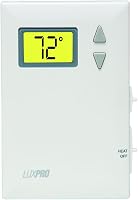
The Honeywell TH1100DV1000/U Pro 1000 is made for buyers who prefer a vertical non-programmable thermostat. Its stated thermostat dimensions are 4 11/16 in high, 2 7/8 in wide and 1 1/8 in deep.
The LCD temperature display and push-button control keep the daily task simple. You can read the setting and make a direct change without opening a schedule or app.
It uses 2 AAA batteries and mounts on the wall. Battery power can suit a replacement where the existing wiring does not support a different power arrangement.
The vertical shape may work well when your existing wall location favors a taller control. A taller unit can also cover marks left by an older taller thermostat.
Measure the available area before replacing a thermostat, especially if the current unit leaves a tight opening. Check the height and width against the wall plate area and nearby trim.
This is a non-programmable option, so it does not create a heating or cooling schedule. That makes it a fit for a home where people adjust the temperature when they need to.
It suits a buyer who wants direct temperature changes and a compact control layout. The trade-off is that it will not learn a routine or change settings on its own.
Choose it when the vertical format and basic controls match your space. If you need a schedule, app access or heat-pump stage support, review the other options first.
Honeywell Home RTH7600D 7-Day Programmable Touchscreen Thermostat: Best for broad system compatibility
- 7-day programming
- 4 periods per day
- Touchscreen display
- Smart Response Technology
- Automatic heat-to-cool changeover
The RTH7600D offers detailed weekly scheduling and a touchscreen interface. Its compatibility list covers several heating and cooling arrangements, but the exact system match still matters.
Pros
- 7-day scheduling
- 4 periods per day
- Smart Response Technology
- Heat-to-cool changeover
Cons
- No Wi-Fi feature stated
- Compatibility varies by system type
The Honeywell Home RTH7600D is the best fit here for detailed 7-day touchscreen scheduling. It offers 4 periods per day, home and away temperatures, temporary and permanent hold settings, and a real-time clock.
Smart Response Technology adjusts the system timing based on how long the furnace and air conditioner take to reach programmed temperatures. It also includes automatic change from heat to cool and a compressor restart delay setting.
The compatibility information is broad but specific. It includes heating only, cooling only, heat pumps with auxiliary heat, hot water, steam or gravity, 750 millivolt systems and gas fireplaces, while the compatibility chart excludes several single-stage and central air arrangements.
The thermostat uses a touchscreen, wall mounting and 1 AAA battery. Its backlit display shows the current room temperature and set point together.
Choose it when you want a detailed schedule and touchscreen control. Check the exact compatibility chart for your system because a broad feature list does not mean every HVAC arrangement is supported.
How do you choose a Honeywell Home thermostat?
Choose a Honeywell Home thermostat by matching the system type first, then selecting the control style. A staged heat pump needs different support from a heat-only system, and a Wi-Fi thermostat has different wiring needs from a battery-powered manual control.
Match heating and cooling stages
Single-stage systems use a simpler setup than multistage equipment. The Riseem, X2P and T4 Pro are aimed at specific single-stage or 1H/1C arrangements, while the T6 Pro supports the staged configurations stated in its title.
Don't assume a thermostat supports auxiliary heat, backup heat or dual-fuel equipment. Check each model's supported system type before moving wires.
Decide how much control you need
Choose Wi-Fi when you want app management or Alexa voice control. Choose 7-day programming when your routine changes by day, and choose 5-2 programming when weekdays and weekends follow two clear patterns.
A non-programmable model makes more sense when you want to adjust the temperature directly. The CT30A1005 goes further with a manual dial for heat-only use.
For a broader comparison beyond Honeywell, our guide to best lux thermostats for home covers another thermostat brand and control approach.
Check the power and wiring
Power requirements vary across this group. The right power choice depends on wiring already in the wall and on the system the thermostat will control.
The Honeywell Wireless WiFi Thermostat needs a C wire, while the Riseem model can use 24 VAC or 2 AA batteries and the X2P uses 2 AA batteries without requiring a C wire. That difference can decide whether a connected model fits your home.
A C wire is not a minor detail when a model needs one. If it is missing, the thermostat may not have power it needs for connected operation.
Battery power can be simpler where wiring allows it. It still needs care because batteries run down and a low battery can affect daily use.
Battery details also differ. The RTH111B is battery powered, the T4 Pro uses 2 AA batteries, the Pro 1000 uses 2 AAA batteries and the RTH7600D uses 1 AAA battery.
AA and AAA batteries are not interchangeable in the same unit. Check battery type before ordering spares, and keep the right size on hand.
Battery compartments should be easy to reach during routine care. A hard to open location can turn a simple battery change into a delayed task.
Turn off HVAC power before working on thermostat wiring. That step protects you while you compare old and new connections.
If system type or wiring is unclear, use professional installation. A professional can check stages, wires and power before the new thermostat is mounted.
Do not force a match based on the shape of the old thermostat. The same wall plate size can hide a system type the new model does not support.
Keep old wiring labels until the new unit is working. Those labels can help if a wire slips or if first placement needs correction.
Test heating and cooling after set-up before relying on the new control. A short test can show whether the system responds to the setting you choose.
Consider the thermostat shape and display
A vertical thermostat can fit a different wall layout than a wider horizontal control. The Pro 1000 states a vertical design, while other models use touchscreen, LCD or backlit displays.
Look at how you use the control each day. Push buttons and a dial suit direct changes, while touchscreen menus suit buyers who want programming and more settings.
Which Honeywell Home thermostat should you choose?
The best Honeywell Home thermostat depends on the system you need to control. Pick the Wireless WiFi Thermostat for app access, Alexa support and 7-day programming.
That pick suits a connected home where remote changes and a weekly routine matter. It still needs the right wiring, including a C wire, before it can do that work.
Pick the T6 Pro for staged system support. Its staged support makes it a better starting point when equipment needs more than a basic setup.
Choose the Riseem for a compatible single-stage setup with a backlit display and flexible power. Its power options can help where a C wire is not required on most systems.
Choose the RTH111B or Pro 1000 for basic non-programmable control, and choose the CT30A1005 for heat-only manual operation. Those options keep daily changes direct and avoid schedules.
The X2P fits a home that follows a weekday and weekend pattern. Its 5-2 scheduling gives that routine two clear parts without a different setting every day.
The T4 Pro fits a 1H/1C system where you want a choice between programmed and non-programmed use. That choice can suit a home that changes habits across the year.
The RTH7600D fits a home that wants detailed 7-day touchscreen scheduling. Its four periods per day can suit morning, daytime, evening and sleep settings.
Each choice has a limit that matters. A schedule does not help a system with wrong stages, and app control does not help a home that does not need it.
Set-up is easier when the replacement matches wiring from the start. Check stages, power and battery needs before mounting the new unit.
If your home uses a dual-fuel setup, our guide to the best Honeywell dual fuel thermostat is the more focused next step. For staged equipment, see the best Honeywell multi-stage thermostats.
For a general home-comfort buying path, you can also compare choices with our What Is a Smart Home Thermostat? Plainly Explained guide.
If you are also planning supplemental heating, our space heater for home guide covers that separate decision.
Our top 3 picks at a glance
-
1
Best for app control and 7-day schedules
Honeywell Wireless WiFi Thermostat
9.6/10 our score
See it on Amazon -
2
Best for staged systems
Honeywell TH6220WF2006/U Lyric T6 Pro Wi-Fi Programmable
9.6/10 our score
See it on Amazon -
3
Best for simple single-stage replacement
Riseem NonProgrammable Thermostat for Home
9.5/10 our score
See it on Amazon
Frequently asked questions
What is the best Honeywell Home thermostat for most homes?
The Honeywell Wireless WiFi Thermostat is the best Honeywell Home thermostat for most connected homes because it combines app control, Alexa support, 7-day programming, alerts and Energy Savings mode.
Choose the T6 Pro instead when your system needs the staged support described for heat pumps or conventional equipment.
Are Honeywell Home thermostats easy to install?
Installation depends on the existing wiring and HVAC system. The Honeywell Wireless WiFi Thermostat calls for professional installation, while other models use battery power or specific mounting systems.
Turn off HVAC power and match the replacement thermostat to your system before changing wires.
What is the difference between programmable and non-programmable thermostats?
A programmable thermostat changes its temperature setting according to a schedule, such as 7-day or 5-2 programming. A non-programmable thermostat keeps control manual, so you change the temperature when your routine changes.
Choose scheduling if your home follows a regular pattern.
Do Honeywell Home thermostats work with heat pumps?
Some do, but support varies by model. The T6 Pro supports up to 2 heat and 1 cool for heat pumps, while the RTH111B supports heat pumps without auxiliary heat.
Check whether your system has auxiliary or backup heat before choosing a model.
Do I need a C wire for a Honeywell Home thermostat?
Not always. The Riseem single-stage model says no C wire is required on most systems, and the Honeywell Home X2P is described as not requiring one.
The Honeywell Wireless WiFi Thermostat needs a C wire, so inspect your wiring before choosing connected control.