8 Best Digital Thermostat for Heat Only (November 2026)
The best digital heat only thermostats include the VIVOSUN Digital Heat Mat Thermostat Controller for seedling heat mats, the Miuputake Non Programmable Thermostat for House for conventional heat-only systems, and the Riseem NonProgrammable Thermostat for Home for white-display simplicity.
On this page (7 sections)
- How we chose the best digital heat only thermostats
- Digital thermostats for heat-only systems
- What should you check before buying a digital heat only thermostat?
- Is a programmable or non-programmable thermostat better for heat only?
- How do you install a digital thermostat for heat only?
- Can a digital thermostat control radiant heat?
- Verdict: which digital heat only thermostat should you choose?
The best digital thermostat for heat only depends on the heating voltage. A 120 to 240 volt electric baseboard or convector needs a line voltage control, while a gas, oil or electric furnace and many boiler systems use a 24 volt conventional control.
Choosing by display size or price before checking that wiring match is the fastest way to buy a thermostat that will not run the system.
For 120 to 240 volt electric baseboards and convectors, the Honeywell Home RLV3120 is the clearest match in this roundup. For a compatible 24 volt conventional furnace or boiler, the Miuputake and Riseem models are the closer starting point, provided the existing wires and terminals fit their stated limits.
This roundup covers digital controls for heating systems without an air conditioning stage. Some models are wall thermostats for household HVAC systems, while others are plug-in controllers for heat mats and similar equipment.
That second group matters because the words heat only can describe very different jobs. A plug-in controller with a probe can hold a seedling mat or reptile tank at a set temperature, but it does not wire into a furnace, boiler or baseboard circuit.
If you need a broader list, start with our guide to the best heat only thermostats. For wiring with only two conductors, see the best 2 wire thermostat heat only options.
Before you narrow the choice, note your heating equipment, voltage and wire count. Those three details will rule out most of the wrong models and leave a short list that is actually safe to install.
Our picks at a glance
-
1
 Best for seedling heat mats
VIVOSUN Digital Heat Mat Thermostat Controller
9.7/10 our score
See it on Amazon -
2
 Best for conventional heat-only systems
Miuputake Non Programmable Thermostat for House
9.6/10 our score
See it on Amazon -
3
 Best for white-display simplicity
Riseem NonProgrammable Thermostat for Home
9.5/10 our score
See it on Amazon
- 4
 Check it
Honeywell TL8230A1003 Electric Heat Digital 7 Day
Best for weekly electric-heat schedules - 5
 Check it
Honeywell Home Digital Non-Programmable Thermostat for Electric
Best for 2-wire electric heat - 6
 Check it
BN-LINK Reptile Thermostat Temperature Controller
Best for flexible plug-in heat control - 7
 Check it
PRO1 T701 Single Stage Non-Programmable Wall Thermostat
Best for a large blue display - 8
 Check it
ELECTECK Non-Programmable Digital Thermostat
Best for a large LCD on 24V heat
How we chose the best digital heat only thermostats
The best digital heat only thermostat must match the heating system before display size or programming matters. We compared system compatibility, voltage, wiring, control range, display type and the way each thermostat is installed.
A 24V furnace or boiler needs a low-voltage wall thermostat. A 120V or 240V electric baseboard system needs a line-voltage thermostat.
These are different system categories, so do not substitute one for the other.
We also separated household wall thermostats from plug-in temperature controllers. The VIVOSUN and BN-LINK models control connected heating devices with a probe.
They are useful for heat mats and similar equipment, not as direct replacements for a home's wired wall thermostat.
Our score weighs specs, features and buyer feedback against what you're shopping for.
| Product | Best for | Control range | Capacity | Use | Our score |
|---|---|---|---|---|---|
| VIVOSUN Digital Heat Mat Thermostat Controller | seedling heat mats | 40–108°F | 1000W | Reptiles, seedlings, germination, incubation and fermentation | 9.7 |
| Miuputake Non Programmable Thermostat for House | conventional heat-only systems | 44–90°F | 9.6 | ||
| Riseem NonProgrammable Thermostat for Home | white-display simplicity | 44–90°F | 9.5 | ||
| Honeywell TL8230A1003 Electric Heat Digital 7 Day | weekly electric-heat schedules | 9.4 | |||
| Honeywell Home Digital Non-Programmable Thermostat for Electric | 2-wire electric heat | 9.4 | |||
| BN-LINK Reptile Thermostat Temperature Controller | flexible plug-in heat control | 1000W | Seed starting, greenhouse, incubator, brooder, brewing and reptile tanks | 9.2 | |
| PRO1 T701 Single Stage Non-Programmable Wall Thermostat | a large blue display | 9.0 | |||
| ELECTECK Non-Programmable Digital Thermostat | a large LCD on 24V heat | 44–90°F | 8.3 |
Digital thermostats for heat-only systems
The Honeywell Home RLV3120 is the clearest match for line-voltage electric heat. The Miuputake and Riseem are stronger matches for compatible 24V conventional heat-only systems.
VIVOSUN Digital Heat Mat Thermostat Controller: Best for seedling heat mats
- 40–108°F control range
- 1000W capacity
- LCD display
- Sensor probe
A simple plug-in controller for heat mats and other heating devices used with reptiles, seedlings, incubation and fermentation.
Pros
- Wide control range
- Sensor probe
- 3-button operation
Cons
- Designed for heating devices, not a home wall thermostat
- Compatibility with a household heating circuit is not stated
The VIVOSUN Digital Heat Mat Thermostat Controller is best for a heat mat, seedling setup or reptile application rather than a home furnace. Its control range is 40–108°F, and its title gives a 1000W capacity for the connected heating device.
A sensor probe tracks the temperature near the application. Three buttons handle temperature settings and Fahrenheit or Celsius display changes.
The LCD shows the temperature, while the plastic controller has a hexagonal shape and a hanging tab and wall mount.
The angled socket helps keep the cord arranged around the controller. VIVOSUN describes this model for reptiles, seedlings, germination, incubation and fermentation, so it suits a small controlled heating project where a probe is useful.
It is not the right pick for a household wall circuit unless your system documentation specifically supports this type of controller. For a home thermostat, use a model whose voltage and wiring match the heating equipment.
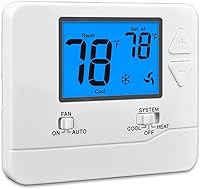
Miuputake Non Programmable Thermostat for House: Best for conventional heat-only systems
- 1 heat/1 cool
- Blue backlight LCD
- 24VAC or 2 AA batteries
- No C-wire on most systems
A non-programmable wall thermostat for compatible single-stage conventional systems, including several heat-only furnace and boiler setups.
Pros
- Blue backlight
- Separate heating and cooling swing
- Includes screws, anchors, manual and cable label
Cons
- Not for 120–240V electric baseboard heat
- Heat-only systems require a C-wire
The Miuputake Non Programmable Thermostat for House suits a compatible single-stage 24V conventional heat-only system. It works with gas, oil or electric furnaces, boiler radiant heat and forced-air heat-only systems.
Its blue-backlit LCD and push-button controls keep the interface simple. The control range is 44–90°F, the room display range is 41–95°F, and stated accuracy is ±1°F.
It runs on 24VAC or 2 AA batteries. A C-wire is not required on most systems, but heat-only and cool-only systems do require one, so check that early.
The base accepts a maximum of 2 to 5 wires, so 6 to 8 wires will not fit. It also has separate heating and cooling swing settings to lengthen or shorten run time.
Large terminal blocks, plus included screws, anchors, manual and cable label, make set-up easier. It is not for 120–240V electric baseboards, multistage systems, heat pumps or mini splits.
Riseem NonProgrammable Thermostat for Home: Best for white-display simplicity
- 1 heat/1 cool
- White backlight
- 24VAC or 2 AA batteries
- Touchpad control
This wall-mounted digital thermostat fits the same general conventional heat-only category as the Miuputake, with a white backlight and touchpad control.
Pros
- Clear backlight
- Separate cycle-rate settings
- Includes screws, anchors, manual and cable label
Cons
- Not for 120–240V electric baseboard heat
- Heat-only systems require a C-wire
The Riseem NonProgrammable Thermostat for Home suits a compatible single-stage conventional furnace or boiler when you prefer a white-backlit display. For boiler-specific choices, compare heat-only thermostats for boilers.
Its heat-only compatibility includes gas, oil or electric furnace systems, boiler radiant heat and forced-air heat.
The S3001-White has a 44–90°F control range, a 41–95°F room display range and stated accuracy of ±1°F. Its wall-mounted plastic body measures 1.06 in deep, 5.43 in wide and 3.86 in high.
The thermostat uses touchpad control and can run on 24VAC or 2 AA batteries. As with the Miuputake, heat-only installations require a C-wire according to the product data, so count and identify the wires first.
Choose Riseem when its white backlight and touch-style controls fit your room better. It has the same major system limits as the Miuputake, including no support for 120–240V electric baseboard heat.
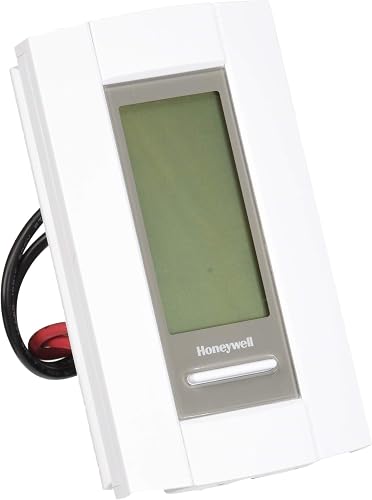
Honeywell TL8230A1003 Electric Heat Digital 7 Day: Best for weekly electric-heat schedules
- 7-day programming
- Digital temperature control
- Backlit display
- Early start
A programmable electric-heat thermostat for buyers who want a different preset schedule across the week.
Pros
- 7-day scheduling
- Early-start function
- Backlit display
Cons
- Not a simple non-programmable control
- The product data does not state its load rating
The Honeywell TL8230A1003 is the programmable pick for electric baseboards, convectors and fan-forced heaters. Its 7-day schedule lets you set different periods across the week instead of adjusting the temperature manually each time.
The digital thermostat uses button control and has a large, clear backlit display. Its early-start feature is designed to reach the programmed temperature by the scheduled time, which can help when your routine changes between workdays and weekends.
This model is different from a basic heat-only wall thermostat because its value comes from scheduling. For more options, compare programmable heat-only thermostats.
It suits electric-heat users who want preset temperature periods, while a non-programmable model is simpler for a steady daily routine.
Confirm the heating equipment and electrical requirements before installation. The product data identifies the supported electric heating equipment but does not state a load rating, so check that detail before choosing it for a particular circuit.
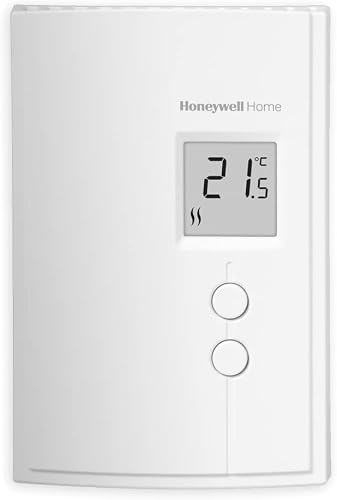
Honeywell Home Digital Non-Programmable Thermostat for Electric: Best for 2-wire electric heat
- 2-wire non-polarized connection
- 120–240V electric heat
- Silent TRIAC switching
- 2000W maximum at 240V
A compact non-programmable choice for line-voltage electric heat, including electric baseboards and convectors.
Pros
- 2-wire connection
- Silent switching
- Heating power indicator
Cons
- Cannot be used with a fan-forced convector
- Not for low-voltage furnace systems
The Honeywell Home Digital Non-Programmable Thermostat for Electric Heat Only is the best match here for 120–240V electric baseboards and convectors. It uses a 2-wire non-polarized connection and supports up to 2,000W at 240V.
Its TRIAC switching is silent, so it avoids the clicking of some mechanical controls. A heating power indicator shows when power is in use, and push buttons handle changes.
The indicator helps you tell at a glance whether the baseboard is calling for heat. You do not need to guess from warmth alone.
The thermostat measures 1.1 in deep, 3.2 in wide and 4.8 in high. It includes mounting screws and solderless connectors, and its compact body suits a smaller wall area.
The load limits matter more than the size. The maximum is 2,000W at 240V and the minimum is 200W, so check both smaller and larger circuits against those limits.
The 2-wire connection keeps installation simpler than a multi-wire conventional thermostat. You still need to shut off power and confirm the circuit, but there are fewer terminals to sort out.
This is a line-voltage thermostat, not a 24V furnace control, and it cannot be used with a fan-forced convector.
If your system is a baseboard or convector heater, compare this choice with our best Honeywell heat only thermostat guide.
BN-LINK Reptile Thermostat Temperature Controller: Best for flexible plug-in heat control
- 40–108°F control range
- 1000W capacity
- LED display
- Temperature probe
A plug-in temperature controller for heating pads, heat lamps and other heating devices, with a probe and a 1000W maximum load.
Pros
- Probe included
- 3-button setup
- ETL listed
Cons
- For heating devices rather than household wall wiring
- Maximum load must stay at 1000W
The BN-LINK Reptile Thermostat Temperature Controller is a plug-in choice for heating pads, heat lamps, seedling mats, incubators, brooder setups and reptile tanks. Its 40–108°F range and 1000W maximum load cover many small heating applications.
A temperature probe, LED display and heating and power indicators make the controller easier to monitor. Three buttons control the temperature or switch between Fahrenheit and Celsius.
The indicators help you confirm the heater is actually on, rather than just plugged in. That distinction matters overnight or in a greenhouse, where a failed connection can go unnoticed for hours.
The controller has a 3.94 ft three-prong power cord and a 4.92 ft temperature probe. It is rated for 120VAC at 60Hz, and the product data identifies it as ETL listed.
The probe length gives you room to place the sensor where the temperature matters most, such as under a mat, inside a tank or beside seedlings. Placement is part of set-up, because the controller can only regulate what the probe can sense.
The 40 to 108°F control range suits seed germination, seedling growth, indoor gardening, fermentation and reptile warming. It is a heating-only controller, so it cannot cool a space that overheats in sun or warm weather.
Use it for a connected heating device rather than a household wall thermostat. Keep the total heating load at or below 1000W, and place the probe where it can measure the area you want to control.
That load limit is a hard trade-off. A larger heater or several devices on one controller can exceed the rating, so add up the wattage before you rely on it for a serious setup.
PRO1 T701 Single Stage Non-Programmable Wall Thermostat: Best for a large blue display
- 1 heat/1 cool
- 4 sq. in. display
- Battery or 24V power
- Separate swing adjustments
A conventional wall thermostat with a large blue display, selectable battery or 24V power, and separate heating and cooling swing settings.
Pros
- Large display
- Color-coded terminal blocks
- Room temperature calibration
Cons
- Designed for 1 heat/1 cool systems
- The product data does not state heat-only wiring limits
The PRO1 T701 is a good fit for a conventional 1 heat/1 cool system when a large blue display matters. Its 4 sq. in.
LCD, glow-in-the-dark button and room temperature calibration make routine adjustments easier.
The thermostat supports gas or electric configuration and can use batteries or 24V power. The universal sub-base uses color-coded terminal blocks and supports wall or junction-box mounting.
Color-coded terminals reduce the chance of swapping wires during set-up, especially if the old thermostat had faded labels. A junction box option also helps where a standard wall box is not in place.
Separate heating and cooling swing adjustments let you tune cycle behavior. The model also includes a 5-minute compressor delay, though that feature matters more in a heating and cooling installation than in a heat-only setup.
Room temperature calibration is the feature that matters most for heat-only use. It lets you correct for a thermostat that reads warm or cold compared with the room, such as when it sits near a draft or an exterior wall.
The large display helps at a distance and in low light, which suits a hallway or entry where you glance rather than stand close. The glow-in-the-dark button is a practical touch for night adjustments.
The product data lists batteries and wires as included components. Confirm the terminal layout and system voltage before choosing it for a heat-only installation.
This model is built for 1 heat/1 cool conventional systems, so multistage equipment or heat pump wiring is outside its stated scope. That limit keeps it simple, but it also means system matching comes before the display benefit.
ELECTECK Non-Programmable Digital Thermostat: Best for a large LCD on 24V heat
- 1 heat/1 cool
- 4.5 sq. in. LCD
- 24VAC or 2 AAA batteries
- ±1°F control
A large-screen 24V conventional thermostat for compatible single-stage gas, oil or electric systems, with battery or 24VAC power.
Pros
- Large LCD
- Separate cycle-rate settings
- 5-minute compressor delay
Cons
- Not for 110–240V electric heat
- Not for auxiliary heat-pump systems
The ELECTECK Non-Programmable Digital Thermostat is a large-screen option for a compatible 24V single-stage conventional heat-only system. Its 4.5 sq. in. white-backlit LCD uses large characters and separate buttons.
It supports electric or gas/oil configuration and can run from 24VAC or 2 AAA batteries. The stated temperature control range is 44–90°F, with ±1°F control in Fahrenheit and Celsius.
The large characters make the room temperature and set point easier to read from across a room. That helps in a bedroom or living area where you may not want to walk up to the wall to check the setting.
This thermostat also includes separate heating and cooling swing settings, low-battery indication and selectable 5-minute compressor delay protection. Its wall-mounted plastic body measures 0.98 in deep, 4.72 in wide and 3.86 in high.
The swing settings let you adjust how often the system cycles, which can affect both comfort and energy use. In a heat-only home, a longer cycle may feel steadier, while a shorter cycle may respond faster after a setback.
Dual power is another practical point. With 24VAC or batteries, the thermostat can keep working if one source is interrupted, and the low-battery indicator warns you before the batteries run down.
The included screws, anchors, installation manual and cable label support set-up, and the transparent faceplate gives it a clean look on the wall. Large separate buttons keep operation simple for anyone who finds small touch controls fiddly.
Do not use it for 110–240V electric baseboards, convectors or radiant-ceiling heat. It is also not for multistage systems, mini splits or heat pumps with auxiliary or emergency heat.
What should you check before buying a digital heat only thermostat?
Check the heating voltage, number of stages, wire count and equipment type before choosing a digital heat only thermostat. The display and schedule come after compatibility.
For a gas, oil or electric furnace and many boilers, look for a 24V conventional thermostat. The Miuputake, Riseem, PRO1 and ELECTECK models are in this group, but each still requires a system match.
For electric baseboards and convectors, look for a line-voltage thermostat. The Honeywell Home RLV3120 supports 120V and 240V electric heat, while the Honeywell TL8230A1003 is a programmable electric-heat option.
For a heat mat, reptile tank or seedling setup, use a probe-based plug-in controller. The VIVOSUN and BN-LINK models are built around that use, with 40–108°F control and 1000W capacity.
Is a programmable or non-programmable thermostat better for heat only?
A programmable thermostat is better when your heat-only schedule changes during the week, while a non-programmable thermostat is simpler for a steady routine. The Honeywell TL8230A1003 provides 7-day programming for supported electric heat.
Programming helps when weekdays and weekends differ. A preset schedule can lower the temperature while you are away and raise it before you return, without relying on memory.
The early-start feature is designed to reach the programmed temperature by the scheduled time. That matters with baseboards and convectors, which can take time to warm a cold room.
Non-programmable models reduce settings to manage. The Honeywell Home RLV3120, Miuputake, Riseem, PRO1 and ELECTECK focus on direct control, with system compatibility deciding the fit.
That simplicity suits a home where someone is usually around. You set the temperature once and the thermostat holds it with no schedule to maintain.
The trade-off is no automatic setback at night or while traveling. For those savings, adjust it by hand or choose a programmable model.
For more options, compare our best non programmable heat only thermostats. If your equipment is a heat pump, read [What Is a Heat Pump Thermostat?
The Complete Guide](/what-is-a-heat-pump-thermostat/) before selecting a conventional heat-only model.
A heat pump needs different staging and auxiliary heat logic. A heat-only thermostat can leave it short cycling or unable to run comfortably in cold weather.
How do you install a digital thermostat for heat only?
Install a digital thermostat for heat only by turning off power, identifying the heating system and matching each wire to the new thermostat instructions. Do not rely on wire color alone, especially when voltage or equipment type is uncertain.
Start with the equipment label. A gas furnace, a boiler and an electric baseboard circuit may all be called heat only, but they use different voltages and terminals.
A 24V furnace thermostat and a 120–240V baseboard thermostat use different wiring systems. Shut off the correct breaker or service switch, and use a qualified professional if you cannot confirm the voltage.
Line voltage wiring can be dangerous, and a 24V thermostat on the wrong circuit will not work even if the wires fit.
Take a photo of the existing terminals before disconnecting wires. Keep wires from falling into the wall, attach them to matching terminals, and restore power only after checking that no bare conductors can touch.
The photo also helps a professional diagnose the job later if the old thermostat was wired in a nonstandard way.
For conventional 24V models, check the wire count against the base limit. The Miuputake and Riseem bases accept a maximum of 2 to 5 wires, so more wires need a different model.
For electric baseboard models, check the load rating. The Honeywell Home RLV3120 supports a maximum of 2,000W at 240V, and a circuit above that is not a match.
After mounting, restore power and run a heating call. Watch whether the equipment starts, stops and holds temperature as expected.
If the system does not respond, turn power off again and recheck the terminals against the manual.
Can a digital thermostat control radiant heat?
A digital thermostat can control radiant heat when the thermostat is designed for that type of system and its voltage matches the equipment. The Miuputake and Riseem identify boiler radiant heat as compatible, while the Honeywell Home RLV3120 is for line-voltage electric heat.
Radiant systems vary widely. A boiler with low-voltage control is not the same as an electric radiant ceiling or baseboard circuit.
Check the equipment label and wiring before choosing a thermostat.
For electric radiant floor systems, compare the dedicated options in our guide to the best Wi-Fi thermostats for radiant floor heating. Do not assume a thermostat is compatible just because both systems use the word radiant.
Verdict: which digital heat only thermostat should you choose?
The best digital thermostat for heat only is the Honeywell Home RLV3120 for 120–240V electric baseboards and convectors. Choose the Miuputake or Riseem for compatible 24V conventional furnace or boiler systems, and choose the Honeywell TL8230A1003 for a 7-day electric-heat schedule.
The voltage split should drive your decision first. A line-voltage baseboard circuit and a 24V furnace circuit are not interchangeable, even when both are listed as heat only.
Pick VIVOSUN or BN-LINK for a heat mat, reptile tank, seedling setup or another plug-in heating device. Those controllers use a probe and a 1000W capacity, which suits small projects rather than a home wall circuit.
Choose PRO1 or ELECTECK when a large display matters and your system matches the stated 1 heat/1 cool limits. The PRO1 T701 offers a 4 sq. in. blue display, while the ELECTECK offers a 4.5 sq. in. white-backlit LCD.
Both still need a system check before purchase. Confirm terminal layout, wire count and voltage, and make sure the equipment is not a multistage system, mini split or heat pump with auxiliary heat.
For the Miuputake and Riseem, settle the C-wire question in advance, because heat-only systems require one. A missing wire may mean extra work.
If your equipment is a heat pump, use a heat-pump-specific guide such as best programmable thermostat for heat pump before buying.
That guide covers staging, auxiliary heat and defrost behavior that a heat-only thermostat does not handle.
Our top 3 picks at a glance
-
1
Best for seedling heat mats
VIVOSUN Digital Heat Mat Thermostat Controller
9.7/10 our score
See it on Amazon -
2
Best for conventional heat-only systems
Miuputake Non Programmable Thermostat for House
9.6/10 our score
See it on Amazon -
3
Best for white-display simplicity
Riseem NonProgrammable Thermostat for Home
9.5/10 our score
See it on Amazon