Best 120 Volt Thermostats: Top 9 Picks (November 2026)
The best 120 volt thermostats include the Cadet F Series Double Pole Built-In Baseboard for Cadet F Series baseboards, the Honeywell TL7235A1003 Line Volt Pro Non-Programmable Digital for quiet digital heating control, and the Cadet Single Pole Line Voltage Thermostat for most 120 volt wall heaters.
On this page (6 sections)
- The best 120 volt thermostats for different heating setups
- How do you choose a 120 volt thermostat load rating?
- Should you choose a built-in or wall-mounted thermostat?
- What is the best 120 volt thermostat for cooling?
- How do you install and care for a 120 volt thermostat?
- Which 120 volt thermostat should you buy?
The best 120 volt thermostat for most wall-mounted electric heaters is the Cadet Single Pole Line Voltage Thermostat. It supports 120, 208 and 240 volt circuits, handles up to 22 amps and uses a straightforward dial with no batteries or programming.
That combination suits bedroom, rental and workshop use where the routine stays fairly steady. A dial can be set once and left alone without daily changes.
Choose the Cadet F Series built-in model when control needs to mount directly to a compatible Cadet baseboard heater. That format puts control at the heater itself and avoids extra wiring to a wall control.
For a corded appliance that may need heating or cooling control, the Legacy TH5 is the more suitable 120 volt setup. It plugs in at the equipment, which changes both the install and the daily use.
These controls are not interchangeable with ordinary low voltage HVAC thermostats. A low voltage control sends a signal to a separate system, while a line voltage control switches power to the heater or appliance directly.
Check heater voltage, maximum wattage, wiring method and thermostat load rating before you buy. A model that is fine at 240 volts may have a much lower wattage limit at 120 volts.
Also confirm the heater type, since baseboards, convectors, fan-forced wall heaters and corded appliances may use different controls. Placement also matters, because direct heat, drafts and sunlight can skew the reading.
If you want a schedule, you need a different category altogether. Manual dials remain simple and dependable for steady use, but they will not lower heat while you are out and raise it before you return.
In short, start with the equipment and the circuit, then pick the control format. The right 120 volt thermostat matches your heater, wiring and how you actually use the room.
Our picks at a glance
-
1
 Best for Cadet F Series baseboards
Cadet F Series Double Pole Built-In Baseboard
9.6/10 our score
See it on Amazon -
2
 Best for quiet digital heating control
Honeywell TL7235A1003 Line Volt Pro Non-Programmable Digital
9.6/10 our score
See it on Amazon -
3
 Best for most 120 volt wall heaters
Cadet Single Pole Line Voltage Thermostat
9.4/10 our score
See it on Amazon
- 4
 Check it
Stelpro Line Voltage Wall Thermostat
Best for simple commercial-style control - 5
 Check it
Honeywell Aube Technologies TH115-A-120S 7-Day Programmable Line
Best for weekly heating schedules - 6
 Check it
Legacy TH5 Line Voltage Thermostat Assembly
Best for corded 120 volt equipment - 7
 Check it
Stelpro Line Voltage Thermostat
Best for precise baseboard setback - 8
 Check it
LUX ELV4 Programmable Line Voltage Thermostat
Best for weekday and weekend programming - 9
 Check it
Tempro TP500 Line Voltage Thermostat
Best for broad voltage flexibility
The best 120 volt thermostats for different heating setups
The best pick depends on the equipment, not just the number 120 on the circuit. For dedicated 120 volt heat-only thermostats, compare controls rated for your heater.
The Cadet wall thermostat is the broadest match for common electric heating, while the built-in Cadet and corded Legacy models solve more specific installation needs.
We compared the stated voltage support, load ratings, control style, heating or cooling use and installation format. Our score weighs specs, features and buyer feedback against what you're shopping for.
For a wider comparison of line-voltage controls, see our guide to best line voltage thermostats for heating and cooling. For scheduled options, compare programmable line-voltage thermostats.
| Product | Best for | Voltage | Rating | Control | Our score |
|---|---|---|---|---|---|
| Cadet F Series Double Pole Built-In Baseboard | Cadet F Series baseboards | 120/208/240 volt | 22 amp | Large twist dial | 9.6 |
| Honeywell TL7235A1003 Line Volt Pro Non-Programmable Digital | quiet digital heating control | 240 VAC | Digital buttons | 9.6 | |
| Cadet Single Pole Line Voltage Thermostat | most 120 volt wall heaters | 9.4 | |||
| Stelpro Line Voltage Wall Thermostat | simple commercial-style control | Mechanical dial | 9.1 | ||
| Honeywell Aube Technologies TH115-A-120S 7-Day Programmable Line | weekly heating schedules | Push buttons | 8.9 | ||
| Legacy TH5 Line Voltage Thermostat Assembly | corded 120 volt equipment | 120 volt | 8.8 | ||
| Stelpro Line Voltage Thermostat | precise baseboard setback | 8.7 | |||
| LUX ELV4 Programmable Line Voltage Thermostat | weekday and weekend programming | LCD buttons and speed dial | 8.2 | ||
| Tempro TP500 Line Voltage Thermostat | broad voltage flexibility | 8.1 |
Cadet F Series Double Pole Built-In Baseboard: Best for Cadet F Series baseboards
- 22 amp rating
- 120/208/240 volt
- 45 to 80 F range
- Built-in end mounting
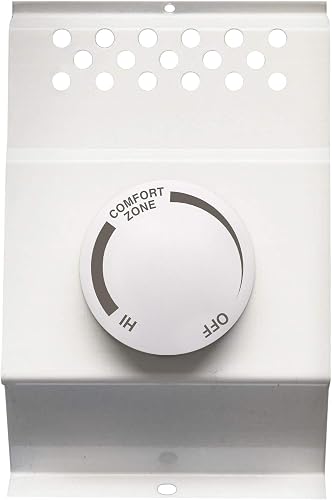
This built-in thermostat replaces the detachable end plate on a Cadet F Series electric baseboard heater. Its 45 to 80 F range and compact white housing suit a direct heater installation.
Pros
- Mounts to either end of a Cadet F Series heater
- Works at 120, 208 and 240 volts
- Large adjusting dial
Cons
- Made for Cadet F Series electric baseboards only
- Not a wall-mounted universal control
The Cadet F Series Double Pole Built-In Baseboard is the most direct choice when you already have a compatible Cadet F Series electric baseboard heater. It mounts to either end of the heater in place of the detachable end plate, which avoids extra wiring between a wall thermostat and the unit.
Its 22 amp rating and 120/208/240 volt support give it broad electrical coverage within the Cadet F Series range. The large twist dial adjusts from 45 to 80 F, and the white compact housing is designed to blend with the baseboard.
The product information also describes a single pole, 2-wire low setting. Turning the dial fully counterclockwise places the thermostat in the low position.
This is not the right choice for a general wall-mounted thermostat replacement. Its main advantage is the built-in format, so confirm that your heater is a Cadet F Series model before planning the installation.
Honeywell TL7235A1003 Line Volt Pro Non-Programmable Digital: Best for quiet digital heating control
- 240 volt operation
- 40 to 86 F control range
- On-demand backlight
- Heating indicator
Honeywell's digital wall thermostat gives non-programmable control for electric heating. The backlight, heating indicator and soundproof operation help in rooms where a clear, quiet control matters.
Pros
- Digital display with backlight
- Reduces clicking noise
- Shows when heat is on
Cons
- Rated for 240 volt use
- No programmable schedule
The Honeywell TL7235A1003 is a strong fit for a 240 volt electric heating circuit where you want a clear digital display without a schedule. It is a non-programmable wall thermostat with electronic temperature control and button operation.
The on-demand backlight helps you read the control in different lighting conditions. A heating indicator shows when the heat is on, while the soundproof operation is designed to reduce the clicking associated with conventional thermostats.
Honeywell gives this model a 40 to 86 F control range and a 15 amp full-load rating at 240 VAC. It has a wired connection, hardwired power source and wall-mount format.
That makes it easy to place in a hallway or bedroom where you might check the setting at a glance. The display is more precise than a dial with no numbers, so small adjustments are simpler to repeat day to day.
The trade-off is that there is no scheduling. If you want the room cooler overnight or while you are away, you will need to change the setting manually each time.
The key trade-off is voltage fit. Although this roundup focuses on 120 volt applications, this Honeywell model is specifically described as a 240 volt thermostat, so it should be considered only when the circuit and heater match that requirement.
Cadet Single Pole Line Voltage Thermostat: Best for most 120 volt wall heaters
- 120/208/240 volt compatibility
- 22 amp rating
- 2-wire single pole design
- Dial control
This wall-mounted Cadet thermostat fits many 120 volt electric baseboards, fan-forced wall heaters and convectors. Its mechanical dial needs no batteries or programming.
Pros
- Handles 120 volt heating circuits
- Works with several electric heater types
- Maintenance-free bimetal mechanism
Cons
- Single pole control
- No digital display or schedule
The Cadet Single Pole Line Voltage Thermostat is the best general-purpose choice for many 120 volt electric heating circuits. It works with 120, 208 and 240 volt baseboard heaters, fan-forced wall heaters and convectors.
Its 22 amp rating supports up to 2,640 watts at 120 volts or 5,280 watts at 240 volts. That makes the load rating easy to compare with the heater's electrical requirements before installation.
The 2-wire single pole design is made to replace many wall-mounted line voltage thermostats. Color-coded wires, a standard wall electrical box and a simple twist dial keep the control format familiar.
A bimetal mechanism cycles the heater without batteries or programming. Choose it when you want basic manual control and broad heater compatibility.
Daily care is minimal because there is no display to clean or battery to replace. Just keep the face free of dust and avoid forcing the dial past its marked range.
If you need a screen or a weekly schedule, one of the digital models below will fit better.
Stelpro Line Voltage Wall Thermostat: Best for simple commercial-style control
- 22 amp single pole rating
- 50 to 90 F range
- 2-wire connection
- Mechanical dial
The Stelpro SWT1F provides manual control for electric baseboards, wall fan heaters and commercial fan-forced heaters. Its 50 to 90 F range gives a broad adjustment span.
Pros
- 2-wire installation
- Works with several electric heating products
- 5-year warranty
Cons
- Mechanical rather than digital control
- 4 F set-point range
The Stelpro SWT1F suits buyers who want a manual wall thermostat for electric baseboards, wall fan heaters or commercial fan-forced heaters. Its 2-wire connection and mechanical dial keep the setup simple for compatible line voltage systems.
The thermostat adjusts from 50 to 90 F, a wider stated range than the Cadet built-in model. Stelpro also describes a 4 F set-point range, meaning room temperature can rise or fall within 4 F of the desired setting.
The white molded plastic housing measures 2 7/8 in wide, 4 5/8 in high and 1 1/2 in from the wall. Its 22 amp single pole design is intended for 240 volt heating systems, so check the exact circuit before using it in a 120 volt application.
Choose this model when broad heating-product compatibility and a traditional dial matter more than display accuracy or programming. Stelpro provides a 5-year warranty.
Honeywell Aube Technologies TH115-A-120S 7-Day Programmable Line: Best for weekly heating schedules
- 7-day programming
- 4 settings per day
- Early Start
- Temporary temperature override
This programmable line voltage thermostat suits rooms with regular weekday and weekend routines. Early Start, temporary override and a heating power indicator add schedule-focused control.
Pros
- Separate daily programming
- 15-minute cycles
- On/standby switch
Cons
- Needs a 4-wire double pole installation
- More setup than a manual dial
The Honeywell Aube Technologies TH115-A-120S is the pick for a room that follows a repeating weekly routine. It supports up to 4 programmed settings for each day of the week, allowing separate schedules for weekdays and weekends.
Early Start works toward reaching the programmed temperature by the programmed time. A temporary bypass lets you change the temperature without changing the stored schedule, while the on-screen heating power indicator shows when heating power is being delivered.
The LCD can show Fahrenheit or Celsius and use a 12- or 24-hour format. Its 15-minute cycles and microprocessor-based control are aimed at reducing temperature swings.
That short cycle pattern can help a room feel steadier than a simple on and off dial. It is a better match for a space that is empty during the day and occupied in the evening.
The on and standby switch is also useful at the end of the heating season. It lets you shut the thermostat down without losing the schedule you have set up.
This thermostat requires a 4-wire double pole installation, which makes it a more involved choice than a 2-wire mechanical dial. Select it when scheduling is worth the extra wiring and setup work.
Legacy TH5 Line Voltage Thermostat Assembly: Best for corded 120 volt equipment
- 120 volt and 15 amp rating
- 3-prong US cord plug-ins
- Heating or cooling use
- 40 to 104 F range
The Legacy TH5 controls corded 120 volt appliances through 3-prong US plug-ins. A terminal change allows heating or cooling use for equipment such as heaters, air conditioners, fans and coolers.
Pros
- Corded installation
- Heating and cooling control
- Works across a broad temperature range
Cons
- 15 amp limit
- Less suited to a standard wall thermostat replacement
The Legacy TH5 is designed for a different kind of 120 volt thermostat installation. It uses 3-prong US 120 VAC cord plug-ins and is rated for 120 volts and 15 amps, so it can control compatible corded equipment without replacing a wall-mounted thermostat.
A terminal change allows heating or cooling use. The stated temperature range is 40 to 104 F, with a 2.5 F differential.
Legacy describes the TH5 as suitable for 120 volt appliances such as heat lamps, electric heaters, air conditioners, fans, coolers and lights. Its corrosion-resistant design is also intended to tolerate harsh environments and high humidity.
That wide range makes it more flexible than a room heating dial alone. It can be used where a heater or fan needs to run only within a set band, rather than all day.
Placement near the appliance is part of the setup. The sensor needs to reflect the air around the equipment, so a spot in a direct draft or against a hot surface can change how it cycles.
This is a practical option for corded equipment, but it is not the natural choice for a standard in-wall electric baseboard circuit. Confirm that the appliance's plug, load and intended switching method match the assembly.
Stelpro Line Voltage Thermostat: Best for precise baseboard setback
- 2500 watt maximum at 240 volts
- Eco setback mode
- 1 F increments
- Sealed casing
The Stelpro ST252NP is a non-programmable digital thermostat for electric baseboards and convectors. Its one-click setback and 1 F increments suit buyers who want simple electronic control.
Pros
- Digital temperature adjustment
- Eco mode for one-click setback
- 5-year warranty
Cons
- Not compatible with fan heaters
- Lower 120 volt load limit than some 22 amp controls
The Stelpro ST252NP is a good choice for electric baseboards and convectors when you want digital control and a simple setback button. It is not compatible with fan heaters or forced-air units, which require the matching FF model.
Its maximum load changes with the circuit: 1,250 watts at 120 volts, 2,160 watts at 208 volts and 2,500 watts at 240 volts. Check the heater's wattage against the matching voltage limit before installation.
The thermostat uses a sealed casing, a sturdy S3 mounting plate and thermistor sensing. Temperature changes can be set in 1 F increments, and the eco mode lowers the setpoint with one press.
That one-touch setback is handy for short absences. You can drop the heat when you leave and restore it with a single press when you return, without reprogramming anything.
The digital display also makes the setting clear at a glance. Unlike a dial with vague markings, you can set the same temperature each time and know it is exact.
This model has a lower 120 volt load limit than the 22 amp Cadet controls. Choose it for a compatible baseboard or convector that falls within 1,250 watts, especially when one-touch setback is useful.
LUX ELV4 Programmable Line Voltage Thermostat: Best for weekday and weekend programming
- 4 periods per day
- 5-2 day programming
- Vacation hold
- Front battery access
The LUX ELV4 gives separate weekday and weekend schedules for electric baseboard, cable and ceiling heat. A temporary override, vacation hold and positive off switch add flexibility.
Pros
- Four program periods each day
- Front battery access
- UL approved
Cons
- Not compatible with resistive heat combined with a blower fan
- Programming takes more setup than a dial
The LUX ELV4 is made for electric baseboard, cable and ceiling heat, with separate weekday and weekend programming. Its 4 program periods per day suit a routine that changes between waking, leaving, returning and sleeping.
A temporary override lets you adjust the current temperature without rewriting the schedule. Vacation hold, front battery access, a low-battery indicator and a positive off switch add useful control for changing occupancy.
The LCD and patented speed dial make programming more structured than a mechanical thermostat. A wall plate is included, and the control mounts to the wall.
Separate weekday and weekend programs are a practical middle ground. They cover a standard work week without the complexity of setting every single day on its own.
The vacation hold is worth noting for longer absences. It lets you hold a lower setting for a set period, then return to the normal program without manual changes each day.
The main limitation is equipment type. LUX says the ELV4 is not compatible with heating appliances that combine an electric heating element with a blower fan.
Choose it for compatible resistive electric heat, not a forced-air load with an inductive blower.
Tempro TP500 Line Voltage Thermostat: Best for broad voltage flexibility
- Heating and cooling control
- 30 to 110 F range
- Steel housing
- Fahrenheit and Celsius scales
The Tempro TP500 is a single-stage wall thermostat for heating and cooling. Its steel housing, capillary sensor and broad voltage range suit basic indoor applications with matching electrical requirements.
Pros
- Heating and cooling control
- Wide stated voltage range
- Steel construction
Cons
- Analog control
- Single-stage operation
The Tempro TP500 is the most flexible voltage-range option in this group, but that flexibility does not remove the need to match the thermostat to the heater. It is a single-stage control for heating and cooling with a stated range of 24 VAC to 600 VAC and 16/22 amp ratings.
Its steel housing and NEMA 1 enclosure suit basic indoor applications where protection from dust, light moisture and indirect splashing is relevant. The capillary tube senses temperature, and the control includes Fahrenheit and Celsius scales.
The temperature range runs from 30 to 110 F. That broad range can help in applications that need more adjustment than a typical room heating control.
Single-stage operation keeps the logic simple. The control switches the load on or off at the set point, so it suits equipment that does not need staged or modulating control.
The dual Fahrenheit and Celsius scales make it easier to set and read across different sites. That can be useful in a workshop or utility space where settings are shared between people.
Choose the TP500 when heating and cooling control, steel construction and broad electrical coverage fit the job. Its analog format and single-stage operation make it less suitable when you want programming or digital temperature steps.
How do you choose a 120 volt thermostat load rating?
Choose a 120 volt thermostat by comparing the heater's wattage and amperage with the thermostat's rating. A thermostat rated for 22 amps may support more heater load than one rated for 15 amps, but the circuit voltage and equipment type still have to match.
For a resistive 120 volt load, watts can be related to amps with the basic formula watts divided by volts. A 1,250 watt heater on a 120 volt circuit draws about 10.4 amps, but use the heater's stated electrical information and local code for the final decision.
The Cadet wall thermostat is rated for up to 2,640 watts at 120 volts. The Stelpro ST252NP is rated for 1,250 watts at 120 volts, so the same heater may fit one model and exceed the other.
Never choose by amperage alone. Check whether the thermostat supports baseboards, convectors, fan heaters, cooling loads or another equipment type.
Should you choose a built-in or wall-mounted thermostat?
Choose a built-in thermostat when the heater is designed for that format, and choose a wall-mounted model when you need a room control away from the heater. The Cadet F Series thermostat replaces an end plate, while the Cadet T521-W mounts in a standard wall electrical box.
A built-in control can keep wiring close to the heater and give the unit a clean appearance. Its limitation is compatibility, since the Cadet model here is made for Cadet F Series electric baseboard heaters only.
A wall thermostat gives you more placement flexibility, but installation requires matching the existing box, wires, poles and heater load. If you are replacing an old wall control, photograph the wiring with power off and confirm the replacement's wiring diagram.
For more product-specific comparisons, see our guide to best 120 volt thermostat Honeywell models and our roundup of best digital 120 volt thermostats.
What is the best 120 volt thermostat for cooling?
The Legacy TH5 is the clearest choice here for corded 120 volt heating or cooling equipment, while the Tempro TP500 is the better fit when you need a wall-mounted single-stage control. Most other models in this roundup are described for electric heating only.
The Legacy TH5 uses a 3-prong cord connection and can switch heating or cooling after a terminal change. Its 40 to 104 F range covers both room heating and cooling scenarios, with a 2.5 F differential for cycling within a narrow band.
The Tempro TP500 also supports heating and cooling, with a 30 to 110 F range and broad voltage information. Its steel housing and NEMA 1 enclosure suit basic indoor use, and its capillary sensor and single-stage switching keep operation straightforward.
That difference in format is the first decision. A corded assembly suits a plug-in appliance that you can place and move, while a wall-mounted control suits a fixed installation where the sensor should stay in one room location.
Do not assume that any thermostat labeled line voltage can control an air conditioner or fan. Confirm appliance type, current, voltage and switching requirements before connecting it.
Cooling loads need particular care because many line voltage controls in this group are heat-only. Even when a model mentions cooling, check that the appliance motor and controls are compatible with the switching method.
Also check the load limit at the exact circuit voltage. A rating that looks generous at 240 volts may be much tighter at 120 volts, so use the figure for your circuit.
Placement affects cooling performance as well. A thermostat in direct sun, near a supply vent or beside a heat source may cycle equipment at the wrong times.
If cooling is your main goal, compare these options with our guide to best 120 volt cooling thermostats. That guide focuses more on cooling-specific controls, so it is worth checking before you settle on a dual-use model.
If you only need heating for most of the year, a heat-only dial may still be simpler. Dual-use models make sense when the same space genuinely needs both modes through the seasons.
How do you install and care for a 120 volt thermostat?
Install a 120 volt thermostat only after matching the circuit, heater, wiring method and load rating. Turn off power at the breaker, verify that the circuit is dead, follow the model's instructions and use a qualified electrician when the wiring is unclear.
A 120 volt circuit can cause serious injury. Do not rely on the old thermostat's appearance or wire color alone, especially when replacing a control with a different pole configuration.
Keep the control clear of heat sources, drafts and blocked air paths when the installation instructions call for a specific location. For a dial model, turn the control gently rather than forcing it past its range.
Digital models may need battery attention, while mechanical models generally need only a clean face and a secure connection. If the heater cycles oddly, the control feels hot, or the circuit trips, switch off power and have the installation checked.
Which 120 volt thermostat should you buy?
Choose the Cadet Single Pole Line Voltage Thermostat when you need a broad 120 volt wall-mounted control for compatible baseboards, fan-forced wall heaters or convectors. Choose the Cadet built-in model for a Cadet F Series baseboard, and choose the Legacy TH5 for corded heating or cooling equipment.
For scheduled heating, pick the Honeywell Aube TH115-A-120S or LUX ELV4 after confirming the required wiring and heater type. For a digital baseboard or convector control, the Stelpro ST252NP is worth considering when the 1,250 watt 120 volt limit fits your heater.
Start with the load rating before you look at features. Compare the heater wattage at your circuit voltage against the thermostat limit, because a model that works at 240 volts may not work at 120 volts.
Then match the format to the room. A wall dial suits steady manual use, a built-in control suits a compatible heater end, and a corded assembly suits a plug-in appliance.
If your routine is fixed, scheduling can save energy without much daily effort. The Honeywell and LUX models both offer multiple periods, but they need more setup and, in one case, different wiring.
If your routine varies, a simple setback may be enough. A one-touch eco button or a temporary override lets you adjust for a day out or a guest visit without rewriting the program.
Do not overlook equipment compatibility. Fan heaters, convectors and baseboards are not all interchangeable, and some controls exclude forced-air units entirely.
Finally, check the install you are comfortable with. Wall-mounted replacements, built-in end plates and corded assemblies each need a different approach, and line voltage work should follow local code.
A 120 volt thermostat is an electrical control, not a universal HVAC replacement. Match the voltage, load, poles, equipment type and mounting format before ordering.
Our top 3 picks at a glance
-
1
Best for Cadet F Series baseboards
Cadet F Series Double Pole Built-In Baseboard
9.6/10 our score
See it on Amazon -
2
Best for quiet digital heating control
Honeywell TL7235A1003 Line Volt Pro Non-Programmable Digital
9.6/10 our score
See it on Amazon -
3
Best for most 120 volt wall heaters
Cadet Single Pole Line Voltage Thermostat
9.4/10 our score
See it on Amazon
Frequently asked questions
Can you use a 120 volt thermostat on a 240 volt heater?
No. Match the thermostat to the heater voltage, wiring and load before installation.
Some line voltage thermostats support both 120 and 240 volts, but others are made for one voltage or a specific heater type.
Turn off power and follow local electrical code.
What is the best 120 volt thermostat for a baseboard heater?
The Cadet Single Pole Line Voltage Thermostat is the strongest general choice here because it supports 120 volt baseboard circuits, carries a 22 amp rating and uses a simple 2-wire dial. The Cadet built-in model is better when you have a compatible Cadet F Series heater.
What is the difference between a 120 volt thermostat and a low voltage thermostat?
A 120 volt thermostat switches line voltage power directly to an electric heater or appliance. A low voltage thermostat controls a separate system through lower-voltage wiring.
They are not interchangeable, so match the control to the equipment and circuit.
Are digital 120 volt thermostats better than dial models?
Digital models make the set temperature easier to read and may add schedules, backlights or setback controls. Dial models are simpler and may need less setup.
Choose based on the heater's load and wiring first, then decide whether programming or a display is useful.
Can a 120 volt thermostat control cooling?
Some can, but many line voltage thermostats are made only for electric heating. The Legacy TH5 and Tempro TP500 include heating and cooling use in their product information.
Confirm the appliance type, voltage, amperage and switching method before connecting a cooling load.