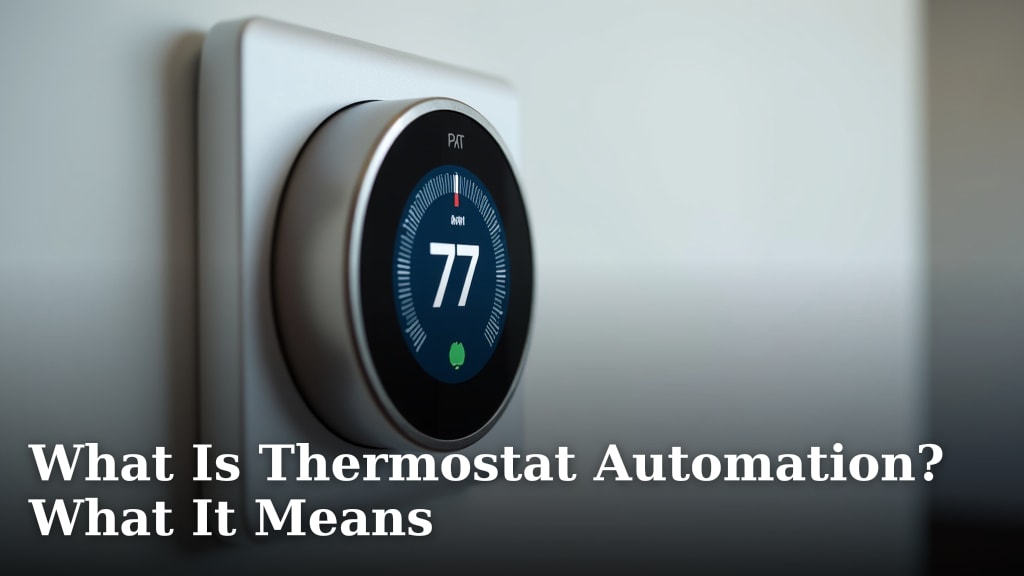
What Is Thermostat Automation? What It Means
Understanding How Thermostat Automation Works
Thermostat automation means your home’s heating and cooling system adjusts itself based on a set schedule, your habits, or real-time data. It works without you having to touch the controls every time. Think of it like a helpful assistant who knows when you’re home, when you’re asleep, and what temperature feels best. This smart assistant uses sensors and sometimes your location to keep your home comfortable efficiently.
The goal is simple: save energy and increase comfort by eliminating manual adjustments. Instead of coming home to a freezing house in winter, your thermostat can start warming things up just before you arrive. It’s about your home responding to your life, not the other way around.
The Core Idea Behind Automated Temperature Control
At its heart, thermostat automation replaces the old “set it and forget it” dial with intelligence. A standard thermostat waits for you to give it a command. An automated one makes decisions for you. It uses a combination of programming, sensors, and connectivity to operate your HVAC system smarter.
We found that the U.S. Department of Energy estimates programmable thermostats can save about 10% a year on heating and cooling. Automation takes this a step further by removing the human error of forgetting to adjust the settings. Your system becomes proactive rather than reactive.
Key Components of an Automated System
Most automated setups share a few key parts. The brain is the thermostat unit itself, which contains the processor and sensors. Then there’s the software or algorithm that decides when to turn the heat or AC on. Many systems also use your smartphone’s location as a signal that you’re heading home.
- Sensors: Detect motion, humidity, and current temperature.
- Schedule Learning: Some models learn your patterns over a week.
- Connectivity: Wi-Fi allows remote control and data processing.
- Geofencing: Uses your phone’s GPS to know when you’ve left or are returning.
What Automated Thermostats Actually Do
These devices go far beyond a simple timer. They create a dynamic environment that adapts to your household. Here are the primary functions that set them apart from basic models.
Learning Your Schedule Automatically
Advanced smart thermostats watch when you adjust the temperature. After a week or two, they start to predict your preferences. If you always turn the heat down at 10 PM, the thermostat will eventually do it for you. A study in the journal Energy and Buildings found that adaptive learning algorithms in thermostats improved energy savings in real-world homes.
Responding to Changes in Real-Time
Some systems respond to external factors. For example, a thermostat might dial back the AC if it detects an open window or a sudden drop in outdoor temperature. Others integrate with weather forecasts to pre-heat your home before a cold front arrives. This responsiveness helps maintain stability without wasting energy.
Remote Control from Your Phone
Almost all automated thermostats connect to a smartphone app. This lets you check the temperature at home from the office. You can adjust settings while lying in bed or start the air conditioning on your drive back from vacation. This feature alone provides immense peace of mind and flexibility.
Different Types of Automated Thermostats
Not all smart thermostats are created equal. The market offers a range of options, from fully learning models to simpler connected devices. Choosing the right one depends on your comfort needs and budget.
Smart Thermostats (Learning Models)
These are the most advanced. They actively study your behavior and adjust accordingly. They often include features like occupancy sensing and detailed energy reports. They represent a true “set and forget” solution for many households. The trade-off is typically a higher upfront cost.
Wi-Fi Programmable Thermostats
These models offer app control and scheduling but don’t learn on their own. You program them through your phone, and they stick to that schedule. They are a great middle ground. You get remote access and automation benefits without the premium price of a learning model. They are reliable and effective for consistent routines.
Basic Smart Thermostats
Even entry-level smart thermostats provide automation. They let you set a weekly schedule via an app and offer remote control. They lack advanced sensors or learning but are a massive upgrade from a manual thermostat. This category makes smart home technology accessible to more budgets.
Practical Benefits You’ll Notice Day-to-Day
Understanding the features is one thing, but how does automation feel in daily life? The benefits are both tangible and subtle, contributing to a more comfortable and efficient home.
Energy Savings Without Constant Adjustment
The biggest benefit is reduced energy waste. Your system isn’t running full blast in an empty house. The EPA’s ENERGY STAR program states that certified smart thermostats can save people about 8% on heating and cooling bills annually. That’s real money back in your pocket with little effort.
Added Comfort and Convenience
Waking up to a perfectly warm home on a chilly morning or coming home to a cool space after a hot day is a genuine luxury. It eliminates the shock of extreme indoor temperatures. This consistency can make your home feel more welcoming and relaxing.
Long-Term Cost Savings
Beyond monthly bills, automation can protect your system. By avoiding constant manual over-adjustments, you reduce strain on your furnace and air conditioner. A well-maintained HVAC system with steady operation may experience fewer breakdowns and enjoy a longer lifespan.
Installation and Setup: What to Expect
Setting up an automated thermostat is often simpler than people think, but a few factors determine the difficulty. Knowing what to expect can help you plan.
Compatibility with Your HVAC System
This is the first check. Most modern homes use a standard 24-volt system that is universally compatible. However, some high-voltage systems (like certain electric baseboard heaters) or complex setups with multiple zones might require a specific model or professional installation. Always use the manufacturer’s online compatibility checker.
The Setup Process
For a compatible home, the process usually involves turning off your HVAC power, removing the old thermostat faceplate, and noting the wire connections. You’ll then attach the wires to the new thermostat’s base plate and snap it on. The rest is done through the smartphone app, which guides you through connecting to Wi-Fi and setting initial preferences. Many users feel comfortable doing it themselves in under an hour.
How to Choose the Right Automated Thermostat
With several options on the shelf, focus on your specific needs. Consider these questions to narrow down your decision.
Check Your Home’s Wiring
Peek behind your current thermostat. If you see a wire labeled “C-wire” (common wire), you have the ideal setup for powering most smart thermostats. If you don’t have a C-wire, some models can work without it, but others might need an adapter or a different model. This is a key compatibility factor.
Consider Your Daily Routine
If your schedule is highly irregular, a learning thermostat might be overkill, or it might be perfect. A programmable model might be better if your days are very consistent. Ask yourself: How predictable is my household’s comings and goings?
Think About Remote Access Needs
Do you travel often? Do you want to check on your home temperature while at work? If remote access is a priority, ensure the model you choose has a robust, easy-to-use app. Read user reviews about app reliability and ease of use.
Quick Checklist Before You Buy
Use this simple list to ensure you’re making an informed choice. Run through these points before you head to the store or click “add to cart.”
- Verify Compatibility: Check if it works with your specific HVAC system (24V vs. high-voltage).
- Assess Your Wiring: Look for a C-wire behind your current thermostat for easiest installation.
- Define Your “Smart” Need: Decide if you want full learning, simple scheduling, or just remote control.
- Consider Ecosystem: Ensure it works with your other smart home devices like Alexa or Google Assistant.
- Set a Budget: Prices range significantly from basic connected models to premium learning units.
- Read Recent Reviews: Look for comments on app stability and customer support experiences.
Conclusion
Thermostat automation is about your home intelligently managing its own comfort and energy use. It moves beyond manual dials to a system that learns, adapts, and reacts for you. The core benefits are straightforward: real energy savings, daily convenience, and a home that simply feels right. You get comfort without constant tweaking and efficiency without the guesswork.
You now understand what it means, how it works, and the different options available. The best next step is to **check your home’s compatibility** and consider your daily routine. From there, you can confidently choose the automated thermostat that fits your life.
Frequently Asked Questions
Is thermostat automation the same as having a smart thermostat?
They are closely related, but not identical. All smart thermostats offer some automation. However, “automation” specifically refers to the system’s ability to adjust itself without your direct input. This can be through a learning schedule or reacting to real-time data.
Can I install an automated thermostat if I don’t have a C-wire?
Yes, it’s often possible. Many modern models are designed to work without a C-wire using alternative power methods. However, **check the compatibility list** for any thermostat you consider. Some may require a professional to install a power adapter if a C-wire is absent.
Do automated thermostats really save enough money to be worth it?
According to ENERGY STAR, certified smart thermostats can save about **8% on heating and cooling bills annually**. Over a few years, this can offset the initial purchase cost. The exact savings depend on your habits, climate, and home insulation.
Will an automated thermostat work with my old heating and cooling system?
Most work with standard 24-volt systems, which are common in homes. Very old or high-voltage systems, like some electric baseboard heaters, may not be compatible. **Use the manufacturer’s online tool** to check compatibility with your specific model before buying.
How much privacy do I give up with a learning thermostat?
These devices collect data on your schedule and home temperature patterns to function. Reputable companies state this data is used to optimize your comfort and is often anonymized. You should **review the privacy policy** of any brand you trust to understand exactly what is collected.